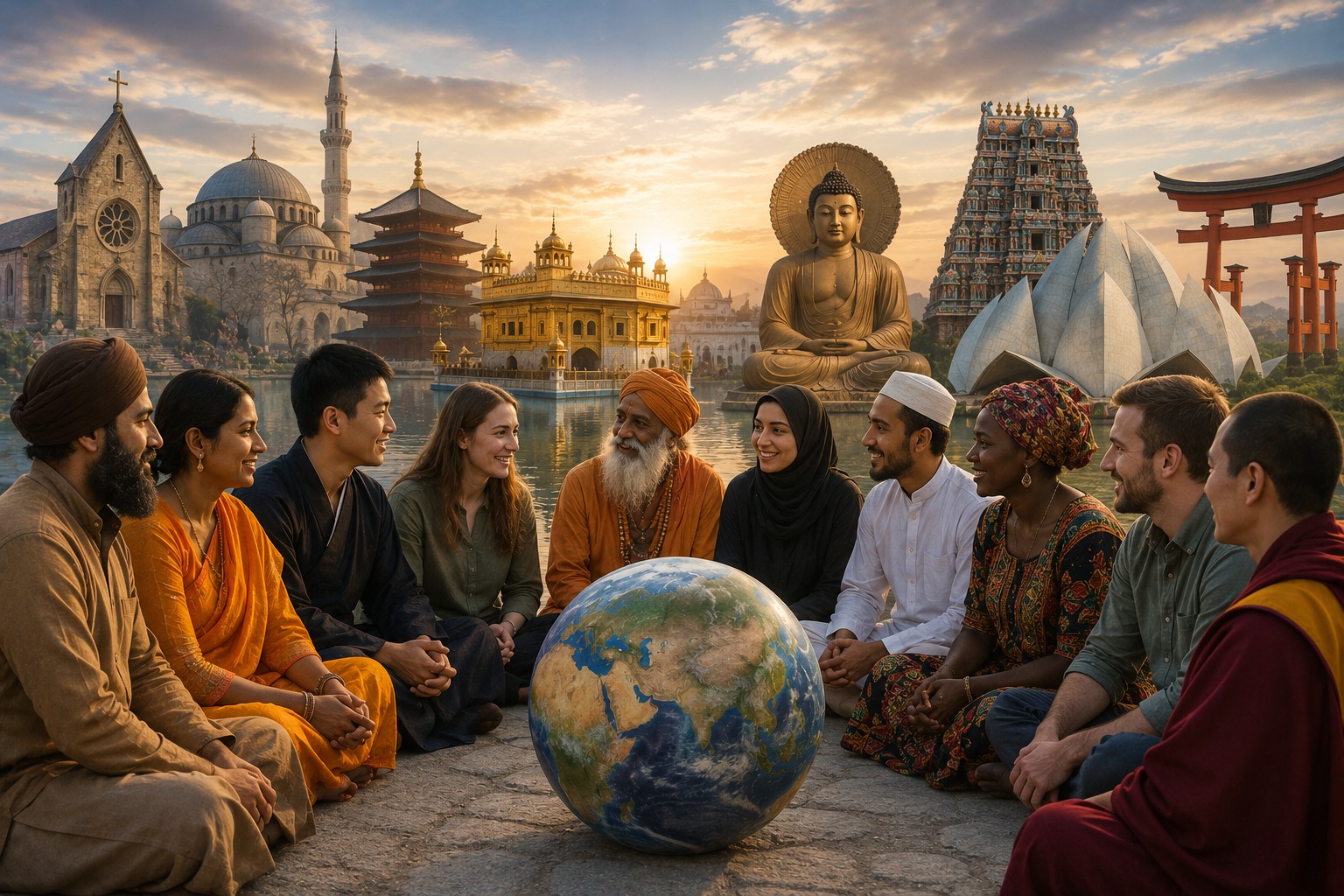

Many Faiths, One Humanity, One Timeless Quest

Shabeer Ahmad Lone


The deepest wisdom shared across humanity’s traditions is reverence: for truth beyond possession, for human dignity beyond division, for the Earth that sustains life, and for the mystery within which all existence unfolds

 

“East and West alike belong to God; wherever you turn, there is the Face of God. Surely God is boundless in His grace and all-embracing in His knowledge.”

-Qur’an 2:115

“Indeed, this community of yours is one community, and I am your Lord; so worship Me. Yet people have divided themselves into separate groups, but all shall return to Us.”

-Qur’an 21:92–93

“To each of you We have prescribed a law and a way of life… Had God willed, He could have made you one single community; but He intended to test you through what He has given you. Therefore, compete with one another in doing good. To God you shall all return, and He will make clear to you the matters over which you differed.”

-Qur’an 5:48

“Indeed, those who believe, and those who are Jews, Christians, or Sabians-whoever believes in God and the Last Day and acts righteously-shall have their reward with their Lord. No fear shall come upon them, nor shall they grieve.”

-Qur’an 2:62; 5:69

“Say: We believe in God, and in what has been revealed to us, and in what was revealed to Abraham, Ishmael, Isaac, Jacob, and their descendants, and in what was given to Moses, Jesus, and the other prophets… We make no distinction between any of them, and to Him we submit ourselves.”

-Qur’an 2:136

“We shall show them Our signs in the horizons and within themselves, until it becomes clear to them that it is the Truth.”

-Qur’an 41:53

“All creation is God’s family, and among them the most beloved to God are those who are most beneficial and compassionate toward His family.”

-Prophetic tradition

“None of you truly believes until he loves for his brother what he loves for himself.”

– Jāmiʿ al-Tirmidhī

“Whoever believes in Allah and the Last Day should honor his neighbor.”

-Ṣaḥīḥ al-Bukhārī; Ṣaḥīḥ Muslim

Tum Ram kaho, woh Rahim kahein, dono ki gharaz Allah se hai;

Tum deen kaho, woh dharam kahein, mansha to usi ki raah se hai.

Tum ishq kaho, woh prem kahein, matlab to usi ki chaah se hai;

Woh jogi hon, tum saalik ho, maqsood-e-dil-aagah se hai.

Kyun larta hai moorakh bande, yeh teri khaam khayaali hai;

Hai pair ki jad to ek wohi, har mazhab ek ek daali hai.

-(Attributed)

Across cultures and epochs, humanity returns to enduring questions: What is ultimately real? What does it mean to be human, and why are we here? What is good, justice, and our responsibility to others? Why does suffering exist, and can it carry meaning? How do we know what is true, and what are the limits of knowledge? Is there a sacred or transcendent dimension beyond the material world?

What happens after death? Who am I beyond identity, and can the self be transformed? How should we live with others in difference and interdependence? What is our relation to nature and the cosmos? And does history itself have meaning, direction, or destiny?

These questions arise wherever human consciousness awakens to its own fragility and its longing for truth. Beneath the diversity of languages, rituals, and beliefs lies a deeper unity: the human search for coherence, goodness, and transcendence.

       Across literary, philosophical, and spiritual traditions-Vedic, Biblical, Qur’anic, Buddhist, Confucian, Greek, medieval, Sufi, bhakti, Indigenous, African, and the Arabic, Urdu, Persian, English, German, French, Chinese, and Kashmiri worlds-“Many Faiths, One Humanity, One Timeless Quest” expresses a shared human condition: despite differences in belief, humanity persistently seeks truth, meaning, moral order, and transcendence.

These diverse traditions converge on a single horizon-the Good, the One, liberation, harmony, or ethical flourishing-whether through unity of Being, love (ishq), Dao, interdependence, or divine encounter. Across all forms, faiths differ, but the underlying quest remains one: humanity’s enduring search for ultimate meaning, truth, and a compassionate way of life.

       At the same time, this shared search opens a deeper philosophical question: what is the nature of the “Ultimate” toward which all traditions point? Is it personal, impersonal, relational, or ultimately beyond all categories of thought? Different civilizations have answered this differently-through God, Brahman, Dao, Nirvana, or Being itself-suggesting that human language may point toward a Reality that exceeds any single conceptual frame.

       From ancient hymns and philosophical inquiries to mystical traditions and indigenous worldviews, humanity has continuously interpreted its place in reality. Though answers differ, the persistence of the questions reveals a common condition: finite beings shaped by infinite longing, seeking meaning in a world both beautiful and precarious.

       Yet this search is not only intellectual or doctrinal; it is also existential and embodied. Human beings do not merely think about truth-they suffer, desire, love, fear, and hope within it. The question of meaning is therefore inseparable from the lived experience of pain, joy, mortality, and relationship.

       Modern interpreters of religion and philosophy-William James, Aldous Huxley, Huston Smith, Karen Armstrong, Raimon Panikkar, Paul Tillich, Karl Rahner, John Hick, Ninian Smart, and Fritjof Schuon-together with voices from diverse traditions such as Al-Ghazali, Ibn Arabi, Confucius, and Swami Vivekananda, converge on a central insight: the plurality of religions does not negate truth but reflects humanity’s diverse encounters with the Ultimate. Religion, in this sense, is not merely doctrine but lived response-shaped by history, culture, experience, and consciousness itself.

       However, this plurality also contains real and sometimes irreconcilable tensions: competing claims about revelation, salvation, authority, and metaphysical truth. A mature philosophy of religion must therefore hold together both convergence and disagreement, recognizing that harmony does not eliminate difference but deepens the need for thoughtful engagement across it.

       Civilizations, likewise, have never developed in isolation. They grow through encounter, exchange, and creative synthesis. Ideas travel across borders more enduringly than empires. Yet history also reveals a sobering truth: human beings are capable of both extraordinary moral vision and profound destruction. The deepest crisis, therefore, is not between religions or ideologies, but within the human tendency to absolutize partial truths and turn conviction into exclusion.

       This tendency is often intensified by institutions and systems of power-religious, political, and economic-that can transform spiritual ideals into instruments of control. Thus, the problem is not only belief itself, but the way belief becomes structured, enforced, and weaponized within history.

       This calls for humility as a foundational virtue. Across traditions, exemplary figures embody this balance of conviction and openness: Socrates’ awareness of ignorance, Confucius’ self-cultivation, the Buddha’s caution against fixed views, Al-Ghazali’s transformative doubt, Rumi’s reconciliation of difference through love, and Gandhi’s insistence that no one holds the whole truth. Such humility is not weakness but clarity-the condition for genuine understanding.

Alongside this intellectual humility stands another dimension often overlooked: aesthetic and contemplative perception. Across civilizations, beauty-whether in poetry, nature, music, or sacred architecture-has served as a silent but powerful pathway to the sense of the transcendent, suggesting that truth is not only known conceptually but also experienced through wonder.

Contemporary thought in psychology, neuroscience, and anthropology reinforces these insights. Human beings are relational, meaning-seeking, and narrative-shaped. Empathy, trust, gratitude, and moral imagination are not optional virtues but core dimensions of flourishing. Even scientific inquiry arises from wonder, a disciplined form of reverence. Ancient wisdom and modern research thus converge on a shared truth: human well-being depends on meaning, relationship, and ethical orientation.

Yet beneath this lies a deeper psychological reality: human existence is marked by anxiety, vulnerability, alienation, and the search for belonging. Spiritual and philosophical traditions across cultures can be read as responses not only to abstract questions, but to this inner drama of consciousness seeking stability, coherence, and transformation.

Across cultures-through Ubuntu, Confucian harmony, Buddhist interdependence, Indigenous ecological wisdom, and theological ideas of stewardship-another principle emerges: reality is fundamentally relational. To be human is to exist within networks of responsibility. Flourishing is therefore communal, ecological, and intergenerational, not merely individual.

In its fullest form, this relational vision extends beyond ethics into ontology: not only human society but the entire cosmos can be understood as interconnected life, where nature is not merely a resource but a living order that demands reverence, care, and participation.

In the contemporary age, this understanding has become urgent. Humanity now wields unprecedented technological power alongside unprecedented fragility: ecological crisis, inequality, displacement, polarization, and the ethical challenges of artificial intelligence. No single tradition or ideology can address these alone. What is required is a renewed sense of shared destiny grounded in solidarity and responsibility.

At a civilizational level, this also demands institutional imagination: rethinking education, governance, media, and global cooperation so that they cultivate not only efficiency and progress, but wisdom, ethical responsibility, and long-term planetary stewardship.

Education, in this light, becomes the formation of moral perception. Its highest purpose is not only skill but wisdom; not only success but character. A humane education fosters empathy without sentimentality, reasoning without arrogance, and conviction without hostility-preparing individuals for cooperation in a shared world.

Such education must also engage plurality directly-training individuals not only in knowledge, but in dialogue across difference, critical engagement with conflicting worldviews, and the ability to hold tension without collapsing into either relativism or absolutism.

Despite suffering and fragmentation, humanity continues to seek truth, justice, beauty, and hope. This enduring orientation toward the good suggests that despair is never final and that the human story remains open.

Even the darkest moments of history reveal this possibility: societies emerging from genocide, oppression, and war often demonstrate the human capacity to transform memory into moral learning, and suffering into renewed ethical consciousness. Hope, therefore, is not sentiment but resilience of meaning.

Thus, beneath all expressions of the sacred and all systems of thought lies a common aspiration: to live wisely, act justly, love compassionately, and contribute to a more humane world. The diversity of faiths and philosophies, therefore, is not the end of understanding but its beginning-each a language pointing toward what exceeds language itself.

The human journey is not a clash of irreconcilable worlds but an unfinished pilgrimage of meaning. Its diversity is not chaos but a symphony of voices seeking harmony not yet fully heard. To recognize this is not to abandon conviction but to deepen it with humility, respect, and openness.

Yet this pilgrimage is not without direction: many traditions also hold a vision of ultimate fulfillment-whether as liberation, salvation, enlightenment, or divine proximity-suggesting that history itself may carry a horizon of meaning beyond its present fragmentations.

The deepest wisdom shared across humanity’s traditions is reverence: for truth beyond possession, for human dignity beyond division, for the Earth that sustains life, and for the mystery within which all existence unfolds. Many faiths, one humanity, and one timeless quest-ever ancient and ever new-calling every generation to enlarge compassion, deepen understanding, and renew our shared destiny beneath the same vast and luminous sky.


Author can be mailed at shabirahmed.lone003@gmail.com

Comments are closed.