

S Ahmad
India’s growing trade and manufacturing ambitions have increased the need for a strong domestic container manufacturing base. The proposed Container Manufacturing Assistance Scheme (CMAS), backed by a ₹10,000 crore outlay, seeks to promote manufacturing, investment and technology development across the container ecosystem. With broader reforms in shipping, ports and logistics, the initiative is expected to strengthen India’s maritime capabilities, generate employment and support India’s long-term trade competitiveness.
A ₹10,000-crore push for domestic container manufacturing is about more than making steel boxes—it is about securing supply chains, creating industrial capacity and giving India greater control over the logistics that underpin its global trade ambitions
A container may appear to be one of the least glamorous objects in global commerce.
It is essentially a standardised steel box, stacked thousands of times on ships, moved by cranes at ports and transferred between ships, trains and trucks. It carries everything from machinery and electronics to textiles, pharmaceuticals and consumer goods. It rarely attracts public attention unless it is delayed, unavailable or caught up in a supply-chain disruption.
Yet the humble shipping container is one of the most important pieces of infrastructure in modern global trade.
Without containers, the movement of goods across continents would be slower, more expensive and considerably less efficient. Their standardised dimensions allow cargo to move seamlessly between ships, railways and road vehicles without repeated unloading and repacking. They have therefore become fundamental to the functioning of global supply chains.
For India, which is seeking to become a major manufacturing and export economy, the availability of containers is not merely a logistics issue. It is increasingly a question of economic competitiveness and strategic resilience.
That is the larger significance of the proposed Container Manufacturing Assistance Scheme (CMAS), announced in the Union Budget 2026–27 with a proposed outlay of ₹10,000 crore over five years.
The scheme is designed to establish a globally competitive domestic container manufacturing ecosystem, support new and existing manufacturing facilities, improve production capacity and develop the wider industrial value chain.
At first glance, the initiative may seem highly specialised.
It is anything but.
India cannot realistically aspire to become a major global manufacturing and trading power while remaining heavily dependent on imports for a basic asset required to move its goods around the world.
The container, in this sense, is not simply a box.
It is part of the infrastructure of economic sovereignty.
The hidden infrastructure of globalisation
Around 80 per cent of global merchandise trade by volume is transported by sea, according to the United Nations Conference on Trade and Development. Containerised cargo accounts for nearly two-thirds of the value of international trade.
These figures explain why maritime logistics matter so much to the global economy.
Modern manufacturing is no longer confined to a single factory or even a single country. Components can be manufactured in one region, assembled in another, packaged elsewhere and sold thousands of kilometres away.
Such a system depends on predictable logistics.
A disruption in shipping can therefore quickly become a disruption in manufacturing, retail and consumption.
The experience of recent years has demonstrated this vulnerability. Geopolitical tensions, disruptions to shipping routes, freight-rate volatility and changing patterns of global trade have exposed weaknesses in international supply chains.
Countries are consequently paying greater attention to resilience.
The lesson is straightforward: the more strategically important an economy becomes, the more important it is to have reliable control over the critical infrastructure that supports its trade.
For India, containers are one such component.
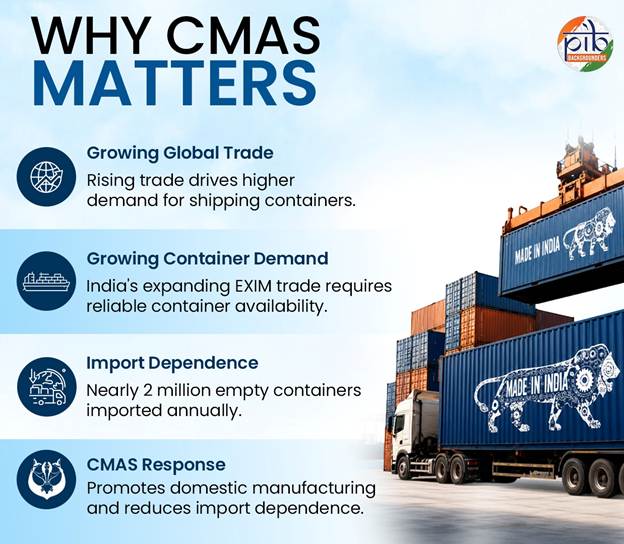
The country currently imports nearly 2 million empty containers every year to meet domestic demand and reposition containers.
That dependence may not appear alarming in ordinary times.
But supply chains are rarely tested during ordinary times.
The real question is what happens when international container availability tightens, shipping routes are disrupted or freight costs rise sharply.
A country seeking to expand exports cannot afford for a basic instrument of export logistics to become a persistent external vulnerability.
From importing containers to manufacturing them
CMAS is therefore an attempt to address a structural weakness.
The proposed scheme aims to establish a competitive domestic manufacturing base by providing financial and institutional support for the industry. It includes assistance for new greenfield manufacturing facilities, expansion of existing brownfield units, operational support, testing infrastructure, skilling and capacity building.
Its ambition is considerable.
The initiative targets annual domestic manufacturing capacity of around 7.5 lakh Twenty-foot Equivalent Units (TEUs)—around ten times the existing production capacity cited in the scheme material.
That scale matters because an industry cannot become globally competitive simply by producing a few thousand containers.
It requires volume.
It requires suppliers.
It requires specialised skills.
It requires quality certification.
It requires steel, corner castings, wooden flooring and other components.
It requires testing facilities and international compliance.
Most importantly, it requires a market.
CMAS attempts to address these requirements together rather than treating container production as an isolated manufacturing activity.
That integrated approach could determine whether India merely produces containers or actually builds a globally competitive container industry.
Why manufacturing capacity matters
The importance of domestic container manufacturing extends beyond replacing imported products.
Manufacturing creates industrial capabilities that can spill over into other sectors.
The production of containers requires specialised steel, fabrication, welding, coating, inspection, testing and quality-control processes. It creates demand for ancillary industries and logistics services.
The scheme identifies areas such as corner castings, wooden frames and Corten steel as part of the supporting ecosystem.
That is where the broader economic opportunity emerges.
A manufacturing ecosystem creates layers of employment.
There are workers directly employed in factories. Then there are suppliers, transporters, maintenance providers, testing laboratories, component manufacturers and service providers.
According to the scheme material, CMAS has the potential to generate around 3,000 direct jobs and more than 50,000 indirect jobs.
The numbers themselves are important, but the larger significance lies in the industrial ecosystem behind them.
India’s manufacturing ambitions will ultimately depend on the ability to develop such interconnected value chains.
The maritime economy cannot be built one component at a time
CMAS becomes even more significant when viewed alongside the broader transformation taking place in India’s maritime sector.
A container manufacturing industry cannot operate in isolation.
Containers need ships.
Ships need ports.
Ports need rail and road connectivity.
Cargo needs logistics networks.
And all of these require efficient digital and regulatory systems.
This is why the container manufacturing initiative sits within a much larger architecture of maritime reforms.
The proposed Bharat Container Shipping Line (BCSL) is an important part of this strategy.
In February 2026, the Ministry of Ports, Shipping and Waterways signed an MoU bringing together the Shipping Corporation of India, Container Corporation of India, Jawaharlal Nehru Port Authority, V.O. Chidambaranar Port Authority and Sagarmala Finance Corporation Limited.
The initiative envisages investments of around ₹99,149 crore in fleet development involving 51 container vessels of various sizes as well as domestic container procurement.
The significance of such an initiative is that it seeks to address another structural issue: India’s dependence on foreign shipping capacity.
If India manufactures containers domestically but relies excessively on external shipping capacity to move them and its cargo, the maritime ecosystem remains incomplete.
The objective, therefore, must be to build capabilities across the chain.
From containers to ships
The same logic explains the importance of the ₹70,000-crore Shipbuilding Financial Assistance Package.
Shipbuilding is among the most capital-intensive and technologically demanding components of maritime manufacturing.
Developing domestic shipbuilding capacity can generate employment, deepen industrial capabilities and strengthen the wider maritime supply chain.
Together, container manufacturing and shipbuilding can help India move towards a more domestically anchored maritime ecosystem.
The long-term ambition should not be to manufacture one maritime product.
It should be to create a maritime manufacturing ecosystem capable of designing, building, maintaining and operating the infrastructure required by India’s growing trade.
That is a much bigger proposition.
And it is one that aligns with the broader objectives of Make in India and Maritime Amrit Kaal Vision 2047.
The logistics connection
India’s container manufacturing push also fits naturally into the country’s wider logistics reforms.
PM Gati Shakti seeks to improve multimodal connectivity between ports, railways, highways and industrial centres.
The National Logistics Policy focuses on improving operational efficiency.
The Sagarmala Programme promotes port-led development.
These initiatives become significantly more effective when supported by adequate physical capacity.
A logistics system is only as strong as its weakest link.
A modern port without adequate containers cannot operate at its full potential.
A well-connected industrial corridor cannot achieve its export potential if cargo cannot be moved efficiently.
A world-class ship cannot solve a shortage of containers.
This is why logistics policy must be understood as an interconnected system rather than a collection of separate infrastructure projects.
The container is one link in that chain.
But it is an essential link.
A box built to global standards
One of the strongest arguments in favour of India’s emerging container industry is that the country is already beginning to demonstrate that it can manufacture containers to international standards.
In July 2026, India witnessed the rollout of its first India-manufactured EXIM shipping container for global shipping company A.P. Moller–Maersk.
The container was unveiled at the Maersk–CONCOR Inland Container Depot in Dadri, Uttar Pradesh.
The container was manufactured according to internationally recognised ISO standards and the International Convention for Safe Containers, or CSC.
That detail is critical.
The objective cannot simply be to manufacture containers cheaply.
The containers have to be accepted by international shipping networks.
They must meet stringent safety and technical requirements.
They must withstand repeated handling, long-distance transport, changing climatic conditions and the physical stresses associated with maritime logistics.
In other words, India’s challenge is not merely to develop a container manufacturing industry.
It is to develop a world-class container manufacturing industry.
The July rollout provides an encouraging indication that this is possible.
The Maersk order and the confidence factor
Another development carries perhaps even greater significance.
Maersk has placed an order for 1,000 additional Made-in-India shipping containers with the DCM Shriram Group.
A commercial order from a major global shipping company is more than a business transaction.
It is also a market signal.
Industrial policy can provide incentives. Governments can create schemes. Infrastructure can be developed.
But ultimately, an industry becomes sustainable when customers are willing to buy its products.
The Maersk order therefore represents an early commercial endorsement of India’s emerging manufacturing capability.
It suggests that global shipping companies are beginning to see India not merely as a market for containers but as a potential manufacturing base.
That distinction could become important over the next decade.
The economics of scale
The success of CMAS will, however, depend on whether the industry can achieve scale without compromising quality.
Manufacturing containers is not technologically equivalent to building highly complex ships or aircraft. But global competition in container manufacturing is intense.
Indian manufacturers will have to compete on cost, quality, delivery time, reliability and scale.
Government assistance can help create the initial capacity.
But long-term competitiveness must come from productivity.
Factories will need efficient production lines.
Workers will need specialised training.
Suppliers will need consistent quality.
Testing infrastructure will need to be robust.
Logistics costs will need to remain competitive.
And manufacturers will have to respond quickly to changing international demand.
This is why the skilling and capacity-building component of CMAS deserves as much attention as the capital assistance.
Factories alone do not create manufacturing competitiveness.
People do.
A chance for industrial clusters
The container manufacturing push could also stimulate industrial clusters around ports, freight corridors and logistics hubs.
If container production is located strategically near steel suppliers, ports, railway networks and export markets, transportation costs can be reduced and supply-chain efficiency improved.
Clusters can also encourage suppliers to locate closer to major manufacturers.
Over time, this can create a self-reinforcing ecosystem.
A container factory attracts component manufacturers.
Component manufacturers attract skilled workers.
Skilled workers encourage supporting services.
Supporting industries attract further investment.
This is how industrial ecosystems mature.
India has already demonstrated the value of industrial clustering in sectors such as automobiles, pharmaceuticals, electronics and engineering.
Container manufacturing could follow a similar path if the policy environment encourages long-term investment.
The maritime reforms beyond manufacturing
CMAS is also part of a wider effort to modernise India’s maritime regulatory environment.
The enactment of the Merchant Shipping Act, 2025, Coastal Shipping Act, 2025 and Indian Ports Act, 2025 provides an updated legal framework for shipping, coastal trade and port governance.
Digital initiatives such as One Nation One Port Process (ONOP), the Maritime Single Window and e-Samudra seek to simplify regulatory procedures, reduce documentation and improve operational efficiency.
These reforms may not attract the same attention as a new port or a new shipping line.
But they matter.
Global logistics depends heavily on predictability.
Every unnecessary form, duplicated process or regulatory delay adds friction.
The more seamless India’s port and shipping systems become, the more attractive the country becomes as a manufacturing and logistics hub.
Physical infrastructure and regulatory efficiency therefore have to move together.
India’s ports are entering a new phase
The container manufacturing initiative also coincides with significant expansion of India’s port infrastructure.
Major projects such as Vadhavan Port, the International Container Transshipment Port at Galathea Bay, the Tuna Tekra Container Terminal and the Outer Harbour Container Terminal at V.O. Chidambaranar Port are aimed at increasing cargo-handling capacity and strengthening India’s maritime connectivity.
India’s position in global port performance is also improving.
Three Indian ports are now ranked among the world’s top 30 in the Container Port Performance Index 2025.
This is significant because container manufacturing, shipping and ports are mutually dependent.
A container manufacturer needs customers.
A shipping line needs containers.
A port needs both.
The development of all three together can create a powerful maritime ecosystem.
From maritime geography to maritime capability
India has always possessed a geographical advantage.
Its long coastline, strategic location in the Indian Ocean and proximity to major global shipping routes give it natural maritime potential.
But geography alone does not make a maritime power.
Capability does.
The ability to build ships, operate ports efficiently, manufacture maritime equipment, move cargo through multimodal networks and provide competitive logistics services determines whether a country can convert geography into economic strength.
For decades, India has had a paradoxical relationship with the sea.
It has depended heavily on maritime trade, yet its maritime manufacturing and shipping capabilities have not always matched the scale of its economy.
That is beginning to change.
CMAS is one part of that change.
The strategic value of reducing import dependence
Reducing dependence on imported empty containers may seem like a relatively narrow objective.
It is not.
Supply-chain resilience is increasingly becoming a strategic economic priority.
The disruptions of recent years have shown that globalisation does not eliminate risk; it can sometimes redistribute it.
A shortage of a seemingly ordinary logistics asset can increase costs across an entire trade network.
Domestic production does not mean India must become completely self-sufficient in every maritime component.
That would neither be practical nor desirable.
The objective should instead be to develop sufficient domestic capability in strategically important areas so that external disruptions do not become internal crises.
Containers fit into that category.
They are not high-value products individually.
But their cumulative importance to trade is enormous.
A manufacturing opportunity beyond the container
Perhaps the greatest opportunity offered by CMAS is the possibility of developing an industry that eventually moves beyond basic container production.
Once manufacturing capabilities, testing infrastructure, skilled labour and supplier networks develop, India can potentially deepen its presence across related maritime products and logistics equipment.
The real value of industrial policy often lies in these second-order effects.
A government scheme may begin by supporting one product.
The ecosystem it creates can eventually support several industries.
That is why CMAS should be judged not merely by the number of containers manufactured but by the industrial capabilities that emerge around the sector.
What success should look like
By the end of the five-year period, the success of CMAS should be visible in more than production statistics.
Success should mean that India has a reliable domestic supply of internationally compliant containers.
It should mean that Indian manufacturers can compete on quality and price in global markets.
It should mean that domestic component suppliers have become stronger.
It should mean that thousands of workers have acquired specialised manufacturing skills.
It should mean that shipping companies increasingly view India as a credible sourcing base.
And it should mean that container manufacturing has become commercially sustainable rather than permanently dependent on government support.
The government can help create the conditions.
Industry must build the competitiveness.
The real test: global competitiveness
The most important word in the entire CMAS proposition is perhaps not “manufacturing”.
It is competitive.
India does not merely need another protected industry.
It needs an industry capable of standing on its own feet and competing internationally.
That will require continuous investment in technology, quality, productivity and workforce skills.
It will require manufacturers to understand global shipping requirements.
It will require closer collaboration between industry, ports, shipping companies and government agencies.
And it will require a long-term view.
Maritime infrastructure is not built for one budget cycle.
Ships operate for decades.
Ports are designed for generations.
Manufacturing ecosystems take years to mature.
The same long-term thinking must guide container manufacturing.
The road to 2047
India’s maritime ambitions are increasingly being framed within the broader horizon of Maritime Amrit Kaal Vision 2047.
The objective is not simply to handle more cargo.
It is to build a maritime ecosystem capable of supporting India’s emergence as a major economic power.
That requires ships.
It requires ports.
It requires containers.
It requires shipyards.
It requires railways and highways.
It requires digital systems.
It requires skilled workers.
And it requires a regulatory environment in which goods can move efficiently.
CMAS therefore deserves to be seen as part of this larger national project.
A container may be small compared with a port or a ship.
But an economy cannot function efficiently when one of its basic building blocks is missing.
India’s container moment
The container is one of the defining technologies of modern trade precisely because it made movement of goods predictable, standardised and efficient.
India now has an opportunity to build a domestic industry around that same principle of standardisation and efficiency.
The ₹10,000-crore CMAS is a significant step towards doing so.
Its immediate objectives—building manufacturing capacity, reducing import dependence, creating jobs and developing an ancillary ecosystem—are important.
Its larger significance is strategic.
It is about ensuring that India’s manufacturing ambitions are supported by India’s logistics capabilities.
It is about making supply chains more resilient.
It is about converting India’s coastline and geographic position into industrial strength.
It is about building the physical and institutional infrastructure necessary for a country that wants to export more, manufacture more and participate more deeply in global trade.
The July 2026 rollout of India’s first domestically manufactured EXIM container for Maersk, followed by an order for 1,000 additional Made-in-India containers, suggests that this ambition is already beginning to move from policy to production.
The challenge now is to maintain the momentum.
If India can combine domestic container manufacturing with efficient ports, competitive shipping, modern shipbuilding, multimodal logistics, digital governance and a skilled workforce, it can build something much larger than a container industry.
It can build a maritime manufacturing ecosystem.
And that ecosystem could become one of the quiet foundations of India’s next phase of economic growth.
The global trade system runs on enormous ships and massive ports.
But it also runs on millions of standardised containers moving almost invisibly across oceans and continents.
For India, the time has come to recognise that the humble container is not merely a box carrying goods.
It is a piece of the country’s economic infrastructure—and increasingly, a building block of its maritime future.
Comments are closed.