


Mohammad Muslim Bhat
Social media platforms were never built to make us smarter. They were built to hold attention, and attention is held most effectively by content that requires almost no effort to consume. A photo, a punchline, a fifteen-second clip. There is little room in that format for nuance, for the slow unfolding of an argument, for the kind of sustained focus that reading a book or working through a difficult problem demands.
A known person of mine, a schoolteacher in her early forties, told me something last month that stuck with me. She said her students can no longer sit through a ten-minute reading passage without reaching for their phones. Not because the passage was boring. Because ten minutes, to a sixteen-year-old raised on reels and fifteen-second loops, now feels like an eternity. That single observation captures a shift happening across classrooms, offices and living rooms everywhere, and it is worth asking plainly: is the combination of social media and artificial intelligence making people less capable of thinking for themselves?
The honest answer is complicated, but the warning signs are hard to ignore.
Social media platforms were never built to make us smarter. They were built to hold attention, and attention is held most effectively by content that requires almost no effort to consume. A photo, a punchline, a fifteen-second clip. There is little room in that format for nuance, for the slow unfolding of an argument, for the kind of sustained focus that reading a book or working through a difficult problem demands. Over years, that constant diet of quick hits appears to be reshaping how people process information, and not for the better.
Researchers who study attention have long noted that the brain adapts to whatever it practices most. Practice skimming, and skimming becomes your default mode even when you sit down with something that deserves careful reading. Practice reacting to a headline instead of reading past it, and eventually you form opinions on subjects you barely understand. This is not laziness in the moral sense. It is closer to a kind of mental atrophy, similar to what happens to a muscle that stops being used the way it was designed to be used.
Then there is artificial intelligence, which complicates the picture further. On its own, AI is a tool, and tools are neutral. A calculator did not make people worse at basic arithmetic in any dramatic sense because most people still needed to understand the underlying logic to use it well. But generative AI is different. It does not just compute; it composes, drafts, summarises and explains. Ask it a question and it hands you a finished answer, polished and confident, often without asking you to wrestle with the material yourself.
For students, this has become a genuine crisis in classrooms from Srinagar to Seattle. Essays that once forced young people to organise their thoughts, build an argument and defend it are increasingly outsourced to a chatbot in seconds. The student submits the work, gets the grade, and walks away having learned almost nothing about how to structure a paragraph or weigh evidence. Teachers report a growing gap between what students can produce with AI assistance and what they can produce on their own, under exam conditions, with nothing but a pen. That gap is the real casualty here, not the technology itself.
Professionals are not immune either. Writers, analysts, even lawyers now lean on AI to draft first versions of documents that used to require original thought. There is nothing wrong with using a tool to speed up mundane tasks. The trouble starts when the tool becomes a substitute for thinking rather than an aid to it, when people stop questioning the output because it sounds authoritative and grammatically clean. Confidence in a machine’s phrasing is not the same as truth, yet many users treat it that way.
Memory is another casualty worth mentioning. Search engines already reduced our need to remember facts, since anything is a search away. AI accelerates that further. Why retain a historical date, a formula, or even a phone number when a prompt away, an assistant will fetch it instantly? Cognitive scientists call this the Google effect, the tendency to forget information that we know can be easily retrieved externally. It is a real phenomenon, documented well before generative AI arrived, and the newer tools only deepen the pattern.
None of this means social media or AI are inherently harmful. Used deliberately, they can expand what a person is capable of. A researcher using AI to sift through thousands of papers in a fraction of the time it would take manually is not getting dumber; she is getting more efficient at a task machines are genuinely better suited for. A teenager who uses social media to follow long-form documentary creators or educational channels is having a very different experience from one who spends four hours a day watching disconnected fifteen-second clips. The medium matters, but so does the manner of use.
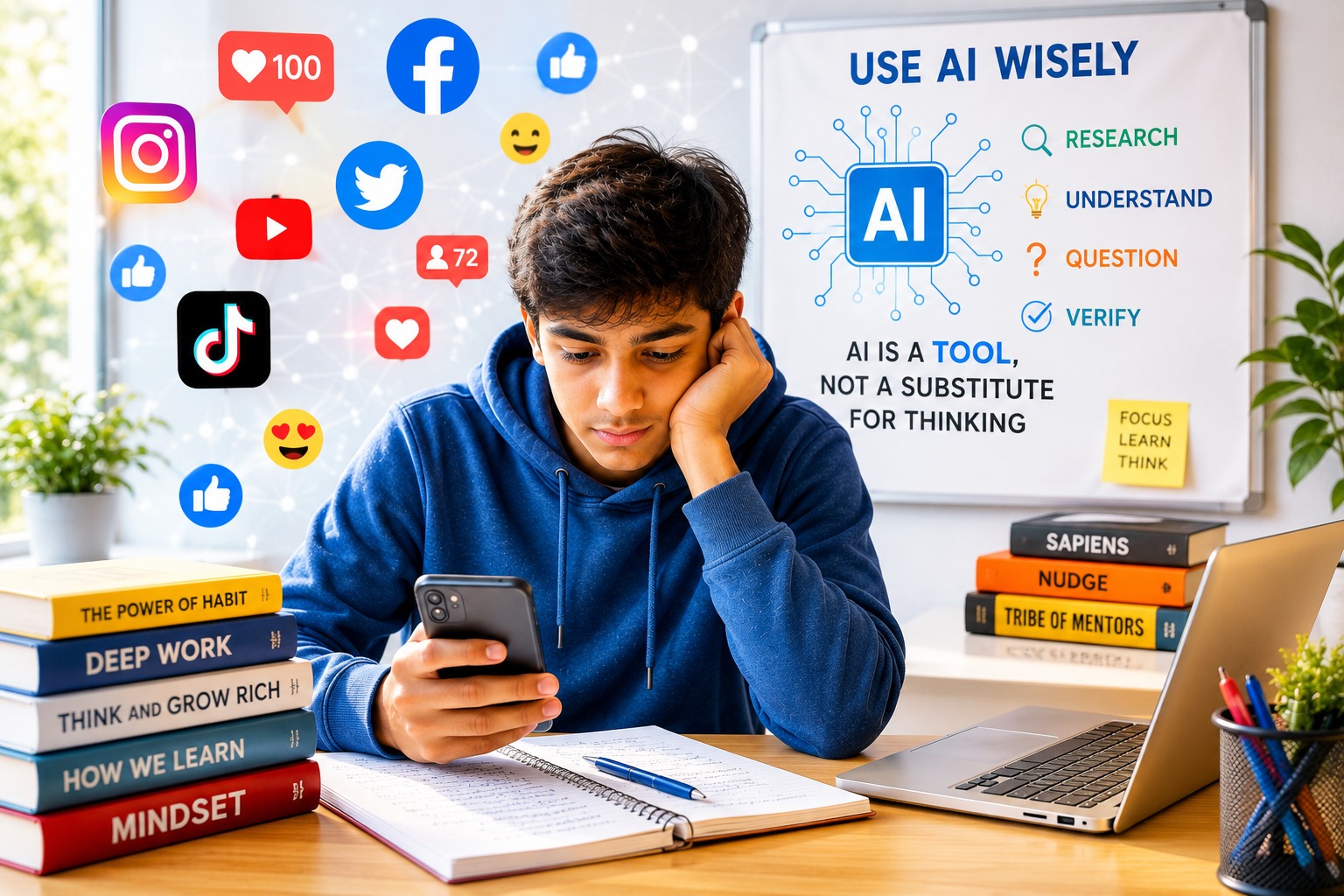
The deeper problem is one of habit and default settings, both technological and personal. Platforms are engineered by design teams whose job is to maximise engagement, not comprehension. Left unchecked, most people will drift toward the path of least resistance, whether that means scrolling instead of reading or asking a chatbot instead of thinking through a problem themselves. Reversing that drift requires intention. It means setting boundaries around screen time, choosing to read a full article before forming an opinion on it, and treating AI output as a first draft to be checked and questioned rather than a final answer to be copied.
In Kashmir, where I write from, these questions carry particular weight. A generation is growing up with smartphones as a constant companion, often in a region where structured extracurricular alternatives are limited and where educational infrastructure is still catching up in many districts. The stakes of getting this wrong are not abstract. They will show up, years from now, in a workforce less equipped to reason through complex problems and a public more susceptible to misinformation dressed up as fact.
The tools themselves are not going anywhere, nor should they. What needs to change is the relationship people have with them, starting with the simple, unfashionable habit of pausing before reacting, reading before sharing, and thinking before typing a prompt and accepting whatever comes back.
Comments are closed.