
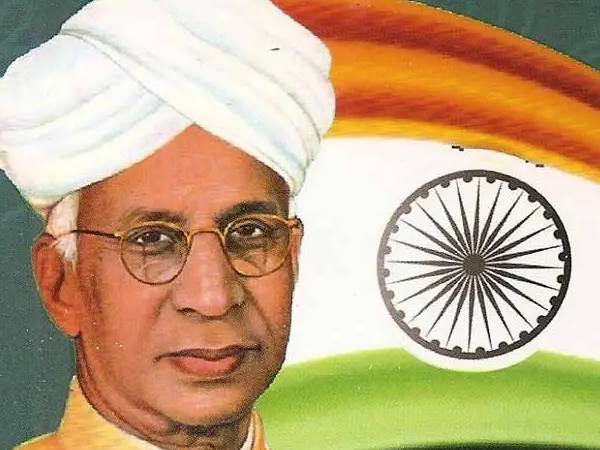
If Dr Sarvepalli Radhakrishnan were a Teacher Today

We mark Teachers' Day in his name. His own questions about 2026 would be sharper than any of the speeches made in his honour.

Mir Altaf


If he walked into a school this Teachers’ Day, I imagine he would sit through the function politely, decline the garland, and then ask the staff something they were not expecting. Not what technology have you brought in, but what are your children learning to care about. Every other question in this debate: the syllabus, the software, the screens, is a question about means. That one is about ends, and no machine has ever been able to answer it on our behalf.

On 5th September every year we celebrate the teacher. We organise functions, present bouquets, exchange greetings and remember Dr Sarvepalli Radhakrishnan, whose birthday is observed as Teachers’ Day in India. We have become so accustomed to the ritual that we rarely ask the harder question: what would he make of the teacher’s world today?

It is worth remembering that he earned the right to an opinion. Before he was Vice-President or President, he spent nearly four decades in classrooms: as a lecturer at Madras, a professor at Mysore and Calcutta, the holder of a chair at Oxford, a vice-chancellor twice over, and finally chairman of the commission that shaped university education in independent India. He was a working teacher far longer than he was anything else.

Imagine him walking into a classroom in 2026. The blackboard has been partly replaced by screens. Students carry smartphones rather than encyclopaedias. Answers can be generated in seconds. Social media competes with books for attention. A child can access more information in a few minutes than an earlier generation could gather in a library in an afternoon.

Would he see this as the triumph of education? Not immediately, I think. He would ask something more important first: in an age when information is everywhere, are we producing people who know how to think?

When knowledge is no longer scarce

Radhakrishnan’s philosophical work rested on a distinction that has suddenly become practical. He argued that the analytical intellect, useful as it is, is not the summit of knowing. Facts can be gathered and arranged by procedure; understanding of the kind that changes a person cannot.

Whatever one makes of that as metaphysics, consider what it implies for a classroom with artificial intelligence in it. A teacher of his cast of mind would not have been frightened by a machine that retrieves, summarises and explains. He might even have welcomed it, because he complained often enough about an examination system that rewarded reproduction over thought and here is a machine that makes reproduction so cheap that we can no longer pretend it is education.

His worry would be different and sharper. We have more information than any previous generation, and that is not the same as having more understanding. A student may hold hundreds of facts and still not distinguish a fact from an opinion. A child may produce a polished essay with AI and be unable to explain its argument in her own words. A student who obtains a fluent paragraph on the Upanishads in four seconds may never sit with a single verse long enough for it to trouble him.

The purpose of education was never to make a person informative. It was to make a person thoughtful, and the difficulty we are now busy removing was the mechanism by which that happened.

He would not, for this reason, ask us to reject the machine. He would ask what we intend to do with it, and insist that it remain a servant of education rather than its master.

The classroom has acquired a new competitor: the algorithm

The teacher of his time competed mainly with distractions outside the classroom. The teacher today competes with an entire digital ecosystem engineered by people who are very good at their work. A child moves from a lecture to short videos, games and algorithmically selected content in seconds.

The issue is not simply that attention spans have shortened. It is that attention itself has become a commodity, bought and sold by platforms designed to keep people scrolling and returning.

The classroom asks for the opposite. Read a difficult book. Follow an unfamiliar argument. Solve a problem that refuses to yield. Listen to someone you disagree with. None of this offers immediate gratification, and all of it builds the one capacity the algorithm reliably erodes.

Radhakrishnan read Sanskrit, Greek and German philosophy at length and wrote two volumes on Indian philosophy while teaching full-time. He would not have treated this as a problem of screen time or discipline. Sustained attention is the precondition of judgement, of patience with other people, of holding a question open long enough to answer it honestly. A society that loses it is not merely less informed; it is less capable of governing itself.


What would he say about misinformation?

This would be familiar ground for him. Much of his early career was spent answering European scholars who wrote about Indian philosophy with enormous confidence and very little understanding. He knew precisely what fluent, well-formed, authoritative error looks like, and how persuasive it is to a reader without the training to test it.

He would recognise our situation at once. The problem is not that false things exist. It is that falsehood now arrives in clean prose, correctly punctuated, in the cadence of authority, from a machine or a feed that feels no shame when it is wrong.

His answer would not be a fact-checking chapter in the syllabus. It would be the older, slower one: train judgement. Who produced this? What is the evidence? What has been left out? Is this a fact, an interpretation, or an opinion repeated until it sounded like one? Teaching that is not a lesson. It is a formation, and it happens mainly by watching an adult do it in front of you, repeatedly, for years.

And what about the commercialisation of education?

This is an uncomfortable question for Teachers’ Day, and he raised it himself. The commission he chaired in 1948 stated that the country was building a civilisation, not a factory or a workshop. It asked for salaries, housing and service conditions that would make able people choose teaching, on the reasonable assumption that a society gets the teaching it pays for.

Set that beside our present arrangement. Education now sits inside a vast commercial ecosystem: coaching centres promising ranks, test-preparation platforms, parallel schooling that begins when the school day ends, tuition fees that consume the savings of families who can least afford them, and an edtech market selling personalisation by subscription.

Competition is not in itself corrupting, and technology has put useful resources within reach of millions. But education is impoverished when the child becomes a customer and learning a product. The language shifts, and then the thinking follows. Marks become scores. Students become consumers. Teachers become service providers. Learning becomes a race.

A teacher of his temperament would find this a graver scandal than artificial intelligence. AI, at least, does not claim to be selling wisdom.

The teacher cannot become a content-delivery system

There is a quieter transformation underway. Teachers are increasingly expected to produce digital material, manage platforms and keep pace with tools that change every few months. These are useful skills. They are not what makes a teacher.

A teacher’s importance has never come from the number of slides prepared or videos uploaded. It comes from a human being in the room who notices that a student is struggling, encourages a hesitant child, challenges an arrogant one, recognises a talent the child has not yet noticed, and understands circumstances that will never appear on a marksheet.

A machine can find the pattern. A teacher can sometimes recognise the person behind the pattern.

What he would expect of us

Not a return to the past. Something harder. He would expect teachers to stay intellectually alive in a field that changes faster than any of us can comfortably follow, to use these tools without becoming dependent on them, and to teach students to question rather than merely consume.

He would also, I suspect, note that one thing has not changed at all. We still honour teachers ceremonially, treat them casually, and then ask them to raise a generation. His request in 1949 that teaching be made a profession able people would choose remains partly unanswered, and it is not a technological problem.

If he walked into a school this Teachers’ Day, I imagine he would sit through the function politely, decline the garland, and then ask the staff something they were not expecting. Not what technology have you brought in, but what are your children learning to care about. Every other question in this debate: the syllabus, the software, the screens, is a question about means. That one is about ends, and no machine has ever been able to answer it on our behalf.

That is the conversation worth having this Teacher’s Day.


The author is a Kashmir based educator. Views are personal.

Comments are closed.