
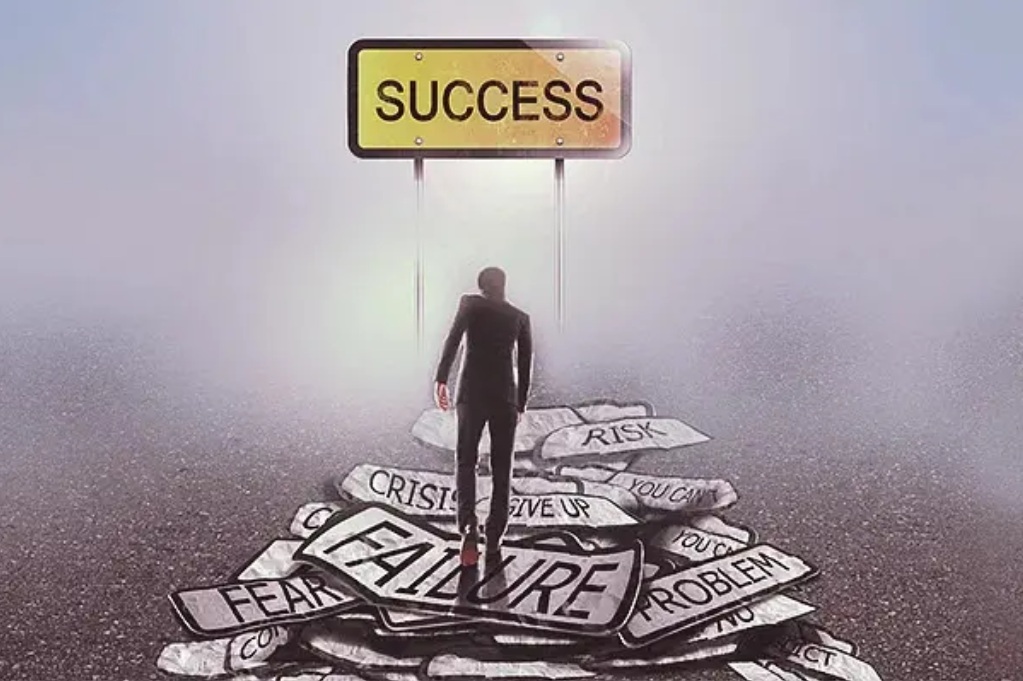


How Failures Lead to Success


 Mohammad Hanief


“If you fail, never give up because F.A.I.L. means ‘First Attempt In Learning.”

— Dr. A.P.J. Abdul Kalam


Failure remains one of life’s most misunderstood experiences. It is routinely linked with disappointment, weakness and defeat, while success is treated as the sole measure of ability. In reality the two are tightly connected. Almost every meaningful achievement is built on setbacks, mistakes, rejection and uncertainty. Successful people simply refuse to treat failure as a final destination.


This lesson matters more than ever. Students compete for limited seats, graduates face an unpredictable job market, professionals must constantly update skills, and entrepreneurs watch ideas rise or collapse in months. Social media amplifies the pressure by showcasing polished images of wealth, careers and awards. What it rarely shows is the long trail of failures that preceded those successes.


Failure is simply the gap between expectation and outcome. Success is the achievement of a goal. Neither has a fixed definition. What looks like failure at one stage of life often proves to be a turning point later. For some, success means a high-paying career; for others it means knowledge, family security, service or personal peace.


In today’s results-driven culture, a single setback can feel crushing. A student who fails an exam fears the future has closed. A job-seeker collecting rejection letters begins to doubt their worth. An employee passed over for promotion questions years of effort. An entrepreneur whose venture folds faces both financial loss and a crisis of confidence. Yet one unsuccessful outcome does not define ability or destiny.


Failure becomes valuable only when it teaches what success cannot. A failed examination exposes weak preparation. A rejected application reveals skill or communication gaps. A collapsed business teaches more about customers, markets and cash flow than any textbook. In this sense failure is feedback: it signals that something must change.


“Success is not a straight road free of obstacles. It is a journey in which achievement and disappointment travel side by side, sometimes requiring us to stop, reconsider our direction and take another route.”

That signal is especially critical in an age of rapid technological disruption. Skills once sufficient no longer guarantee security. Professionals must learn, unlearn and relearn. Those who treat a technology-driven setback as a threat stagnate; those who treat it as a prompt to acquire new capabilities move forward. The ability to adapt after failure is becoming more valuable than the ability to succeed once under familiar conditions.


The same principle drives innovation. New ideas rarely arrive fully formed. Scientists discard experiments, engineers redesign systems, entrepreneurs pivot business models, writers revise drafts. Progress depends on the willingness to learn from what did not work.


Failure can also redirect. A rejected application may open a better profession. An unsuccessful venture may spark a stronger idea. A disappointing exam result may lead a student toward a field that better matches their strengths. What first appears as a closed door often reveals a more suitable path.


Resilience is another quiet dividend. People who have recovered from disappointment develop a stronger capacity to face the next challenge. Resilience does not mean the pain disappears; it means the pain does not permanently dictate the next step.


Modern society, however, often cultivates an unhealthy fear of failure. Parents fixate on examination scores. Young people avoid unconventional careers for fear of criticism. Employees hesitate to take initiative. Entrepreneurs refuse to experiment. That fear can prove more damaging than failure itself. A person who never risks disappointment also never risks growth. Innovation requires experimentation, and experimentation inevitably includes the possibility of failure.


Social media intensifies the distortion. Carefully curated images of achievement create the false impression that success is swift and painless. The years of uncertainty, rejected ideas and private struggles remain invisible. Many people therefore compare their unfinished journey with someone else’s finished presentation—and despair.


There is a crucial distinction between failing and giving up. Failing means an attempt did not produce the expected result. Giving up means deciding the effort should end. A person can fail repeatedly and still succeed, provided each failure produces learning and adjustment. Simply repeating the same mistake is not perseverance. True perseverance demands reflection, adaptation and patience.


After a setback it is natural—and necessary—to pause. Disappointment should be acknowledged. But reflection must eventually lead to action. Instead of remaining trapped in “Why did this happen?”, the more useful question is “What can be done differently next time?” Taking responsibility for what was controllable is a mark of maturity; blaming others rarely produces improvement.


In professional life, the response to a mistake often matters more than the mistake itself. An employee who owns an error, diagnoses its cause and prevents recurrence demonstrates professionalism. A student who revises study habits after a poor result shows growth. An entrepreneur who studies a failed venture already possesses knowledge that can improve the next one.


Young people especially need to hear that success does not mean never failing. A poor exam result does not erase potential. A rejected application does not end a career. A failed business does not prove lack of ability. A mistake need not become a permanent label. What matters is what follows.


Every failure offers two possibilities: a reason to stop, or a reason to improve. The choice rests with attitude. Samuel Beckett captured the spirit cleanly: “Ever tried. Ever failed. No matter. Try again. Fail again. Fail better.” Progress does not require perfection. It requires the courage to keep learning.


Human history itself is a record of repeated attempts. Discoveries, inventions, businesses and social advances exist because people were willing to try what had not been tried before. Had failure always been treated as unacceptable, much of the progress we now enjoy would never have occurred.


Failure should not be romanticised. It can bring real emotional, financial and professional costs, and not every setback automatically yields success. What converts failure into opportunity is reflection, learning, adaptability and continued effort.


Success, therefore, is not a straight road free of obstacles. It is a journey in which achievement and disappointment travel side by side. Sometimes progress is rapid; sometimes it requires stopping, reconsidering and taking another route.


The essential lesson remains simple: failure is an event, not an identity. We may fail an examination, but we are not failures. We may lose a job opportunity, but our career is not over. We may make a wrong decision, but we can learn from it. We may fall short of a goal, but we can set a new one.


In a world that celebrates instant success, Dr Kalam’s reminder deserves renewed attention. We do not need to be fearless of failure. We need to be prepared to learn from it. Sometimes failure does not take us away from success—it teaches us how to reach it.


The author is a senior analyst and environmentalist. Feedback can be sent to m.hanief@gmail.com. Twitter/X: @haniefmha

Comments are closed.