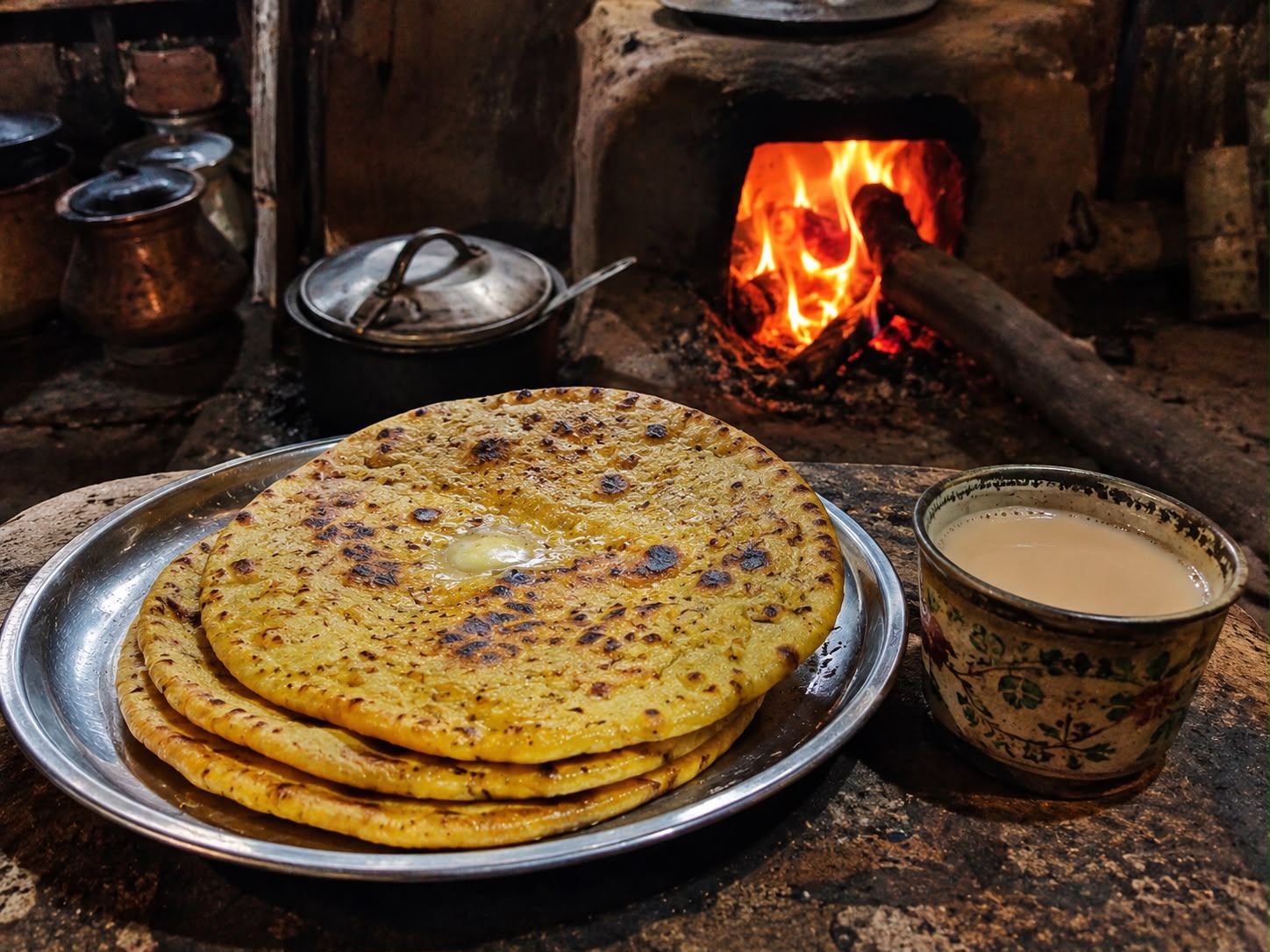
Gurez, Jul 15: In an era where fast food chains and instant meals are rapidly replacing traditional culinary practices in the Kashmir Valley’s plains, the remote Tulail Valley in Gurez is emerging as a last bastion of the region’s ancient food heritage, with its traditional Maki ki roti and Nun chai (salty pink tea) becoming a major crowd-puller for tourists.
With the government giving the green signal for border tourism up to Chalwali village, the northern Kashmir valley has witnessed a record surge in footfall, bringing economic relief to locals who have long depended on the army for survival during harsh winters.
“We charge Rs 30 for one cup of Nun chai with one Maki ki roti, and Alhamdulillah, our business is booming,” Habibulla, a local resident who runs a small eatery along the route, told Kashmir Convener. “Earlier, people in the plains had almost stopped eating Maki ki roti. But now, tourists stop here with great enthusiasm to taste it, and many even order extra packets to take back home.”
The Valley, known for its picturesque Kishanganga river and traditional log houses, has been a favourite among adventure travellers for years. However, the tourism boom in the past few years has brought a new wave of visitors eager to experience the authentic Kashmiriyat that has largely disappeared from urban centres.
“It is a blessing that we are witnessing such a massive tourism boost. Since the administration gave the go-ahead to tourists till Chalwali, my earnings have multiplied,” Habibulla said.
The Tulail Valley, located in upper Gurez, holds a distinct beauty—both in its landscapes and cultural expanse. Residents still live in wooden log houses and follow ancient traditions, though they remain cut off from the rest of the world for nearly six months every year due to heavy snowfall.
Despite the lack of 24/7 electricity, poor mobile connectivity, grim job prospects, and inadequate medical facilities, the warmth of the people remains undiminished.
“It’s not only about earning money; it is about culture sharing and knowing each other. That is something we celebrate,” said Sajad Sarwar, who runs a homestay in his traditional wooden house in Sheikhpora. “Earlier, we were only dependent on the army whenever there was any opportunity. But with the tourism boost, people started coming here, so we started hosting them.”
Sajad said the tourist rush in his homestay has been consistently good over the past six years. “They taste our authentic local dishes, and sharing cultural aspects is something really cherishing,” he added.
“People are coming here to know our struggles and sufferings, but also to experience our culture. That is something really cherishing,” Sarwar said.
Sandeep, a traveller from Pune visiting Tulail for the first time, said the authenticity of the place left him spellbound.
“I have been to Srinagar and Pahalgam, but this is completely different. The wooden houses, the river, and the warmth of the people—it feels like stepping back in time,” Sandeep told Kashmir Convener, sipping Nun chai at Habibulla’s eatery. “And the Maki ki roti with this salty tea—I have never tasted anything like this.”
Priya Menon, a Bengaluru-based software professional who has been travelling in Kashmir for two weeks, said Gurez was the highlight of her trip.
“Honestly, I came here because of Instagram reels, but the reality is far more beautiful,” she said. “The locals here are so welcoming. They don’t treat you like a tourist; they treat you like a guest. The Nun chai is unlike anything we get in the cities. I wish more people knew about this place—but at the same time, I hope it doesn’t get spoilt.”
The border tourism push, coupled with the valley’s growing popularity on social media, has doubled tourist numbers every year. The administration’s decision to allow visitors up to Chalwali—the last village on this side—has further catalysed the influx.
Local authorities have welcomed the trend but have also urged tourists to respect the fragile ecosystem and cultural heritage of the region.
Earlier on Wednesday, Deputy Commissioner Bandipora Indu Kanwal Chib during her visit to Gurez warned of strict action against those violating waste management norms, asserting that the fragile border valley “cannot afford” a waste crisis amid rising tourist footfall.
Chairing an Extended Producer Responsibility (EPR) Convention on Plastic Waste Management at Government Higher Secondary School, Dawar, organised in collaboration with the Indian Army’s 109 Brigade, DC Bandipora said environmental conservation must keep pace with tourism expansion.
“A plastic check post has been established at Tragbal to curb entry of single-use plastics. Tourism stakeholders, including hoteliers and camping site owners, must ensure proper collection, segregation and disposal of waste. Violations will invite strict action,” she said.
The administration will soon install heritage boards, information displays and awareness wall paintings across Gurez to promote environmental consciousness, the DC added.
With winter just a few months away, the valley will soon be cut off again, leaving its residents to rely once more on the army for emergencies. But for now, the aroma of freshly baked corn bread and the steam of pink tea continue to draw visitors to this Himalayan outpost, offering a rare glimpse into a way of life that is fast disappearing elsewhere in the Valley.


Comments are closed.