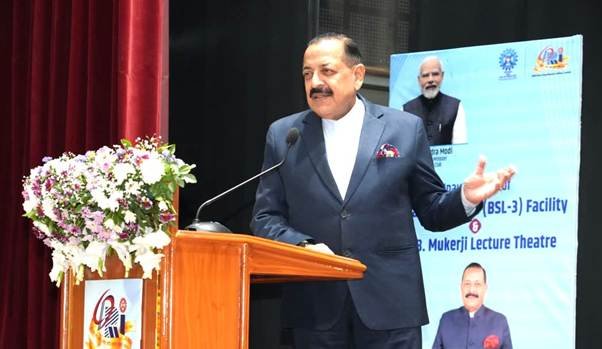
LUCKNOW, November 27: Union Minister of State for Science and Technology Jitendra Singh on Friday inaugurated a Biosafety Level-3 (BSL-3) and Animal Biosafety Level-3 (ABSL-3) facility at the CSIR-Central Drug Research Institute (CDRI) in Lucknow, saying the infrastructure would strengthen India’s research capabilities against challenging infectious diseases.
The Minister also inaugurated the Dr B. Mukerji Lecture Theatre at the institute and called for India to move beyond its position as a major supplier of generic medicines to become a global centre for innovative drug discovery and development.
The new facility will provide high-containment infrastructure for research involving Mycobacterium tuberculosis and non-tuberculous mycobacteria (NTM), strengthening the institute’s work on infectious diseases.
Addressing the gathering, Singh said indigenous research, clinical development and stronger industry partnerships would be central to India’s transition towards developing innovative therapeutics. He said the shift was important for strengthening the country’s pharmaceutical capabilities and advancing the vision of Viksit Bharat 2047.
He cited CSIR-CDRI’s record in drug discovery and development, stating that the institute had developed 13 drugs that had reached the market, licensed more than 80 process technologies and six diagnostic technologies, and filed over 1,000 patents in India and abroad.
The institute has also published more than 12,000 research papers and maintains a compound library of around 90,000 molecules, over 50 animal models and more than 30 in-vitro screening systems, according to the Ministry of Science and Technology.
Referring to CDRI’s contribution to public healthcare, Singh highlighted Centchroman, also known as Ormeloxifene, an indigenous non-steroidal oral contraceptive developed by the institute. Its inclusion in the National Family Planning Programme in 2016 marked an important step in translating indigenous research into a public health intervention, he said.
The Minister said more than 350 lakh strips of the contraceptive had been distributed free of cost to women through ASHA workers over the past five years, with the current user base exceeding five lakh women.
He also referred to the institute’s drug-development pipeline, including a standardised extract of Picrorhiza kurroa for metabolic dysfunction-associated steatotic liver disease (MASLD), which has completed Phase III clinical trials. Two other compounds, L-Ormeloxifene for contraception and S007-1500 for fracture healing, have entered Phase I clinical trials.
Singh said India ranked third globally in pharmaceutical production by volume and 11th by value, and supplied a significant share of generic medicines to international markets. He urged research institutions and pharmaceutical companies to work more closely to take promising discoveries from laboratories to clinical evaluation and commercialisation.
He emphasised the role of artificial intelligence and the integration of biology, chemistry and computational sciences in accelerating drug discovery. He also called for stronger collaboration among scientists, clinicians, hospitals and industry to ensure that research addresses clinical needs.
The Minister appreciated CDRI’s collaborations with pharmaceutical companies, including Zydus, Cipla, Dr Reddy’s Laboratories, Himalaya and Themis Medicare, and encouraged the institute to expand its role as a research partner for the industry.
He also highlighted the institute’s contribution to scientific capacity building, saying it had trained more than 2,000 PhD scholars and over 10,000 other trainees.
The programme was attended by CSIR-CDRI Director Dr Radha Rangarajan, CSIR-CIMAP Director Dr Prabodh K. Trivedi, former CDRI Director Dr Madhu Dikshit, representatives of research and medical institutions, scientists, researchers and industry representatives.
The institute also signed collaborative agreements with ICMR-National Institute of Research in Tribal Health, Uttar Pradesh University of Medical Sciences and Medanta Hospital, Lucknow. Singh said the partnerships would support collaborative research and accelerate the translation of scientific findings into healthcare applications.
He expressed confidence that CSIR-CDRI would continue to contribute to India’s drug discovery capabilities and the national goal of Viksit Bharat 2047. – (PIB)


Comments are closed.