

Syed Yunis Bukhari
“Balancing green ambitions with rising energy demands is undoubtedly one of the greatest challenges of our time. Yet it is also one of the greatest opportunities to build cleaner economies, healthier societies and a more sustainable future.”
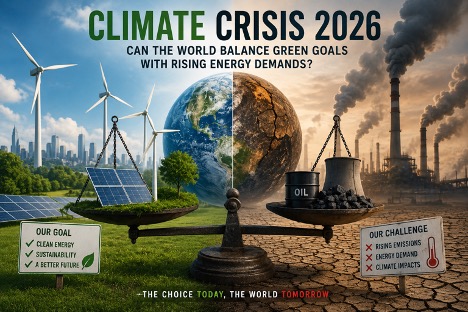
As the world enters the second half of this decisive decade, humanity faces a paradox that will define the future of our planet. On one hand, nations are racing to reduce carbon emissions, transition to renewable energy, and fulfil ambitious climate commitments. On the other, global energy demand continues to surge, driven by economic growth, rapid urbanization, digital transformation, and the aspirations of billions seeking better lives.
The challenge is no longer simply about producing more energy. It is about producing enough energy to power the modern world without accelerating the climate crisis that threatens it.
The year 2026 has become a stark reminder that climate change is not a distant possibility it is a present reality. Across continents, record-breaking temperatures, devastating floods, prolonged droughts, destructive wildfires, and increasingly erratic weather patterns have become alarmingly common. Scientists continue to warn that the window for limiting global warming is narrowing, while governments struggle to balance environmental responsibility with economic necessity.
The question confronting policymakers, industries, and citizens alike is both urgent and complex: Can the world meet its growing energy needs while staying on track to achieve its climate goals?
The answer will shape not only the future of the environment but also global economic stability, public health, food security, and geopolitical relations.
For decades, economic development and energy consumption have moved hand in hand. Every factory, hospital, school, transportation network, and digital platform relies on energy. As populations grow and living standards improve, demand inevitably rises. Emerging economies require vast amounts of electricity to support industrialization and poverty reduction, while developed nations increasingly depend on energy-intensive technologies such as artificial intelligence, cloud computing, data centres, and electric mobility.
Ironically, the technologies expected to help solve climate challenges are themselves becoming major consumers of energy.
Artificial Intelligence, for example, is revolutionizing industries and accelerating innovation, but the massive data centres that power AI systems consume enormous amounts of electricity. The digital economy, often perceived as environmentally friendly, carries a substantial energy footprint. This reality highlights a growing challenge: the transition to a greener future must also accommodate the energy demands of a rapidly digitizing world.
The global response has been a historic push toward renewable energy. Solar and wind power have expanded at unprecedented rates, becoming increasingly affordable and efficient. Investments in clean energy technologies have reached record levels, and many countries have committed to achieving net-zero emissions within the coming decades.
These developments represent significant progress.
Today, renewable energy is no longer a niche alternative. It is becoming a central pillar of global energy strategies. Solar farms now stretch across deserts, offshore wind projects generate electricity on an industrial scale, and advances in battery technology are improving the reliability of clean energy systems.
Yet the transition remains far from complete.
Despite remarkable growth in renewables, fossil fuels continue to supply a substantial share of global energy needs. Coal remains a critical source of electricity in many countries. Oil continues to dominate transportation, while natural gas is widely used to stabilize power grids and support industrial activities.
This dependence is not simply a matter of policy reluctance. It reflects practical realities.
Renewable energy sources are inherently variable. Solar panels do not generate electricity at night, and wind turbines depend on weather conditions. Although energy storage technologies are advancing rapidly, large-scale deployment remains expensive and technically challenging. Until storage solutions become more accessible and efficient, many countries will continue relying on conventional energy sources to ensure energy security.
This tension between sustainability and reliability lies at the heart of the global energy debate.
Complicating matters further is the issue of climate justice.
The world’s richest nations built their prosperity through centuries of industrialization powered largely by fossil fuels. Today, many developing countries are being asked to pursue cleaner growth pathways despite having contributed far less to historical greenhouse gas emissions.
For these nations, energy is not merely an environmental issue it is a development imperative.
Reliable electricity powers healthcare facilities, enables education, supports agriculture, creates jobs, and drives economic progress. Millions still lack access to affordable and dependable energy. Asking developing economies to sacrifice growth without providing sufficient financial and technological support risks widening global inequalities.
This is why climate finance has emerged as one of the most contentious issues in international negotiations. Developing countries argue that wealthier nations must honour their commitments to provide funding, technology transfer, and capacity-building support. Without meaningful cooperation, global climate ambitions may remain difficult to achieve.
At the same time, the economic argument for climate action has never been stronger.
Extreme weather events are imposing enormous financial costs worldwide. Floods destroy infrastructure, droughts reduce agricultural productivity, wildfires devastate ecosystems, and heatwaves strain healthcare systems. Insurance losses from climate-related disasters continue to rise, while governments spend billions on disaster response and recovery.
Inaction is proving increasingly expensive.
Moreover, climate change is not merely an environmental concern; it is a public health emergency. Air pollution linked to fossil fuel combustion contributes to millions of premature deaths annually. Rising temperatures increase the spread of infectious diseases, worsen respiratory conditions, and place vulnerable populations at greater risk.
The transition to clean energy therefore offers benefits that extend beyond emissions reduction. It can improve public health, enhance energy security, stimulate innovation, and create millions of new jobs.
Indeed, the green economy is rapidly becoming one of the largest sources of employment growth worldwide. Renewable energy projects, electric vehicle manufacturing, sustainable construction, green hydrogen production, and climate technology startups are generating opportunities across diverse sectors. The challenge is ensuring that workers possess the skills needed to participate in this transformation.
Education and workforce development will be crucial.
Universities, technical institutions, and training centres must prepare future generations for careers in sustainable industries. Governments must invest in reskilling programmes to support workers transitioning from carbon-intensive sectors. Businesses must embrace innovation while ensuring that economic transformation remains inclusive and equitable.
The climate crisis is often framed as a choice between environmental protection and economic growth. In reality, this is a false dichotomy.
The true challenge is not choosing between development and sustainability; it is redefining development itself. Economic progress in the twenty-first century must be measured not only by growth rates but also by resilience, sustainability, and long-term societal well-being.
The world possesses the scientific knowledge, technological capabilities, and financial resources necessary to address climate change. What remains uncertain is whether there is sufficient political will and international cooperation to act at the scale and speed required.
History may remember this decade as the moment humanity decided whether to confront the climate crisis or merely manage its consequences.
The stakes could not be higher.
Every fraction of a degree matters. Every investment decision matters. Every policy choice matters.
Balancing green ambitions with rising energy demands is undoubtedly one of the greatest challenges of our time. Yet it is also one of the greatest opportunities to build cleaner economies, healthier societies, and a more sustainable future.
The question is not whether the world needs energy. It always will.
The real question is whether humanity can power its future without compromising the future itself.
Comments are closed.