

Can PM SHRI Transform India’s Classrooms?

S Ahmad


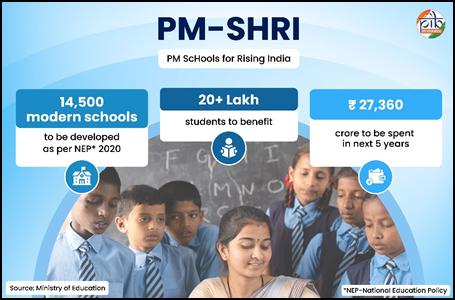
Launched on 7 September 2022, the Pradhan Mantri Schools for Rising India (PM SHRI) Scheme seeks to develop over 14,500 exemplar schools aligned with the vision of the National Education Policy (NEP) 2020. With a total outlay of ₹27,360 crore across 2022–23 to 2026–27, the scheme strengthens infrastructure, pedagogy, inclusion, and sustainability, while equipping students with 21st-century skills. As of July 2026, 13,092 schools – around 90% of the target- have been selected across 36 States/UTs including schools under KVS, NVS, and NCERT. The schools are selected through a three-stage Challenge Mode based on defined quality benchmarks. Envisioned as mentor institutions for neighbouring schools, PM SHRI schools mark a shift from infrastructure-centric development towards holistic, equitable, and future-ready education.

There is a quiet transformation underway in India’s school education system. It is not as dramatic as the construction of a highway, the inauguration of a bridge or the launch of a new industrial corridor. There are no cranes that can be photographed as evidence of progress, nor can the success of education be measured merely by the number of buildings completed. Yet, if it succeeds, this transformation could have a far deeper and longer-lasting impact on the country’s future.

India has one of the largest school education systems in the world, with 14.71 lakh schools catering to more than 24.69 crore students. Behind these numbers are millions of children growing up in vastly different circumstances—urban and rural, privileged and disadvantaged, multilingual and culturally diverse, digitally connected and digitally excluded. The challenge before Indian education, therefore, is not simply to put more children inside classrooms. It is to ensure that what happens inside those classrooms gives every child a meaningful chance to learn, grow and participate in society.

This is where the Pradhan Mantri Schools for Rising India, or PM SHRI, initiative assumes significance.

Launched in September 2022, the scheme seeks to strengthen more than 14,500 existing schools and develop them as exemplar institutions demonstrating the principles of the National Education Policy (NEP) 2020. With a total project cost of ₹27,360 crore, including a Central share of ₹18,128 crore, PM SHRI is intended to be considerably more than an infrastructure programme. Its larger ambition is to demonstrate what a modern, inclusive, child-centred Indian school should look and feel like.

By July 2026, 13,092 schools had been selected across States and Union Territories, covering 725 districts and 8,340 blocks and urban local bodies. The network includes government schools as well as institutions under the Kendriya Vidyalaya Sangathan, Navodaya Vidyalaya Samiti and NCERT. More than 20 lakh students are expected to benefit directly.

The numbers are impressive. But numbers alone cannot determine whether PM SHRI will become a landmark intervention or another government scheme whose impact remains uneven across the country.

The real test lies elsewhere: Can a selected group of schools become genuine centres of educational excellence and influence the wider school system around them?

That is the promise—and the challenge—of PM SHRI.

From buildings to learning

For decades, discussions around school education in India have often been dominated by infrastructure. Does a school have a building? Are there enough classrooms? Is there electricity? Are there separate toilets for boys and girls? Is drinking water available? Does the school have a library, playground or laboratory?

These questions remain important. A child cannot be expected to learn comfortably in an unsafe building without basic facilities. Yet infrastructure is only the foundation of education. It is not education itself.

A new classroom does not automatically produce better learning. A smart board does not automatically make a lesson engaging. A computer laboratory does not automatically create digital competence. A modern school building can still reproduce an outdated teaching culture.

PM SHRI is important precisely because it attempts to move the conversation beyond infrastructure.

Its framework brings together learning outcomes, pedagogy, teacher development, school leadership, technology, inclusion, vocational exposure, environmental sustainability, sports and arts. The objective is to create schools where the child is not merely a recipient of information but an active participant in the learning process.

That is a significant departure from the traditional image of schooling in which success is frequently associated with memorisation, examinations and marks.

The NEP 2020 vision places greater emphasis on competency, critical thinking, creativity, communication and problem-solving. PM SHRI is expected to make these principles visible in everyday school practice.

That distinction matters. A policy becomes meaningful only when it changes what teachers do, what students experience and how schools function.

The child must become the centre

Perhaps the most consequential aspect of the PM SHRI vision is its attempt to make learning more child-centred.

The 5+3+3+4 curricular and pedagogical structure proposed under NEP 2020 recognises that children do not learn in the same way at every stage of their development. Foundational learning, therefore, cannot be treated simply as a smaller version of secondary education.

Play-based learning, experiential education, inquiry, local knowledge, arts and crafts and exposure to the world outside the textbook can make education more meaningful.

The proposed bagless days and internships with local artisans, for instance, have the potential to reconnect schools with their surrounding communities. A child learning about a traditional craft from a practitioner is experiencing knowledge differently from reading about it in a textbook. Similarly, understanding agriculture, local ecology, handicrafts or traditional occupations can help children see that knowledge is not confined to the four walls of a classroom.

This is particularly relevant in rural India, where schools often exist within rich social and cultural ecosystems.

The challenge, however, will be implementation. Experiential learning cannot become another phrase printed in school records. A “bagless day” should not simply mean a day without books. It should mean a different kind of learning.

The success of PM SHRI will ultimately depend on whether such concepts become part of school culture rather than occasional activities conducted to satisfy programme requirements.

Equity cannot remain a slogan

India’s educational challenge is also a challenge of inequality.

A child in a well-resourced urban school and a child in a remote rural school may technically belong to the same education system, but their educational experiences can be worlds apart. Differences in infrastructure, teacher availability, parental support, language, technology and exposure can shape educational outcomes long before a child reaches an examination hall.

PM SHRI’s emphasis on equity and inclusion is therefore central to its purpose.

The scheme seeks to provide quality learning environments to children from diverse social and economic backgrounds, including those living in rural and underserved areas. Its emphasis on barrier-free access, safety, separate toilets, drinking water and other basic facilities acknowledges that inclusion begins with the physical environment.

But genuine inclusion goes much deeper.

It means ensuring that a child with a disability can participate fully. It means ensuring that a child from a linguistic minority does not feel that the language spoken at home is a disadvantage in school. It means creating classrooms where children with different abilities can learn together without being labelled or marginalised.

The emphasis on mother tongue and local or regional languages, particularly in the early grades, is therefore more than a linguistic policy. It is an educational necessity.

The latest UDISE+ 2025–26 data records 6,102 Sanskrit teachers, 1,994 Urdu teachers and 9,152 regional-language teachers in PM SHRI schools. These numbers illustrate the diversity that the system must accommodate.

Language is not merely a medium through which information is delivered. It is connected to identity, comprehension and confidence. A child learns more effectively when the classroom does not make the language of home appear inferior to the language of formal education.

At the same time, multilingualism must not become a barrier to opportunity. Children should be enabled to acquire strong foundational literacy in familiar languages while gradually gaining proficiency in other languages and the wider skills required for higher education and employment.

The objective should be additive, not restrictive: more languages, more competence and more opportunity—not a choice between identity and mobility.

Technology is a tool, not a teacher

The expansion of technology in PM SHRI schools is another important component of the initiative.

ICT facilities, smart classrooms, internet connectivity, digital resources, STEM programmes and platforms such as DIKSHA can significantly expand what a teacher and student can access.

For a child in a remote school, digital resources can open a window to laboratories, museums, lectures, demonstrations and learning materials that may otherwise be inaccessible.

But technology also carries a danger: the temptation to confuse equipment with transformation.

A smart classroom can remain an ordinary classroom if the pedagogy does not change. A computer can remain unused if teachers are not confident in using it. Internet connectivity means little if students are not taught how to evaluate information critically.

Digital education must therefore be understood as a pedagogical opportunity rather than an equipment-distribution exercise.

The real question is not how many smart classrooms have been created. It is whether technology has helped a child understand a difficult concept better, conduct an experiment, explore a subject independently, collaborate with others or develop the ability to distinguish reliable information from misinformation.

The answer will determine whether the digital component of PM SHRI is transformative or merely cosmetic.

Teachers will decide the outcome

No education reform can succeed by changing buildings, syllabi or technology while leaving teachers out of the equation.

The teacher remains the most important link between educational policy and the child.

PM SHRI’s focus on teacher and school-leader capacity building is therefore one of its most important features. Support is being provided through DIETs, including financial assistance of up to ₹3 lakh per DIET for capacity-building programmes and support of up to ₹2,500 per teacher for training subject teachers, principals, special educators, ICT teachers and master trainers.

The areas of training—competency-based pedagogy, the Holistic Progress Card, school safety, mental health and well-being, counselling and ICT integration—reflect the changing demands placed on educators.

The modern teacher is expected to be more than a transmitter of textbook knowledge. Teachers increasingly have to understand learning differences, technology, emotional well-being, assessment and changing career aspirations.

That requires continuous professional development, not occasional workshops.

Teacher training should also avoid becoming a compliance exercise in which teachers attend programmes, sign attendance sheets and return to the same classroom practices.

Professional development works when teachers are given time, mentoring, peer support and opportunities to experiment and reflect.

The same is true of principals.

A school cannot become an exemplar institution without strong institutional leadership. A principal who merely manages attendance, files and administrative correspondence cannot drive educational transformation. School leaders need the authority, capacity and vision to support teachers, engage parents, analyse learning outcomes and build a culture of improvement.

The ripple effect will determine success

The most ambitious feature of PM SHRI may not be what happens inside the 13,092 selected schools. It is what happens outside them.

The scheme envisages PM SHRI schools as models for neighbouring institutions, providing mentoring, handholding and sharing innovative practices.

This is where the scheme can potentially move from being a school-improvement programme to a system-improvement programme.

India cannot transform 1.4 million schools by treating each institution as an isolated project. A small network of exemplar schools can, however, become laboratories of innovation if their experiences are documented, evaluated and shared.

But this ripple effect will not happen automatically.

A PM SHRI school cannot become a model simply because it carries the designation. Its practices must be demonstrably better. Teachers from neighbouring schools should be able to observe classrooms, discuss pedagogy and adapt successful practices. School leaders should be able to learn from one another. Clusters should become genuine professional communities rather than administrative groupings.

Most importantly, the model must be replicable.

If an educational practice requires resources unavailable to an ordinary government school, it will have limited systemic value. A model school should not become an island of excellence surrounded by schools that remain unchanged.

The true measure of a PM SHRI school should therefore be its influence on the educational ecosystem around it.

The green school should also be a thinking school

The environmental dimension of PM SHRI is another welcome development.

Schools can teach sustainability in two ways: through textbooks and through everyday practice.

A school that teaches children about water conservation while wasting water, or lectures about waste management while producing mountains of unmanaged waste, teaches a lesson very different from the one intended.

Green schools can turn environmental education into lived experience through rainwater harvesting, energy conservation, waste segregation, biodiversity initiatives, kitchen gardens and responsible use of resources.

More importantly, environmental awareness can be connected to local realities.

For a child living near a river, lake, forest or agricultural area, climate and ecology are not abstract concepts. They are part of everyday life.

Schools can become spaces where children understand the environmental challenges of their own communities and develop practical solutions.

That is precisely the kind of education required for the future: education that connects knowledge to life.

The difficult questions cannot be ignored

Yet any serious assessment of PM SHRI must go beyond official achievements.

The selection of 13,092 schools is significant, but selection is only the beginning. A school can meet prescribed benchmarks at the time of selection and still struggle later with teacher shortages, maintenance, leadership changes or inadequate local support.

Similarly, quality cannot be reduced to a checklist.

The School Quality Assessment Framework can provide structure and accountability, but the most important dimensions of education are sometimes difficult to quantify. Does a child feel safe asking a question? Does a teacher encourage curiosity? Does a girl feel equally confident participating in class? Does a child from a disadvantaged background believe that higher education is within reach?

These questions matter as much as the availability of infrastructure.

There is also a broader question of regional variation. India’s school system operates across states and Union Territories with different administrative capacities, languages, social realities and resource constraints. A centrally designed framework must therefore leave adequate room for local adaptation while protecting national standards.

PM SHRI’s flexibility in curriculum contextualisation is useful in this regard.

The challenge will be maintaining a balance between uniform quality benchmarks and India’s enormous diversity.

Investment is rising—but impact must rise with it

The increase in the Central share of approved Project Approval Board outlay from ₹2,520 crore in 2023–24 to ₹5,224 crore in 2026–27—an increase of about 107 per cent—shows that the initiative is expanding.

Greater investment creates greater opportunity, but it also creates greater responsibility.

Every rupee spent on a school must ultimately be judged by the value it creates for students.

Does it improve learning? Does it reduce exclusion? Does it make teachers more capable? Does it improve attendance and engagement? Does it make schools safer? Does it prepare students for further education, employment and citizenship?

These are the questions that should increasingly accompany financial and physical progress reports.

The education system needs both accountability and patience. Learning outcomes do not change overnight. School culture takes time to transform. Teacher capacity cannot be built through a single training programme.

But patience should not become an excuse for weak monitoring.

There must be transparent mechanisms to measure outcomes, document failures as well as successes, and identify what works in different contexts.

A school is more than a school

Ultimately, PM SHRI’s greatest promise lies in its understanding that a school is not simply a place where children prepare for examinations.

It is a social institution.

It is where children learn how to cooperate with people different from themselves. It is where they encounter ideas, languages, cultures and perspectives beyond their homes. It is where they learn discipline but also questioning, competition but also cooperation, individual ambition but also social responsibility.

This is why the emphasis on sports, arts, life skills, leadership, creativity and socio-emotional development matters.

A country aspiring to become a knowledge economy cannot afford an education system that produces students who are good at reproducing answers but uncomfortable with questions.

India needs young people who can think critically, work collaboratively, adapt to technological change, communicate across languages and cultures, solve unfamiliar problems and remain grounded in democratic and constitutional values.

That is the deeper meaning of a future-ready education.

The real examination begins now

PM SHRI has built a considerable foundation. It has a clear policy framework, substantial financial backing, a growing network of selected schools and an ambitious vision of what Indian public education can become.

But the most important phase is not selection. It is implementation.

The success of the initiative will not be determined by the number of schools that receive the PM SHRI label. It will be determined by what a child experiences on an ordinary Tuesday morning in one of those schools.

Does the teacher encourage the child to ask why?,  Does the classroom accommodate different abilities? , Does the child understand what is being taught rather than merely memorise it? Does technology deepen learning?, Does the school respect the child’s language and culture?,  Does the principal create an environment in which teachers themselves keep learning?, Does the school share what it learns with its neighbours? And, perhaps most importantly, does the child leave school more curious, capable and confident than when he or she entered?

These are harder questions than counting classrooms, computers or sanctioned projects. They are also the questions that matter most. PM SHRI should therefore be judged not as a collection of upgraded schools but as an experiment in changing the culture of Indian education.

If its exemplary schools genuinely become centres of innovation, inclusion and professional learning—and if their practices travel beyond their own boundaries—the initiative could create precisely the ripple effect India needs. But if model schools become showcase institutions without transforming teaching and learning, the opportunity will be diminished.

India does not merely need better school buildings. It needs better educational experiences. It does not merely need students who pass examinations. It needs young citizens who can think. It does not merely need technology-enabled classrooms. It needs teachers empowered to use technology intelligently. And it does not merely need a few excellent schools. It needs excellence to spread. That is the real promise of PM SHRI—and the real test that lies ahead.


The article is based on the inputs and background information provided by the Press Information Bureau (PIB). Author is Writer, Policy Commentator. He can be mailed at kcprmijk@gmail.com

Comments are closed.