
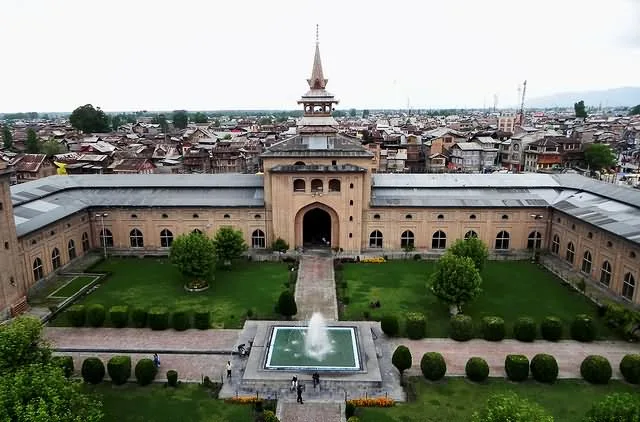
Built, Burnt and Reborn: Why Jamia Masjid Still Matters to Kashmir
In the wooden pillars, spacious courtyard and enduring walls of Srinagar’s Jamia Masjid lies a history that cannot be replaced once lost.


Afreen Jan
Built, burnt and reborn, Jamia Masjid is more than a monument of Kashmir’s past. It is a living symbol of endurance, craftsmanship and continuity—and a reminder that the heritage we inherit is also the heritage we are responsible for leaving behind.
In the historic heart of Srinagar, where narrow streets carry the sounds, memories and rhythms of generations, stands a monument that has witnessed the changing face of Kashmir for centuries. In Nowhatta, surrounded by the old city and its historic neighbourhoods, the Jamia Masjid remains one of the most recognisable symbols of Srinagar’s religious, architectural and cultural heritage.
For those who enter its spacious courtyard or stand beneath its traditional sloping roofs, the mosque may appear to be an extraordinary example of Kashmiri architecture. But Jamia Masjid is much more than a beautiful old structure.
It is a record of time.
Its wooden pillars have witnessed generations of worshippers. Its courtyard has hosted countless congregations. Its walls have survived fires, destruction, reconstruction and political change. Rulers have come and gone, cities have expanded, lifestyles have changed, yet the mosque has continued to occupy a central place in the historic landscape of Srinagar.
Its story is therefore not simply the story of a building.
It is the story of continuity and resilience.
Jamia Masjid was built during the reign of Sultan Sikandar of the Shah Mir dynasty at the beginning of the fifteenth century. Historical accounts traditionally place its construction between 1398 and 1402. Sultan Zain-ul-Abidin, the son and successor of Sultan Sikandar, is associated with its later development and improvement.
From its early years, the mosque grew into an important centre of congregational worship and religious life in Srinagar. Over the centuries, its significance extended beyond the immediate purpose of providing a place for prayer. It became part of the cultural geography of the old city itself.
Its architecture reflects the meeting of Islamic traditions with local Kashmiri craftsmanship. Timber occupies a central place in the structure, with numerous wooden pillars supporting its distinctive character. The spacious courtyard, sloping roofs and four prominent towers contribute to an architectural identity that is unmistakably Kashmiri.
At a time when concrete, steel and glass dominate modern construction, there is something profoundly meaningful about a monumental structure whose identity is so closely tied to wood and traditional craftsmanship.
The timber is not merely a construction material.
It represents knowledge.
It represents skill.
It represents generations of craftsmen who understood how to build structures suited to the local climate, landscape and aesthetic traditions.
A monument that refused to disappear
Perhaps the most remarkable chapter in the history of Jamia Masjid is not its construction but its repeated destruction and rebuilding.
In 1479, a devastating fire severely damaged the mosque. Reconstruction followed during the reign of Sultan Hasan Shah. The work continued after his death and was completed under Ibrahim Magre.
But history was not finished testing the structure.
A major fire in Srinagar in 1620, during the reign of Mughal Emperor Jahangir, caused further damage. Once again, the mosque was reconstructed.
Later, during the reign of Aurangzeb, another major fire damaged the mosque, leading to further restoration.
There is a powerful lesson in this repeated cycle.
Jamia Masjid was built, damaged, rebuilt, damaged again and rebuilt once more.
Its survival was not accidental. Each generation made a decision that the monument was worth restoring.
That decision tells us something about the value societies place on their heritage.
A building can survive a fire through reconstruction. What is far more difficult to restore is a lost cultural memory.
The people who rebuilt Jamia Masjid were not simply repairing walls and roofs. They were restoring a place that carried meaning for their community.
They understood something that modern societies sometimes forget: heritage is valuable precisely because it connects the present with something older than itself.
Architecture that speaks in wood
One of the most striking aspects of Jamia Masjid is its traditional wooden architecture.
Kashmir has a long history of craftsmanship in wood. The material has been used in homes, shrines, mosques and other historic structures across the Valley. It reflects not only aesthetic choices but also the ingenuity of local builders who developed techniques suited to the region.
At Jamia Masjid, the numerous wooden pillars are among the most distinctive elements.
Each pillar is part of a larger architectural system, but collectively they create something more profound: a physical record of craftsmanship.
In an age when buildings can be designed digitally, constructed rapidly and replaced almost as quickly, historic structures remind us that architecture was once also an expression of patience.
A craftsman worked with his hands.
A structure was built to endure.
Knowledge was passed from one generation to another.
The building itself became a teacher.
That is why preserving Jamia Masjid is not only about preserving a monument. It is also about preserving knowledge of how Kashmir’s traditional architecture was conceived, constructed and maintained.
If such structures disappear, an entire vocabulary of craftsmanship can disappear with them.
The mosque and the city around it
Jamia Masjid cannot be separated from Nowhatta and the old city of Srinagar.
Its surroundings are part of its story.
For centuries, the mosque has existed alongside historic streets, markets, neighbourhoods and traditional patterns of urban life. The mosque and the city around it have developed together.
This is an important point in an era of rapid urban transformation.
Modernisation often focuses on individual buildings, roads and infrastructure. But historic cities are not collections of isolated structures. Their identity comes from the relationship between buildings, streets, markets, public spaces and communities.
Remove one element and the character of the whole landscape can change.
Jamia Masjid is therefore not merely a monument standing inside Srinagar.
It is part of the historic identity of Srinagar.
Its location, surroundings and relationship with the old city give it a significance that cannot be reproduced somewhere else.
A replica of the mosque built in another location would not carry the same historical meaning.
Heritage is not only about physical architecture.
It is also about place.
History beyond textbooks
For younger generations, historic monuments can sometimes seem distant.
History is often encountered through dates, names and chapters in textbooks. Students memorise dynasties, rulers and important events, write examinations and then move on.
But monuments offer a different kind of education.
Stand inside Jamia Masjid and history becomes physical.
The wooden pillars are no longer simply examples of traditional architecture described in a book. They are objects that can be seen and touched. The courtyard is not merely a geographical reference. It becomes a space through which generations have passed.
The repeated destruction and rebuilding of the mosque offers a lesson in resilience that no textbook can communicate in quite the same way.
Young Kashmiris need opportunities to experience such history.
They should be encouraged to visit historic mosques, temples, shrines, forts, bridges, gardens and other heritage sites across the region. They should learn not only who built them but also why they mattered, how they survived and what they tell us about the society that created them.
A society that knows its history is better equipped to understand its present.
Preservation is not opposition to progress
There is sometimes a false choice between development and heritage.
A city must modernise, we are told. Roads need improvement. Buildings need renovation. Infrastructure must expand. New commercial spaces are required.
All of this is true.
But development does not have to mean erasing history.
In fact, cities that successfully preserve their historic identity often demonstrate that modernity and heritage can coexist.
The challenge is to modernise intelligently.
Historic structures require specialised conservation, regular maintenance and careful attention to traditional materials and architectural techniques. Their surroundings also need thoughtful planning so that modern construction does not overwhelm the character of heritage zones.
Preservation should not mean freezing a city in the past.
It should mean allowing the past to remain visible while the city moves forward.
A city without history may be modern, but it risks becoming anonymous.
Srinagar’s identity does not come only from new roads, commercial centres or contemporary buildings. It also comes from its old neighbourhoods, historic waterways, traditional architecture, gardens, shrines, mosques and markets.
These places give the city its memory.
What we inherit and what we leave behind
Every generation inherits something from those that came before it.
We inherit buildings.
We inherit traditions.
We inherit languages, crafts, stories and cultural practices.
But inheritance also brings responsibility.
We cannot expect future generations to appreciate heritage if we allow it to disappear during our own lifetime.
The question, therefore, is not simply what Jamia Masjid means to us today.
It is what it will mean to Kashmiris a hundred years from now.
Will they still be able to stand beneath its traditional roofs?
Will they still see its wooden pillars?
Will they still understand the craftsmanship that produced them?
Will they still be able to experience the historic relationship between the mosque and the old city?
Or will they encounter its history only through photographs and digital archives?
That choice is being made gradually, through the decisions we take about conservation, urban planning and cultural priorities.
A living monument, not a dead relic
It is easy to describe an ancient structure as a monument of the past.
But Jamia Masjid is not simply a relic.
Its importance lies partly in the fact that it has remained connected to the living cultural and religious life of Srinagar.
That distinction matters.
Heritage is strongest when it remains connected to people.
A museum object can be protected behind glass. A living monument requires a more delicate balance—respecting its history while allowing it to remain part of contemporary life.
Jamia Masjid has survived because generations cared enough to rebuild it after destruction.
The lesson for our generation is equally clear.
We must care enough to preserve it for those who come after us.
A story of resilience
There are many ways to tell the history of Kashmir.
We can tell it through rulers and dynasties, wars and political changes, literature and art.
But we can also tell it through buildings.
Jamia Masjid tells one such story.
Built during the medieval period, developed under successive rulers, damaged repeatedly by devastating fires and restored by generations who refused to let it disappear, the mosque has endured.
Its wooden pillars have outlived the hands that shaped them.
Its courtyard has witnessed generations come and go.
Its architecture has preserved techniques that modern construction rarely replicates.
Its very survival demonstrates the determination of successive generations to protect what they considered valuable.
Perhaps that is the greatest lesson Jamia Masjid offers us.
Heritage survives when people decide that it matters.
The mosque has already survived fire, destruction and the passage of centuries. Its future now depends on a different kind of challenge: whether modern Kashmir can develop without forgetting the physical reminders of its past.
Srinagar must grow.
But it must not grow at the cost of its memory.
For when a historic monument disappears, we do not simply lose an old building. We lose a piece of the story that explains who we are.
Jamia Masjid stands today as a reminder that history is not always hidden in books and archives. Sometimes, it stands quietly in the heart of a city—in timber, stone, courtyards and roofs—waiting for the next generation to notice.
Comments are closed.