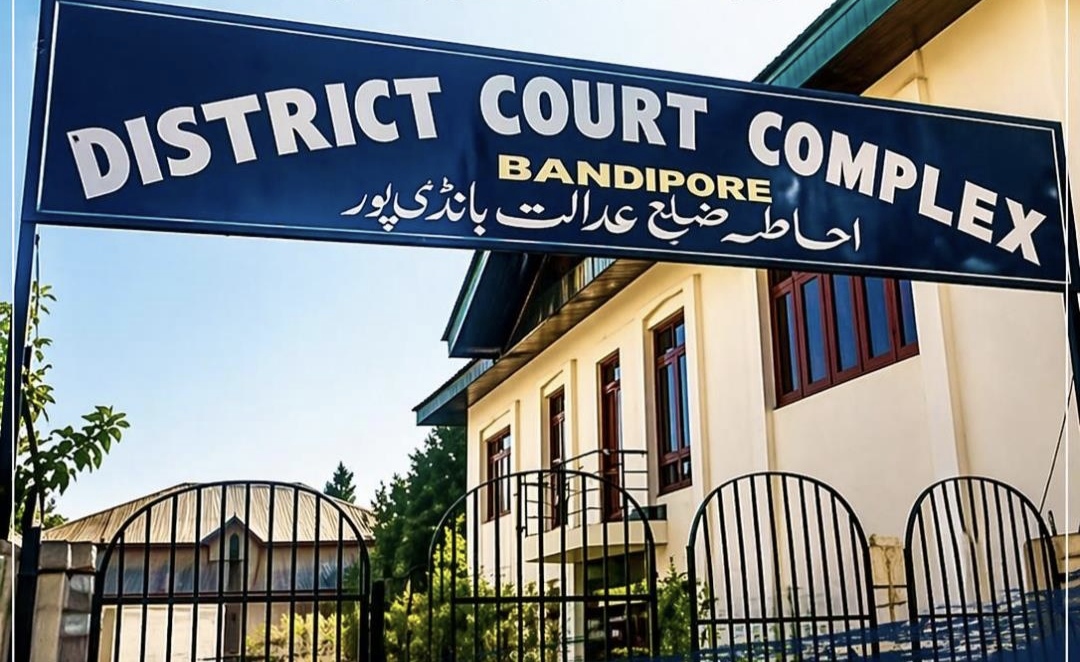
Bandipora, April 23: A local court in Bandipora on Wednesday granted bail to an under-trial accused of murdering an Ikhwan Commander Abdul Rashid Parray alias Billa in 2017.
Additional District and Sessions Judge Mir Wajahat granted bail to the accused Aiyaz Ajmad Sofi in the murder case, citing prolonged incarceration of nearly eight years, absence of strong corroborative evidence, and violation of the constitutional right to a speedy trial.
The Court directed that the accused be released on bail upon furnishing a personal bond of Rs 1 lakh along with two local sureties of the same amount to its satisfaction. It further ordered that the accused must surrender his passport, if any, within 48 hours of release and shall not leave the Union Territory of Jammu and Kashmir without prior permission of the court.
On April 16, Billa was shot dead by suspected terrorists near his residential house. He was also wanted in connection with a number of murder cases including the massacre of seven civilians at Saderkote in Bandipore in 1996.
Police had registered an FIR No. 22/2017 at Police Station Hajin under Sections 302 and 120-B of the Ranbir Penal Code read with Sections 7/25 of the Arms Act.
While granting bail court took into account the nature of the allegations—described as a criminal conspiracy resulting in murder—and the circumstances emerging during trial, including the deceased’s background as a former Ikhwani commander with a history of violent rivalries and his alleged involvement as the main accused in a separate case concerning the killing of seven family members, the court held that the grant of bail must be accompanied by strict supervision.
The court held that Sofi had remained in continuous custody for approximately seven years and ten months, while the trial showed no immediate prospect of conclusion, with a significant number of prosecution witnesses yet to be examined.
It ruled that continued detention under such circumstances would violate Article 21 of the Constitution guaranteeing the right to life and personal liberty, including a speedy trial.
According to the prosecution case, the incident occurred on April 16, 2017, when unidentified assailants entered the residence of the deceased in Hajin, took him into a separate room, and shot him dead. The complainant, the widow of the deceased, reported that the attackers had locked family members in another room before fleeing the scene.
The court noted that Sofi, who had been working as a cable operator in the victim’s household, was not named in the FIR or in initial investigation reports, including statements recorded under Section 161 CrPC. He was arrested about 14 months after the incident, and no recovery of incriminating material was made from him.
While acknowledging the prosecution’s argument that conspiracy cases may unfold during investigation and that non-mention in the FIR is not conclusive, the court observed that the primary material linking the accused to the crime consisted of disclosure statements and alleged extra-judicial confessions of co-accused. It noted that such evidence is considered weak unless supported by independent corroboration, which was not evident at the current stage.
The court clarified that its observations were limited to a prima facie assessment required at the bail stage and would not affect the trial proceedings or determination of guilt.
The judge observed that bail is intended not only to secure the accused’s presence during trial but also to ensure that the liberty granted is not misused in a manner that could affect public order, community safety, or the fairness of proceedings. “The liberty of the petitioner must be accompanied by a measured regime of supervision that ensures it is not misused,” the court said.
On the issue of delay, the court highlighted that out of 29 listed prosecution witnesses, a substantial number remained to be examined. It observed that the trial had progressed slowly over nearly nine years and was unlikely to conclude in the near future.
Referring to established legal principles, the court reiterated that bail is not intended to serve as pre-trial punishment and that prolonged under-trial detention without timely conclusion of trial undermines constitutional guarantees. It noted that even in serious offences, the gravity of charges alone cannot justify indefinite incarceration.
The prosecution’s concerns regarding possible witness intimidation and absconding were addressed through stringent bail conditions. The court noted that no material had been placed on record to show any attempt by the accused to tamper with evidence or influence witnesses during his custody.
The court imposed additional conditions, including mandatory monthly reporting to the Station House Officer of Police Station Hajin, disclosure of all mobile devices, and prior intimation before leaving Bandipora district. He has also been barred from contacting prosecution witnesses or engaging in any unlawful activity.
The SHO has been directed to monitor compliance and submit periodic reports to the court every three months. The court further instructed the prosecution to ensure expeditious production of witnesses in the ongoing trial, warning that unnecessary adjournments would not be entertained.


Comments are closed.