

Malik Nazir
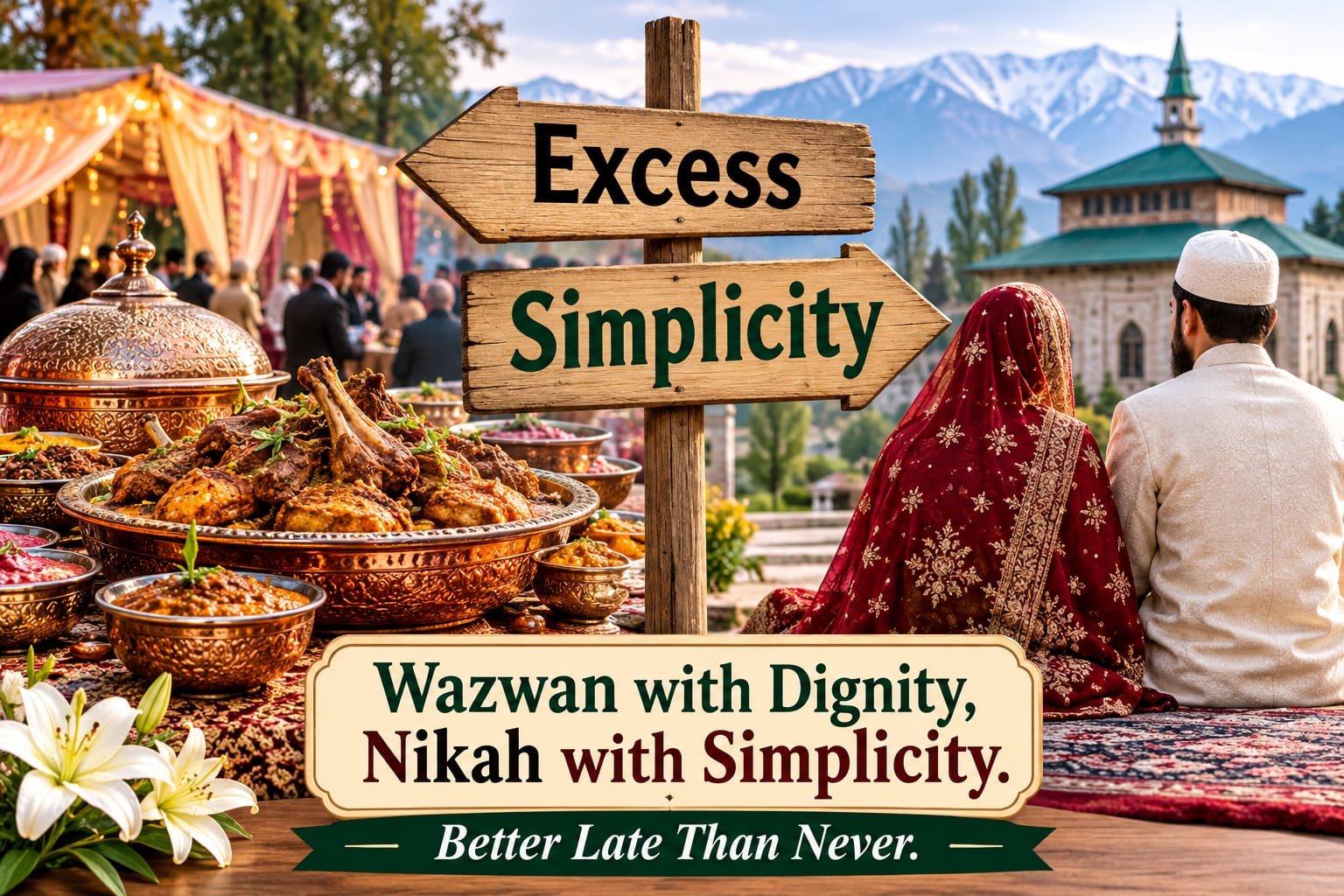
Reform must not remain confined to press briefings, public announcements or religious sermons. Let marriages become a true union of souls rather than a burden on shoulders. Let Wazwan retain its cultural dignity without becoming a competition in extravagance, and let simplicity be celebrated rather than ridiculed.
There is an old proverb that aptly captures the moment Kashmir finds itself in: better late than never. The recent decision by the president of the Waza Association to regulate the service of Wazwan by fixing a deadline, curbing excessive dishes, issuing clear instructions to staff and assistants, and setting a definite time for the feast is a welcome and mature step. It has come late, but reform delayed is not reform denied.
The president did not simply issue a diktat. He sat with fellow professionals, discussed the matter and then took the public into confidence through a press briefing. Meaningful change begins with community consensus and clear communication.
People are tired of unnecessary rituals, yet few dare to break away from them. The host who trims the menu fears gossip, while the guest who leaves early fears being misunderstood. A collective decision, backed by the association of chefs, can remove this apprehension. If implemented sincerely, it may achieve what individual courage has failed to accomplish and quietly pave the way for change.
Yet even a welcome decision can have a flaw, and honesty demands that we acknowledge it. During the press briefing, the president was heard attributing certain excesses, including the preparation of weapon-shaped dishes, to village chefs. The remark carried an unnecessary undertone of regional prejudice. It would have been better to criticise the trend rather than associate it with a particular area. Excessive dishes, showmanship and waste are not the monopoly of any village or city. They are manifestations of a culture of display. Giving a social problem a geographical identity risks dividing the very people whose cooperation reform requires.
Once, while driving inside a mechanical car park in Lal Chowk, I had to blow the horn at a handcart puller, a man of my father’s age, as he could not hear me otherwise. Instead of moving aside, he looked at my vehicle’s number plate and remarked that villagers sell their land to buy cars, adding a jibe at banks that provide vehicle loans. My necessary gesture was apparently seen as an affront to his urban pride. I smiled and moved on.
That incident returned to mind last week when I heard similar sentiments from the president of the Waza Association. It is unfortunate that some still invoke the divide of “Gaam and Shahar” over ordinary social matters. Whether urban or rural, the problem is the same, and so is the solution.
In the same spirit, initiatives taken by some prominent religious clerics including grand mufti deserve appreciation. Their announcement of Nikah timings, appeal for simple marriages, suggested timeline for the ceremony and advice against attending weddings after Isha prayers are encouraging. Marriages that stretch well past midnight are accompanied by extravagance are a reminder of how deeply social customs can overshadow the very purpose of a sacred occasion. Such initiatives are timely reminders that the dignity of a marriage lies in its simplicity and blessings, not in the hours spent celebrating or the money spent displaying wealth.
What begins as a regulation can become a social norm, and what seems burdensome today may become an ease for the next generation.
Rules alone cannot bring this change. Each of us must act as responsible citizens. We must respect these initiatives, refrain from mocking a host who serves fewer dishes, and appreciate a family that solemnises its daughter’s marriage before Isha prayers.
All schools of thought should endorse these views on marriage austerity, timely ceremonies and restraint in the number of Wazwan dishes. It is achievable if we collectively resolve to make it happen.
The growing number of unmarried men and women in Kashmir is a matter of serious concern. The crushing financial burden of Kashmiri weddings is one reason that deserves honest introspection. Lavish ceremonies, excessive demands and social expectations have turned a joyous occasion into a financial challenge for many families.
Reform must not remain confined to press briefings, public announcements or religious sermons. Let marriages become a true union of souls rather than a burden on shoulders. Let Wazwan retain its cultural dignity without becoming a competition in extravagance, and let simplicity be celebrated rather than ridiculed.
Comments are closed.