
The Journey of Hope
(A story of a young man who finds his way from the darkness of failure to the light of success, discovering the value of hard work, hope, history, and every person's contribution.)


Usuf Mir
He now knew that looking straight ahead was not always enough to reach one’s destination. Sometimes, one must learn from the past, read about the achievements of those who came before, and value the efforts of others. He glanced back once at his office building, then continued walking with the young man.
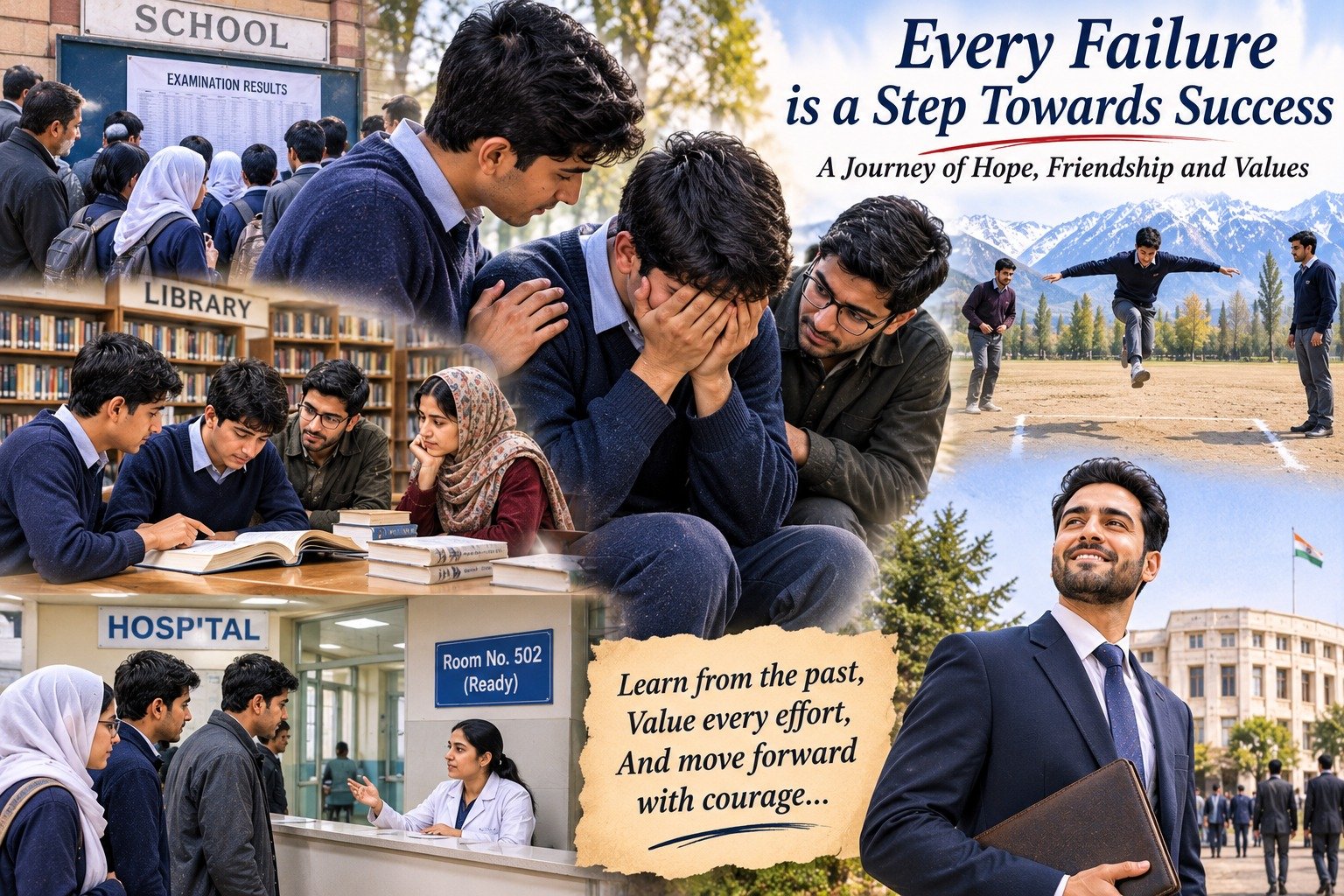
It was the morning of 15 October. An unusual crowd had gathered outside the school. Students, parents and teachers all wore anxious expressions. The examination results were to be announced that day. The marks cards were to be displayed on the school wall, and everyone was eager to know whether they had succeeded or failed.
Strangely, despite the large crowd, a silence hung in the air. Now and then, a child’s voice could be heard, or the sound of a parent’s footsteps. Suddenly, the crowd pressed closer to the wall. Every student was searching for their name and roll number.
Some faces lit up with joy. Some students congratulated their friends. But on other faces, disappointment was slowly taking hold.
Sajid stood before his marks card. He looked at it once, then again. He could hardly believe his eyes. His marks were very low. He had failed the examination.
He said nothing to anyone. He quietly walked away and headed home. After that day, he did not return to school.
Two days passed, then three, then four. Sahil and Majid began to notice that Sajid was neither attending school nor answering anyone’s calls. They tried to contact him several times, but received no reply.
One day, Sahil said to Majid,
“It’s not right for Sajid to disappear like this. Where could he be?”
Majid replied,
“I’ve called him many times too. I haven’t even been able to speak to his family. We should go to his house ourselves.”
They gathered a few other classmates and went to Sajid’s home.
When the door opened, Sajid’s mother stood before them. The moment she saw the boys, her eyes filled with tears. She took them inside and said, weeping,
“My children, perhaps only you can make him understand. For the past several days, he has shut himself in his room. He hardly eats and refuses to speak to anyone. He just lies under his quilt. We are terribly worried.”
She led them to his room.
Sajid was lying on the bed, covered with a quilt. Even when he heard his friends’ voices, he did not move.
Sahil gently approached him and lifted one corner of the quilt.
“Sajid! We’ve come to see you. At least look at us.”
Sajid turned his face away.
Majid stepped forward and pulled the quilt back. Sajid hid his face in his hands, and tears began to roll down his cheeks.
“I can’t face anyone. Everyone has passed except me. I failed. I will never go back to school.”
Sahil placed a hand on his shoulder.
“Failing one examination doesn’t make a person a failure, Sajid! Your journey through life has hardly begun, and you’ve already given up?”
Majid embraced him and said,
“We are your friends. We stood by you when you succeeded, and we stand by you now that you’ve failed. Come on, get up and come with us.”
After a long effort to comfort him, Sajid finally got out of bed. His friends took him outside and led him straight to an open field.
At one end of the field, Sahil marked two points about five feet apart.
Sajid looked at them in surprise.
“What are you doing?”
“Nothing much,” Sahil replied. “I just want you to do something. Try to jump across the distance between these two marks.”
Sajid looked from one mark to the other.
“I can’t do that.”
“Just give it a try.”
Sajid took a small step and jumped, but managed to cover barely a foot. He tried again and reached about two feet, but he still could not cross the five-foot distance.
Sahil said,
“Now move a little farther back.”
Sajid stepped back five or six feet. He ran forward and jumped. This time he covered more distance than before, but still fell short of the mark.
Sahil said,
“Move farther back.”
Sajid went back again. Sahil signalled to him to start running from a greater distance. Sajid began to run, gathered speed and leapt with all his strength. This time, he crossed the five-foot gap.
He was surprised himself.
Majid laughed and said,
“See! You have done what you thought was impossible.”
Sajid looked down at his feet and then asked Sahil,
“But what has this got to do with my failure?”
Sahil replied,
“Not everything becomes clear at once. Sometimes, to move forward, a person has to take a few steps back. That doesn’t mean defeat. It means preparing oneself for the next move. You, too, should look back at your life, understand your weaknesses, read about the achievements of those who came before us, and then move forward with renewed strength.”
Majid said,
“Come on. Let’s take you somewhere else today.”
The three friends reached the school library. Books on many subjects lined its shelves. Sahil took out a few books on history and biographies, while Majid picked up books about scientists and inventors.
Turning the pages of one book, Sajid remarked,
“These people really achieved remarkable things. Some became scientists, some made their mark in medicine, others opened new paths in engineering, while some influenced the world through literature and learning.”
Sahil said,
“That is why we should read about our predecessors. Their lives show us the difficulties they faced, how hard they worked, and how they earned recognition through their achievements.”
Sajid asked,
“But all this belongs to the past. How can it help us today?”
Closing the book, Sahil replied,
“History is not limited to events that happened hundreds or thousands of years ago. What happened yesterday is history today, too. A person who achieved something remarkable yesterday can be just as inspiring to a child today as someone who lived a thousand years ago. If an ordinary student from a disadvantaged area, in our own time, works hard and becomes a senior officer, a scientist or a successful person in any field, that person can become an example for generations to come.”
Majid added,
“And success does not mean becoming only a doctor or an engineer. Someone can become a good teacher, a farmer, a journalist, a pilot, an architect, a writer or a scientist. Everyone can move forward according to their own abilities and interests.”
Sajid listened quietly. The disappointment that had once filled his face was beginning to fade.
Just then, one of Sahil’s friends said,
“Come on, let’s leave now.”
They returned the books to their shelves, left the library and started walking home.
On the way, one of their friends suddenly complained of chest pain. At first, he thought it was something minor, but within a few moments the pain grew worse. The boys became alarmed and rushed him to a nearby hospital.
At the hospital, Saila, one of Sahil’s friends, joined them.
They learned that a well-known cardiologist treated patients there. When Sahil mentioned the doctor’s name, Sajid immediately said,
“I’ve read about this doctor on the internet. He is a very famous cardiologist. People praise his skill and experience.”
They went to the reception desk and asked to see the doctor.
The woman at the desk told them that the doctor was not seeing patients in his usual room that day.
Sajid asked,
“Why? Is the doctor on leave today?”
The woman explained,
“No, the doctor is in the hospital, but the cleaning staff have staged a symbolic protest against the administration. They have left a few rooms in one particular block uncleaned to draw attention to their problems and to the importance of their work. As a result, the doctor’s usual room could not be made ready.”
Sajid asked in surprise,
“But how can the cleaning of one or two rooms affect the work of such a renowned doctor?”
Before Sahil could reply, he glanced towards Saila. Saila said,
“That is an important lesson in life, Sajid! The doctor has spent years studying. He has skill, experience and fame. But he, too, needs a clean and safe environment to do his work. Cleaning is not an insignificant job. If the person responsible for cleaning does not do the work properly, even the greatest doctor cannot perform his duties as he should.”
Just then, the woman informed them that Room No. 502 was clean and ready. The doctor could examine the patient there.
The friends took their companion towards Room No. 502. A little later, the doctor arrived, examined the patient and gave the necessary instructions.
Sajid watched everything quietly.
On the way back, he said to Sahil,
“Today I’ve understood that a person’s worth is not measured only by their position or fame. Everyone’s work is connected, in one way or another, to someone else’s work.”
Sahil smiled and replied,
“Exactly! Whether someone is a doctor, a teacher, a farmer or a cleaning worker, everyone has a responsibility. What truly matters is how honestly and conscientiously a person performs their duty.”
When Sajid returned home that day, many thoughts were moving through his mind. He remembered the two marks in the field. The books he had seen in the library and the incident at the hospital were fresh in his memory too.
He said to his mother,
“Mother, I will go back to school tomorrow.”
His mother looked at him in surprise. Tears of happiness filled her eyes. She placed her hand on his head and embraced him.
The next day, Sajid returned to school. Some students were surprised to see him, but he paid no attention to them. He went to his classroom and met his teacher.
This time, he decided to understand his mistakes. Whenever he failed to understand a lesson, he asked questions. He worked through difficult problems again and again. He began to value his time. He set aside separate hours for games, reading and studies. He now understood that wishing for a destination was not enough; reaching it required continuous effort.
Days passed. Months turned into years. Sajid’s hard work began to bear fruit. He retook his examinations and passed. He continued his education, choosing a path suited to his interests and abilities. Instead of being afraid of failure, he began to treat every difficulty as a new experience.
In time, Sajid completed his higher education and, through hard work, ability and honesty, rose to an important government position. People came to know him not merely by his title, but by the way he worked. He treated his staff with respect, listened to their concerns and valued every person according to the responsibility they carried.
One day, a young man came to his office. He held his marks card in his hand, and disappointment was written all over his face.
He said to Sajid,
“Sir, I have failed my examination. I no longer feel like studying. I think I will never be able to achieve anything in life.”
Sajid remained silent for a few moments. Then he looked at the young man and asked,
“Have you ever been to a field where two marks are placed five feet apart?”
The young man looked surprised.
“No, sir.”
A faint smile appeared on Sajid’s lips.
He remembered his own past: that same fifteenth of October, the school wall, the marks card, the tears in his mother’s eyes, the affection of his friends and the two marks in the field. Everything came rushing back to him.
He said to the young man,
“Come with me. I’ll take you somewhere and show you a small lesson.”
He rose from his chair and walked out of the office with the young man.
His feet were moving forward, but his mind was filled with that scene from years ago, when he had first crossed the five-foot distance.
He now knew that looking straight ahead was not always enough to reach one’s destination. Sometimes, one must learn from the past, read about the achievements of those who came before, and value the efforts of others. He glanced back once at his office building, then continued walking with the young man.
The journey of hope was still going on…
“Sometimes, to move forward, a person has to take a few steps back. That doesn’t mean defeat. It means preparing oneself for the next move. Looking back, understanding our mistakes and learning from experience can give us the strength to move ahead.”
Comments are closed.