

Sheikh Fiza
Across three decades, the cost to Kashmir has been a large number of women with fewer qualifications and fewer options than they might have had. Getting those girls back into classrooms, and keeping them there, is one of the most practical ways to start repairing that.
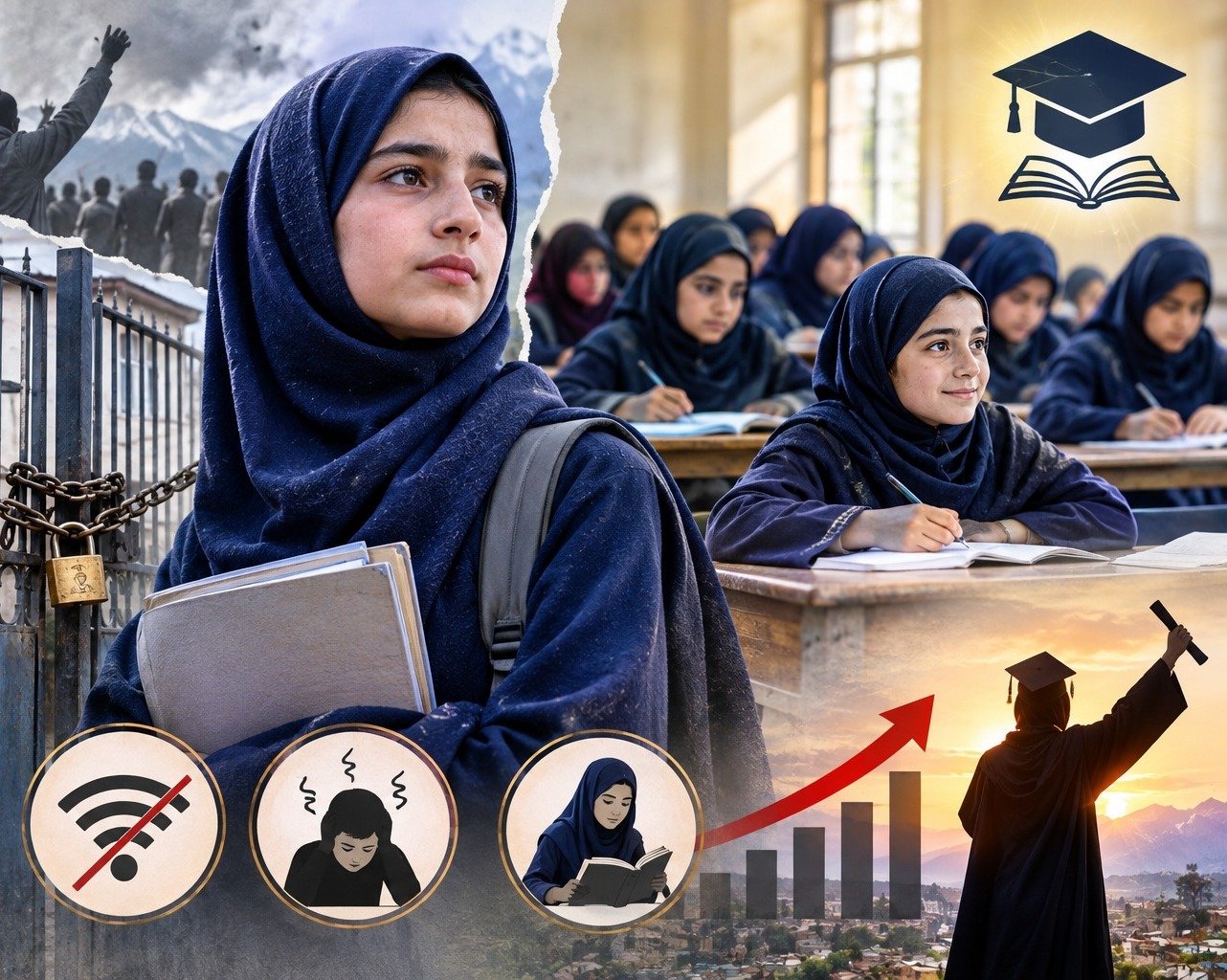
Ask almost anyone who went to school in the Kashmir Valley over the past thirty years, and they will have a story about a closed gate, a postponed exam, or a term that never quite happened. Unrest, curfews, strikes, and shutdowns have repeatedly broken up the school calendar. Every child has felt that. Girls have felt it longer.
Time that never came back: The simplest way to see the damage is to count days. Reporting based on US State Department findings describes constant school closures as part of the long-running conflict. In 2016, more than 300 schools were closed, and for the year as a whole, they were open for only about four months on average. Nobody can learn a full syllabus in a third of the year. Teachers rush through chapters, exams get moved, and now and then a whole session is written off.
The buildings and facilities have also slipped. Classes are more crowded than they used to be, and sanitation systems in schools have worsened. Parents see this. A school that feels cramped or unsafe is an easy thing to give up on, and families often give up on a daughter’s place first.
What fear does in a classroom: Some of the harm never appears in a register. Children who grow up around constant tension bring it with them to school. Reports describe a significant impact on the mental health of students, and most schools have nobody trained to help. A child who is worried about a parent, or who has lost a relative, is not going to take in a lesson just because the doors are open.
The numbers from the 1990s: One of the clearest studies looks at the early 1990s. The researcher compared people who were of school age during the worst years with people who had finished school before that period, and with people in quieter parts of Jammu and Kashmir.
For girls, the result was large: girls in urban Kashmir had up to 3.5 years less schooling than girls in less affected regions. Boys and girls in the hardest-hit areas were both less likely to start or complete primary school, though girls lost more. The author’s suggestion was to run literacy and job programs for the women who missed out.
Kashmiri writers have described what this looked like at ground level. A girl would go on “leave”, then another, and eventually the school would close. In many homes, uncertainty settled the question without anyone formally deciding it.
Why it falls harder on girls?
Mostly, it comes down to getting around. Researchers who study the region say long-running unrest can narrow women’s access to public spaces and strengthen traditional gender roles. When a curfew can be announced at short notice, even a short walk to school becomes a gamble.
The 2023 Status of Education Report says these limits affect women far more than men, and researchers point to curfews and worries about personal safety as major reasons. If a family is nervous about a daughter’s journey, she is usually the one who stays home, while her brother’s schooling carries on.
This is not entirely new. Kashmir already had one of the lowest literacy rates for women in India, partly because boys’ education was prioritised. The unrest did not invent that gap, but it made it wider and harder to close.
After 2019: no internet, no classes. In August 2019, communication restrictions added another problem. The first internet shutdown lasted about seven months, the longest in any democracy. Online lessons were impossible, students could not reach study material, and many could not complete exam registrations, so academic years were effectively lost.
Women in higher education described their own set of difficulties. A study of female PhD scholars at five Kashmiri institutions found that sudden curfews and network outages directly compromised their studies. Some put their degrees on hold, some left, and a few changed fields altogether.
Where things stand now?
The recent figures show the problem has not gone away. Official numbers from 2020 put female literacy at 58 per cent, compared with 78 per cent for men. The Status of Education Report 2023 found 5.5% of girls aged 14 to 16 in Jammu and Kashmir entirely out of school. And figures presented to India’s parliament in March 2026 show the girls’ secondary dropout rate peaked at 12.6% in 2023–24, above the national average of 9.6%.
It is worth being careful here. Dropout is shaped by poverty, the quality of teaching and family circumstances as well, so these numbers can’t be pinned on one cause. Still, the pattern is what researchers have been describing for years.
What could change it?
Keeping schools open is the minimum. Beyond that, a few things would make a real difference: dependable internet so lessons can continue during disruptions, safe and predictable routes to school and college, counsellors in schools, catch-up classes for children who have fallen behind, and some outreach to parents so that families feel confident about sending daughters out each day. None of this is complicated to describe. The harder part is sustaining it over years rather than months.
Why it matters?
A girl who finishes school tends to change things around her, from her own earnings and choices to what her family expects of the next generation. A girl who leaves early takes that possibility with her. Across three decades, the cost to Kashmir has been a large number of women with fewer qualifications and fewer options than they might have had. Getting those girls back into classrooms, and keeping them there, is one of the most practical ways to start repairing that.
Comments are closed.