
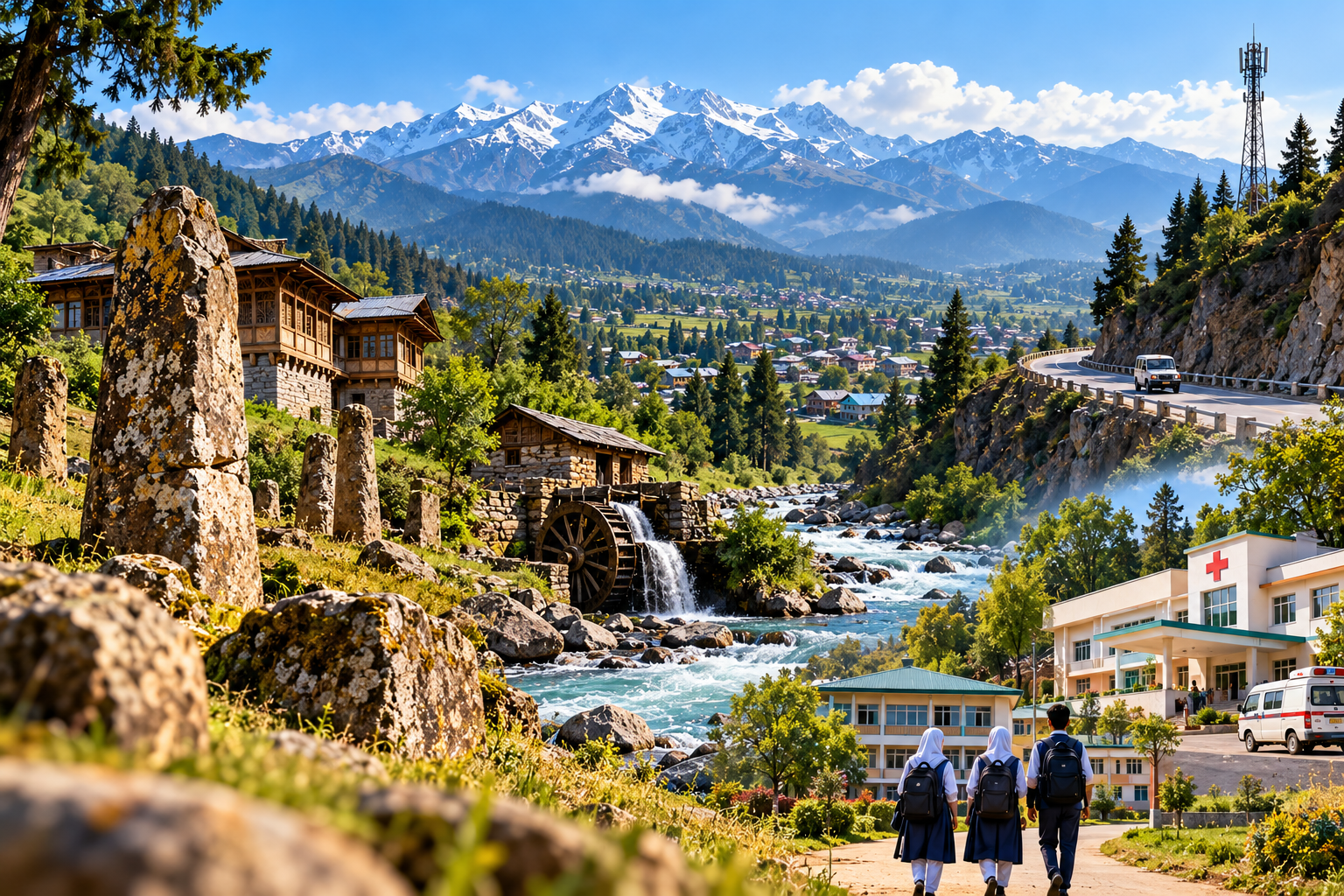
Kupwara: A District Waiting for Its Promise to Be Fulfilled
Heritage, healthcare, education and livelihoods: why the district’s potential still awaits delivery

Umeed Rashid
“Kupwara has considerable potential for cultural preservation, economic growth and public development. The pressing question is why so much of that potential remains insufficiently realised.”
There are places whose importance is immediately apparent on a map, and there are places whose true significance emerges only when one begins to understand their people, their history and the burdens they have carried across generations. Kupwara belongs to the latter. The district possesses considerable potential for cultural preservation, economic growth and public development.
The pressing question is why so much of that potential remains insufficiently realised. A road that remains difficult to traverse, a medical facility unable to provide essential treatment or a student whose ambitions are restricted by inadequate educational resources represents a gap between the promise of public service and its actual delivery. Development acquires meaning when it changes these realities.
One of its advantages is a historical inheritance that deserves far greater scholarly attention. The past of Kupwara remains incompletely documented, and reports concerning several archaeological and religious sites suggest that its history may be considerably richer than its public profile indicates. The megalithic menhirs associated with Laderwan invite questions about ancient communities and their practices.
Reports of ninth-century bronze objects linked to the Utpala period in the Zurhama corridor warrant careful examination. The reported subterranean khanqah at Shah Nagari in Mawar also deserves investigation, as do accounts of a temple, a Sufi shrine and a shared spring at Tregham. These claims must be verified through proper archaeological and historical research.
Kupwara therefore needs a systematic survey of its historical sites, supported by the relevant government departments and academic institutions. The findings should be documented and made accessible to researchers and the public. Where protection is warranted, it must be accompanied by proper conservation rather than the occasional official visit.
The district’s traditional architecture deserves similar consideration. Taq construction and Dhajji Dewari techniques, associated with parts of the region including Keran and Teetwal, embody accumulated knowledge about local materials and the demands of the climate. Traditional watermills, known locally as aab-e-grata, preserve another aspect of community ingenuity.
Reports concerning the deterioration of the Khumriyal Guest House also call for a clear assessment of its condition and future. Preserving heritage is not an exercise in nostalgia. It can strengthen education, encourage research and create opportunities for local enterprise.
The essential requirement is credibility. Kupwara’s history should be investigated with intellectual seriousness, free from exaggeration and protected from the neglect that so often deprives communities of their inheritance.
This is also where the district’s tourism ambitions deserve a more practical foundation. Kupwara has considerable scope to develop tourism around its cultural and historical resources. People need reliable information before travelling, safe and maintained access routes, suitable accommodation and basic public facilities.
Waste management and environmental protection must be built into planning from the beginning. Tourism should create livelihoods that endure beyond a particular season. With appropriate training and support, residents could establish homestays or work as local guides.
Small enterprises could offer regional food and handicrafts, giving visitors a better understanding of the district while allowing more income to remain within local communities. Any expansion must also respect the environment and the rights of people whose homes and livelihoods are affected by tourism projects.
The question of infrastructure is central to this ambition. Connectivity determines whether people can reach essential services and whether businesses can operate beyond their immediate surroundings. In a district where weather and terrain can complicate travel, road maintenance requires particular care.
A route is of little practical value if its condition makes everyday journeys unreliable or emergency access difficult. The same principle applies to digital connectivity. Internet access has become an important condition of educational opportunity and economic participation. Poor coverage can leave remote communities at a disadvantage even when digital services are formally available to them. Identifying coverage gaps and improving access should therefore be part of the district’s development planning.
Healthcare demands even greater urgency. Illness places families under enormous strain when treatment is difficult to obtain locally. The district needs medical facilities that can provide dependable primary care and respond effectively to emergencies.
This requires qualified personnel, essential medicines and functioning diagnostic equipment. A hospital building alone cannot meet these needs if the services inside it remain inadequate. Maternal care and paediatric treatment must be accessible, while mental health deserves recognition as an essential part of public healthcare.
Where specialist treatment is unavailable, referrals should be organised efficiently so that patients are not left to navigate an unfamiliar system at their most vulnerable moment. Emergency transport must be dependable, especially for communities facing longer journeys to medical facilities.
Education carries equally profound consequences for Kupwara’s future. Its young people deserve schools that cultivate understanding and colleges that prepare them for a changing world. That requires competent teaching, adequate laboratories and libraries, and access to modern learning resources.
Vocational training could connect education with fields such as information technology, agriculture, tourism and healthcare support. Such programmes must be designed around genuine employment prospects rather than offered simply to satisfy administrative targets. Scholarships and reliable transport can make a meaningful difference, particularly for students from disadvantaged households. Girls must have safe and practical access to continued education.
Employment remains one of the most important tests of whether development is reaching the population. A stronger local economy requires small businesses that can grow, skilled workers who can find meaningful employment and entrepreneurs who can obtain support without being overwhelmed by unnecessary obstacles.
Access to credit and reliable electricity matters to a new enterprise as much as formal encouragement does. Training programmes should be judged by whether participants acquire useful skills and find work, while public schemes must be administered transparently.
Agriculture offers considerable scope for strengthening this economic base. Walnuts hold an important place in Kupwara’s agricultural identity, but farmers could benefit from greater investment in processing, grading, packaging and access to wider markets.
Selling raw produce often leaves cultivators with limited control over the value ultimately earned from their work. Horticulture, beekeeping and suitable livestock enterprises may offer opportunities in appropriate areas, provided farmers receive practical guidance and there is a realistic market for what they produce.
These ambitions depend upon the quality of basic public services. Reliable electricity and clean drinking water are fundamental to households, schools, hospitals and commercial activity. Sanitation and drainage require regular attention, while waste disposal must be organised in ways that protect settlements and water sources. Infrastructure frequently attracts attention when a project begins, but its long-term value depends upon maintenance.
Poorly planned construction and careless waste disposal can place lasting pressure on the surrounding environment. Tourism and infrastructure projects should therefore be assessed for their ecological consequences before irreversible damage occurs. Local residents need a meaningful role in reporting environmental concerns, and the authorities must respond when regulations are breached.
The social life of Kupwara deserves investment as well. Young people need accessible sports facilities where talent can be developed through regular coaching and competition. Libraries and cultural spaces can encourage reading, discussion and creative expression. Access to recreation and culture is part of a district’s quality of life, not a luxury to be considered only after every other project has been completed.
For these priorities to become reality, governance must be more transparent and responsive. Residents should be able to learn how public funds are being spent and when promised projects are expected to be completed. Public consultation must influence decisions rather than serve as a formality after the important choices have already been made.
Kupwara’s frontier location and geographical circumstances must also inform public planning. Preparedness cannot begin only when a crisis arrives. It must form part of the ordinary responsibilities of administration.
Kupwara has an inheritance worthy of preservation and a population entitled to a future of greater opportunity. The measure of Kupwara’s progress will ultimately be found in the ordinary experiences of its people. It will be seen in a patient who receives timely treatment, a student who can pursue an ambition without unnecessary barriers, a farmer who earns a fair return and a young entrepreneur who can build a viable future at home.
It will also be found in the survival of a historical site that might otherwise have disappeared from public memory. The responsibility now lies in ensuring that the promise of the district becomes a reality for the people who have sustained it through generations.
“The measure of Kupwara’s progress will ultimately be found in the ordinary experiences of its people. It will be seen in a patient who receives timely treatment, a student who can pursue an ambition without unnecessary barriers, a farmer who earns a fair return and a young entrepreneur who can build a viable future at home.”
Comments are closed.