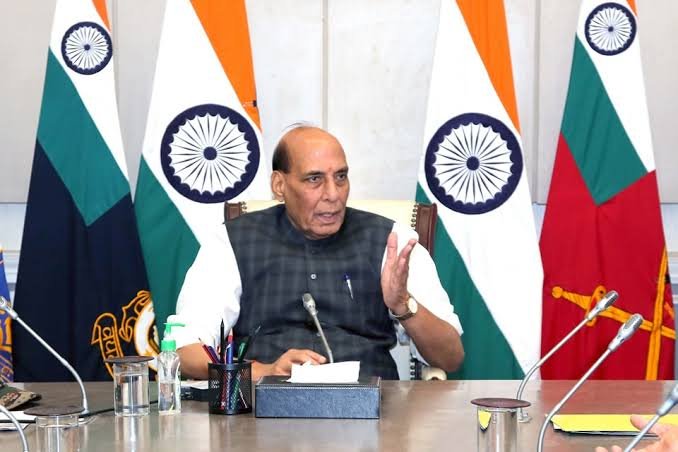
New Delhi, September 27: Defence Minister Rajnath Singh on Sunday said India believes in peace and does not seek to occupy the territory of any country, but would safeguard its security and strategic autonomy when threatened.
Addressing a Defence Conclave in New Delhi, Singh said India seeks global stability without compromising its strategic autonomy. He also said there could be no scope for dialogue with countries that promote terrorism against India, adding that nations supporting terrorism must be made to understand that it cannot be used as a strategic instrument.
Emphasising national unity as a component of national security, Singh said the responsibility for the country’s security was not limited to the armed forces but was shared by every citizen. He called for rising above divisions based on religion, caste, language, region and other identities and placing national interest above narrow interests.
The Defence Minister described India as a civilisational power and highlighted its approach based on democratic and civilisational traditions, “Vasudhaiva Kutumbakam” and “Sabka Saath, Sabka Vikas”. He also highlighted India’s engagement with countries of the Global South and initiatives such as Vaccine Maitri and the Voice of Global South Summits.
On defence self-reliance, Singh said India’s defence exports had increased from Rs 686 crore in 2013-14 to Rs 38,424 crore in 2025-26, with Indian defence products being exported to more than 100 countries. He said the government has set a target of Rs 50,000 crore in defence exports by 2029.
He said the defence allocation had risen to Rs 7.85 lakh crore in 2026-27 from around Rs 2.53 lakh crore in 2013-14. Around 75 per cent of the capital acquisition budget, amounting to Rs 1.39 lakh crore, has been earmarked for procurement from the domestic defence industry, according to the Ministry of Defence.
Singh said the nature of warfare was changing with the increasing importance of cyber, space, electronic and information warfare, along with technologies such as artificial intelligence, drones, autonomous systems, quantum technology and hypersonic systems.
He highlighted steps being taken towards indigenisation, including 509 defence equipment, weapon systems and platforms included in five positive indigenisation lists of the Armed Forces. DPSUs have also identified 5,417 items for indigenisation, of which around 3,300 have been indigenised, he said.
The Defence Minister said India’s defence ecosystem now includes DPSUs, private companies, startups, MSMEs, universities and research institutions. He said investment proposals worth about Rs 70,000 crore had been received in the Uttar Pradesh and Tamil Nadu Defence Industrial Corridors, with around Rs 10,000 crore already invested.
Singh also highlighted the SRIJAN and SRIJAN DEEP portals aimed at supporting import substitution and indigenous defence manufacturing. According to the Ministry, around 33,000 imported items have been identified for import substitution through SRIJAN, with approximately 15,700 subsequently indigenised.
He said the iDEX and iDEX-Prime programmes were supporting startups and innovators in the defence sector. As of March 2026, 676 startups and innovators had been engaged through iDEX and 551 contracts signed, while procurement worth more than Rs 2,400 crore had been approved from startups and MSMEs.
A major announcement at the conclave was the decision to transfer DRDO-developed technologies for conventional missile systems to eligible Indian industries, allowing qualifying private companies to undertake production.
Singh said the move would strengthen the preparedness of the armed forces and facilitate timely delivery of missiles, while allowing DRDO to focus increasingly on research and development and industry to take a larger role in production.
He said the government’s objective was to develop indigenous capabilities across the defence spectrum, from individual components to complete weapon systems, to strengthen strategic autonomy and reduce dependence on imports.


Comments are closed.