NEW DELHI, SEPTEMBER 26: The Election Commission of India (ECI) on Saturday extended the deadline for filing claims and objections under the Special Intensive Revision (SIR) of electoral rolls in Delhi and Maharashtra, while directing field officials to facilitate document collection from electors who have received notices for being unmapped or having logical discrepancies.
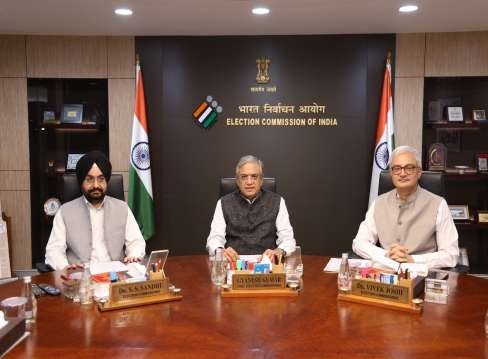
In a statement issued to Kashmir Convener on Saturday, an official spokesperson of ECI said the Commission, at a meeting held on September 26 (Saturday), extended the period for filing claims and objections in Delhi till October 30, 2026, and the deadline for disposal of notices, claims and objections till November 30, 2026.
In Maharashtra, the deadline for filing claims and objections has been extended till October 12, 2026, while the period for disposal of notices and claims and objections has been extended till November 10, 2026.
According to the statement, the Commission said that in cases where notices have been issued during the ongoing SIR to persons whose records are unmapped or contain logical discrepancies, Booth Level Officers (BLOs) will visit their homes to collect the required documents and upload them on the ECINet system for consideration by the Electoral Registration Officer (ERO).
Such persons need not ordinarily be called to the ERO or Assistant Electoral Registration Officer (AERO) office for a hearing, the Commission said. Hearings will be held only in exceptional circumstances as determined by the ERO, preferably through an online mode.
An adult member of the family may also be authorised by the elector to attend a hearing on their behalf, if required. The Commission said facilities for online hearings would be strengthened.
The Commission directed District Election Officers (DEOs) to establish adequate help desks and organise special camps, as required, for people living in night shelters, labourers, poor and homeless persons and other vulnerable groups.
It also said that the declaration attached to Form 6 for SIR had been upheld by the Supreme Court. Outside the SIR period, the forms applicable under the Registration of Electors Rules, 1960, will be used, it said.
On the ECINet system, the Commission said field officers have role-based access in accordance with their statutory powers. A committee headed by a Senior Deputy Election Commissioner and including an independent expert from an IIT or IIIT will review the system to verify its compliance with the applicable Acts and Rules and submit a report to the Commission.
The Commission said several upgrades to the portal had already been carried out based on inputs received from State Chief Electoral Officers in recent months. Further flexibility required by field officers would also be operationalised, it said.
It further decided that all new initiatives concerning IT modules and portals would be discussed in the Committee of Officers before being placed before the Commission for approval.
The Commission also directed that agendas for all its meetings be circulated in advance and minutes issued subsequently. Annual Performance Appraisal Reports (APARs) of all officers are to be completed within the stipulated timeframe of December 31 every year, while approval of the Commission will be required for foreign trips undertaken by its officers.
The Commission further directed that all instructions issued by the Commissioners to officers be complied with.
The ECI said SIR had already been completed in 20 States and Union Territories, including Bihar and West Bengal. It said persons whose names were left out during or after the SIR, including young and first-time voters, could apply to the concerned ERO for inclusion in electoral rolls under the process of continuous updation.
Chief Electoral Officers, District Election Officers and Electoral Registration Officers have been directed to facilitate the process and immediately launch special drives to enrol such electors, the Commission said.
The Commission also clarified that a letter sent to the Cabinet Secretary was not related to any policy matter concerning the Commission or its IT division, but concerned the functioning of an officer on deputation to the ECI.
It said work redistribution orders issued by the officer concerned were not implemented following directions from two Commissioners, and that oversight of the IT division by the Deputy Election Commissioner was never withdrawn.
The Commission said its decisions on SIR had been taken unanimously. It said the order for SIR issued on June 24, 2025, covering all States and Union Territories and beginning with Bihar, followed by West Bengal and 30 other States and UTs, had received unanimous approval of the Commission.
According to the Commission, the Supreme Court upheld the SIR order in its May 27, 2026 order. The schedule for SIR in 12 States and Union Territories was issued on October 27, 2025, while the schedule for 19 States and Union Territories was issued on May 14, 2026, both with the unanimous approval of the Commission.
The Commission said the final number of electors would be known only after final publication of electoral rolls in the remaining 12 States under Phase III.
It also cited measures in Goa, where the Chief Electoral Officer has directed BLOs to conduct house-to-house visits to voters left out of the rolls to collect their forms. Of 97 voters identified in the exercise, 81 had already submitted Form 6 for inclusion, the Commission said.


Comments are closed.