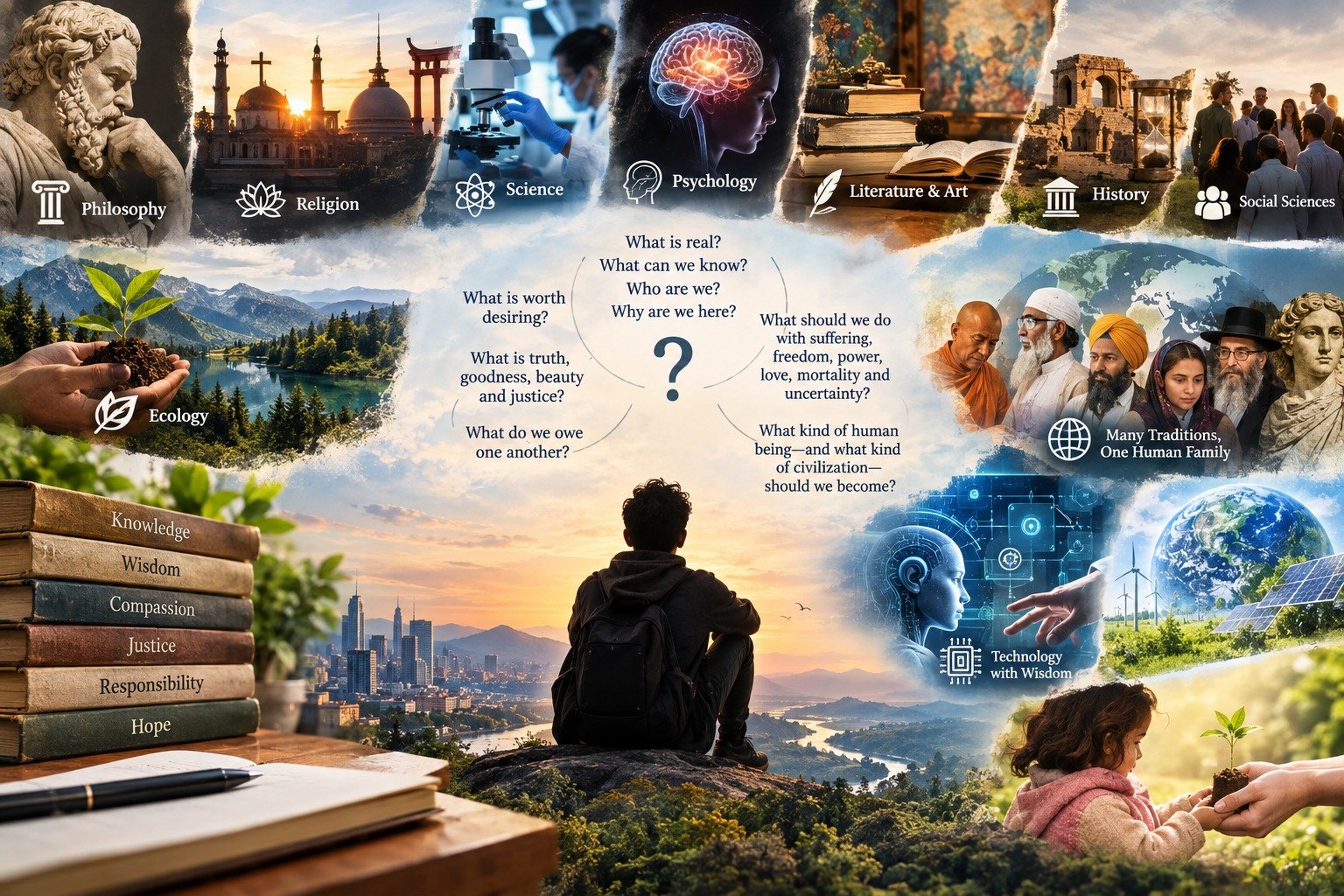
Every civilization is, in part, an answer to a set of questions: What is real? What can we know? Who are we? Why are we here? What is worth desiring? What is truth, goodness, beauty and justice? What do we owe one another, other living beings, and generations yet unborn? What should we do with suffering, freedom, power, love, mortality and uncertainty? And, ultimately, what kind of human being-and what kind of civilization-should we become?
These questions belong neither to one discipline nor to one culture. Philosophy investigates reality, knowledge, meaning, ethics and consciousness; religion asks about revelation, transcendence, responsibility and ultimate purpose; science tests what can be observed and explained; psychology studies the formation of the self, emotion, desire and behaviour; literature and art illuminate experience from within; history reveals the consequences of human choices; social sciences examine institutions, inequality, power and collective life; ecology reminds us that humanity exists within, not above, the living world. Islamic, Hindu, Buddhist, Jain, Sikh, Jewish, Christian, African, East Asian, Indigenous, Persian, Greek, and modern secular traditions, among many others, preserve different vocabularies and insights for addressing these perennial questions. None exhausts the human quest; together, critically and dialogically approached, they enlarge it.
Yet information is not wisdom, and knowledge does not automatically produce goodness. A civilization may become technologically sophisticated while remaining morally immature. It may multiply means without asking whether its ends are worthy. It may conquer distance while losing attention, accumulate wealth while deepening exclusion, and expand power while weakening responsibility. The decisive question, therefore, is not merely what humanity can know or make, but what it should love, desire, restrain, protect and become.
This makes the education of desire a central civilizational task. Human beings are shaped not only by what they understand but by what they seek, admire and consider worth possessing. Desire influences consumption, ambition, relationships, politics, economics, technology and ecological behaviour. To educate desire is not to suppress aspiration but to distinguish the merely attractive from the genuinely valuable, immediate gratification from enduring flourishing, possession from stewardship, competition from cooperation, and power over others from power exercised for the common good.
Meaning likewise cannot be reduced to pleasure, achievement or comfort. Human flourishing involves purpose, belonging, agency, relationship, character, contribution and the capacity to live responsibly amid uncertainty. Suffering complicates every easy philosophy of happiness: it can wound, distort and destroy, yet human beings can sometimes transform suffering through courage, solidarity, understanding, service and hope. Death gives urgency to life without making life meaningless; mortality invites not despair but a more serious question about what deserves our limited time.
The self, too, is neither an isolated ego nor a finished possession. We become ourselves through relationships, language, memory, culture, education, work, place and moral choice. Freedom is therefore inseparable from responsibility. Conscience must be cultivated; guilt must be capable of repentance; shame must not become humiliation; forgiveness must not erase justice; compassion must not become indifference to truth. Love, at its deepest, is not merely sentiment but a disciplined recognition of another’s dignity.
The same principle applies beyond the individual. Justice is not only a private virtue but an institutional question. Laws, economies, schools, technologies and political systems distribute opportunity, vulnerability, voice and power. A humane society therefore asks not simply whether individuals are good, but whether its structures enable human dignity, protect the vulnerable, restrain domination, cultivate trust and permit people to participate meaningfully in common life. Democracy, education, law and public institutions are ultimately moral achievements as much as administrative arrangements.
Religious traditions contribute another dimension: the possibility that reality exceeds the visible and measurable, that human dignity carries obligations deeper than self-interest, and that knowledge without humility is incomplete. At the same time, religious claims require serious interpretation, self-criticism and dialogue; secular perspectives likewise benefit from confronting questions of transcendence, ultimate value and moral grounding rather than assuming them away. Genuine pluralism is neither relativism nor uniformity: it is the disciplined practice of seeking truth while recognizing the dignity of those who understand differently.
Humanity’s relationship with the more-than-human world now makes these questions unavoidable. Climate disruption, biodiversity loss, pollution and resource pressures expose the limits of a civilization organized around endless extraction. Ecological responsibility requires a wider moral imagination-one capable of seeing nature not merely as raw material but as the living context of human existence, and future generations not merely as abstractions but as moral claimants upon the present.
Technology intensifies the challenge. Artificial intelligence, biotechnology, automation and digital systems can enlarge human capability, but capability without wisdom can magnify both benefit and harm. The central question is therefore not whether technology will change humanity-it will—but whether humanity can develop the ethical imagination, institutional safeguards and civic wisdom necessary to govern its own creations.
The deepest answers will not come from a single discipline, ideology or civilization. They emerge through an ongoing conversation among evidence and experience, reason and revelation, tradition and critique, science and philosophy, contemplation and action, local wisdom and global knowledge. Such dialogue requires intellectual humility: the willingness to distinguish certainty from probability, knowledge from assumption, conviction from evidence, and inherited wisdom from inherited prejudice.
Ultimately, life’s biggest questions are not examinations for which humanity can produce final answers. They are disciplines of becoming. They teach us to live more truthfully, desire more wisely, suffer more courageously, love more deeply, exercise power more responsibly, inhabit the Earth more humbly, and imagine futures worthy of human dignity. The measure of an answer is therefore not only whether it can be defended in argument, but whether it can be embodied in life.
The question beneath all the questions is consequently simple and inexhaustible: What is worth knowing, loving, desiring and becoming-and what kind of world do our answers create? Our answers become our character; our character becomes our relationships; our relationships shape our institutions; and our institutions, taken together, become civilization. To answer life’s biggest questions, then, is ultimately to decide-through what we believe, choose and practice-what kind of human future we are willing to make.


Comments are closed.