

How Community Cadres Are Transforming Rural India

S Ahmad


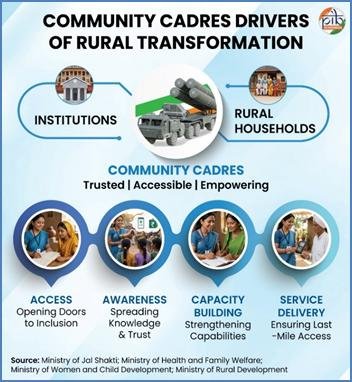
A network of trained grassroots workers forms the backbone of decentralized service delivery. These workers support the implementation of government programmes, mobilize communities, and provide timely assistance at the village level. Across the country, more than 9 lakh Community Resource Persons (CRPs), along with ASHAs, Anganwadi Workers, Swachhagrahis, Awaas Mitras, and other frontline workers, are bridging the gap between institutions and rural households.

For decades, rural development in India was largely discussed in terms of roads, houses, electricity, drinking water, sanitation, health centres, schools, banks and employment programmes. These remain important measures of development. But there is another part of the story that is often less visible: the people who stand between these institutions and the households they are intended to serve.

A government scheme may have a budget, guidelines, digital portal and administrative machinery. Yet none of these automatically guarantees that a woman in a remote village knows about the scheme, understands her eligibility, completes the documentation, reaches the appropriate institution or receives the service.

This is where India’s growing network of community cadres becomes important.

Across rural India, millions of frontline workers and community-based functionaries are increasingly serving as the human link between government programmes and rural households. They work in health, nutrition, agriculture, livestock, fisheries, banking, insurance, sanitation, water management, housing, enterprise development and social inclusion.

The scale of this network is substantial. The source material records more than 10.40 lakh Accredited Social Health Activists (ASHAs), 10.58 lakh Anganwadi Workers and ANMs, and more than nine lakh Community Resource Persons working across different areas. Nearly 4.08 lakh CRPs are engaged in agriculture, allied activities and rural enterprises, while others work in banking, financial literacy, insurance, gender awareness and community development.

These workers are more than scheme facilitators. They represent an important shift in the way rural development is being delivered.

The old model was often institution-to-beneficiary.

The emerging model is increasingly institution-to-community-to-household. That difference matters.

The Last Mile Is Human

The phrase “last-mile delivery” is frequently used in development policy. But the last mile is not merely a geographical distance between a government office and a village.

It is also a distance of information, trust, literacy, confidence, accessibility and social circumstances.

A rural woman may technically have access to a bank but still need help understanding digital transactions. A farmer may have access to an agricultural programme but require someone to demonstrate improved practices. A family may be eligible for a housing benefit but struggle with documentation and procedural requirements. A village may have a water system but need trained people who can maintain it.

Community cadres operate precisely in this space. They generate awareness, provide handholding, facilitate access to services, support documentation and link households with institutions. They also work as trainers, service providers, behaviour-change agents and scheme facilitators.

Their greatest strength is proximity.

They belong to the communities they serve or work closely with them. They understand local conditions, social relationships and practical difficulties in ways that a distant administrative structure may not always be able to do.

That proximity can make a government programme more understandable and accessible. It can also make rural development more participatory.

From Beneficiaries to Local Service Providers

One of the most significant changes is visible in the livelihood architecture created under the Deendayal Antyodaya Yojana-National Rural Livelihoods Mission.

DAY-NRLM has mobilised more than 10 crore rural households into around 92 lakh Self-Help Groups, creating one of the country’s largest networks of women-led community institutions. Alongside Village Organisations and Cluster Level Federations, more than nine lakh Community Resource Persons work across agriculture, livestock, fisheries, enterprise promotion, banking, financial literacy, insurance and social development.

This represents a deeper change in the meaning of rural participation.

Women who may once have been viewed primarily as beneficiaries of development programmes are increasingly becoming trained service providers and community leaders.

The Krishi Sakhi is a good example:More than 1.91 lakh Krishi Sakhis have been mobilised to strengthen grassroots agricultural extension, while more than 4.62 crore Mahila Kisans had been covered under farm livelihood interventions as of June 2025, supported by more than three lakh trained livelihood CRPs.

Their importance lies not simply in numbers. Agriculture is changing rapidly. Farmers need information about production practices, livestock management, markets, inputs and technologies. Government agricultural extension cannot always physically reach every household frequently enough.

A trained local woman who can explain a practice, demonstrate it and remain available for follow-up can bridge that gap.

The same principle extends to allied sectors. Around 1.70 lakh Pashu Sakhis have been mobilised to support livestock-rearing households, while more than 2,012 Matsya Sakhis are extending assistance to fisheries-based livelihoods and market access. Van Sakhis are also providing field-level support in forest-based regions.

The message is clear: rural development is gradually moving from a model in which people receive programmes to one in which communities acquire the capacity to deliver knowledge and services themselves.

The Village as a Financial Gateway

The transformation becomes even more visible in financial inclusion.

For someone living far from a bank branch, travelling to a town for a simple transaction can mean lost wages, transport expenses and considerable inconvenience. Digital banking has reduced some of these barriers, but digital access alone does not guarantee financial inclusion.

This is where Bank Sakhis and Business Correspondent Sakhis become important.

More than 1.48 lakh BC Sakhis are providing doorstep financial services in villages, including account opening, deposits, withdrawals, fund transfers and balance enquiries. More than 50,548 branch-level Bank Sakhis facilitate credit linkages, and Bank Sakhis have helped SHGs access ₹13.41 lakh crore in bank credit since 2013-14.

These figures illustrate something important: financial inclusion is not simply about opening bank accounts. It is about making the financial system usable.

The presence of a trained local intermediary can help a first-time user overcome hesitation and understand how banking works. Financial literacy then becomes an essential complement to physical and digital access.

The network of 56,727 Financial Literacy CRPs is part of this effort. During 2025-26, more than 3.81 crore women SHG members received financial literacy training covering areas such as savings, credit, insurance, pensions, enterprise financing and business correspondence.

A bank account can open a door. Financial knowledge helps people walk through it.

When Banking Becomes a Livelihood

The story of Debashree Gogoi Bora from Nagaon, Assam, illustrates another dimension of the community-cadre model.

She entered the BC Sakhi programme after being introduced to it by a neighbour. She began with basic banking transactions, subsequently obtained a Common Service Centre ID and established a Customer Service Point.

For more than five years, she has helped villagers access financial services, serving around 30 to 35 customers daily. Between April and August, she processed more than 2,500 transactions and earned a monthly commission ranging from ₹10,000 to ₹17,000.

But her work did not stop at banking. She also runs DTP, photocopying and photo-printing services, while using her home-baking skills to support local celebrations.

This is significant because it demonstrates how one community-based intervention can generate multiple forms of economic activity.

A woman who begins as a banking facilitator can become a local entrepreneur.

The community then benefits twice: first from easier access to financial services, and second from the creation of another rural enterprise. That is the kind of multiplier effect rural development policy should increasingly seek.

From Livelihoods to Enterprise

The next frontier is entrepreneurship. Rural households do not necessarily want to remain dependent on agriculture alone. Many possess skills, ideas and local resources that can become viable enterprises if they receive the right combination of training, credit, planning and market access.

Community Resource Persons for Enterprise Promotion and Udyog Sakhis are helping identify such opportunities, prepare enterprise plans, facilitate credit and establish market linkages.

Nearly 48,785 Udyog Sakhis are supporting non-farm livelihoods, while CRP-EPs provide specialised assistance under the Start-up Village Entrepreneurship Programme. As of June 2026, 4.32 lakh enterprises had been supported under SVEP. The National Campaign on Entrepreneurship is also aimed at training 50,000 CRPs on enterprise promotion and providing enterprise-development training to 50 lakh SHG members.

This has the potential to change the economic character of villages. The objective should not simply be to create more schemes. It should be to create local economic ecosystems in which skills, finance, production and markets connect.

A trained local cadre can become one of the connecting points in that ecosystem.

Health Begins Before the Hospital

The importance of community cadres becomes especially clear in health and nutrition.

A hospital or health centre is essential, but healthcare cannot begin only when a person reaches a medical facility. Awareness about maternal health, child nutrition, sanitation, immunisation and preventive care often begins at household level.

As of December 31, 2025, more than 10.40 lakh ASHAs were serving as a first point of contact within India’s healthcare system. They operate as community-based workers and receive performance-based incentives under national health programmes.

Their role is therefore not merely administrative. It is relational. The ASHA knows the families in her area. She can identify problems early, encourage families to seek appropriate services and connect them with the formal health system.

Similarly, Anganwadi Workers remain central to nutrition and early childhood care. They identify children affected by severe or moderate acute malnutrition, provide supplementary nutrition and promote behavioural change relating to breastfeeding, child feeding, hygiene and sanitation.

By March 2026, more than 10.58 lakh AWWs had been trained under efforts to strengthen early childhood care and education. This illustrates an important principle: public services become more effective when infrastructure is supported by informed and trained people who can work continuously with communities.

Sanitation Is Also About Behaviour

Few areas demonstrate this better than sanitation. Building toilets is important. But sanitation becomes sustainable only when behaviour changes.

Swachhagrahis are positioned at that intersection. They act as community motivators for sanitation and hygiene practices. The network includes people from different backgrounds, including ASHAs, ANMs, AWWs, water workers and other village-level functionaries. More than 10.36 lakh functionaries and 36,342 master trainers have been trained under the capacity-building system associated with Swachh Bharat Mission-Grameen.

The experience of Bastar offers another lesson. Women from Self-Help Groups became Swachhata Didis and took up community waste management. Solid Liquid Resource Management centres were established across 114 villages and 71 Gram Panchayats, creating systems for collection, segregation, transport, processing and recycling.

In one year, these centres generated more than ₹12.22 lakh in revenue, while rural SHG women earned ₹2.50 lakh through payments from Panchayats and material recovery facilities.

This is where sanitation meets livelihood. Waste, once viewed simply as a public nuisance, can become an economic resource when communities are organised and trained to manage it.

Water Security Requires Local Ownership

The same logic applies to drinking water. A piped water system cannot remain sustainable if villages lack the capacity to operate and maintain it.

Under the Jal Jeevan Mission, Village Water and Sanitation Committees or Pani Samitis are involved in planning, implementation, operation and maintenance of in-village water systems. The committees are selected through Gram Sabhas and are designed to ensure at least 50 per cent representation of women, along with representation of Panchayat members and disadvantaged communities.

More than 5.33 lakh VWSCs/Pani Samitis are operational across the country, according to the source material.

The Nal Jal Mitra programme adds another layer by training community members in plumbing, electrical work and pump operation so that minor repairs can be handled locally.This is an important lesson for infrastructure policy.

Building an asset is only the beginning. Maintaining it is equally important. Local technical capacity can reduce dependence on distant service providers and help ensure that infrastructure remains functional.

A House Is More Than a Sanction

Housing programmes also demonstrate the value of community-level handholding.

Under PMAY-G, Awaas Mitras help beneficiaries navigate eligibility, documentation, construction monitoring and coordination with the administration. The programme aims to construct 4.95 crore rural houses by March 2029.

The experience of Sumati Debbarma from West Tripura provides a human face to this process. Living with her daughter in a dilapidated kutcha house, she received assistance under PMAY-G and completed construction of a pucca house in 2022. She received ₹1.30 lakh in three instalments through Direct Benefit Transfer linked to construction progress and geo-tagging.

The Awaas Mitra assisted her with documentation, monitored construction and coordinated with the Block Administration. Community participation through shramdaan also contributed to completion.

The lesson is straightforward. For a vulnerable household, a scheme becomes meaningful not when it is announced but when the family can actually navigate the system and receive its intended benefit.

Convergence: The Next Big Challenge

Perhaps the most important evolution in this entire model is the move towards convergence. For too long, development programmes have often been organised in departmental silos. Health belongs to one department, sanitation to another, livelihoods to another, financial inclusion to another and housing to another.

But rural households do not live in departmental compartments. The same family may simultaneously need income, healthcare, sanitation, drinking water, housing, credit and social protection.

That is why household-level convergence matters. The source material describes convergence as connecting rural households with multiple dimensions of development—livelihoods, health, sanitation and financial inclusion—and identifies frontline cadres as important last-mile enablers of this approach.

This can make development more holistic. A woman connected to an SHG may receive livelihood training, access bank credit, learn about insurance, receive health information and become part of a sanitation or nutrition initiative.The development impact is greater when these interventions reinforce each other.

The Rise of Local Women Leaders

Perhaps the most encouraging aspect of the community-cadre model is the emergence of rural women as local leaders.

Aarti, from Thanwa Mudiyari Gram Panchayat in Uttar Pradesh’s Basti district, grew up in a financially vulnerable household, left education early and married young. Her family’s income depended largely on her husband’s migrant earnings.

Her trajectory changed after she joined a Self-Help Group in 2016.

She subsequently became an office-bearer in the SHG, Village Organisation and Cluster Level Federation before becoming a Convergence Community Resource Person under the Panchayati Raj Institutions-Community-Based Organizations Convergence Project.

She helped mobilise villagers, supported the establishment of a weekly market and strengthened connections between the Panchayat, frontline workers and rural households.

Her story matters because it shows that community institutions can produce leadership from within communities.

Development is not only about what the Government delivers to villages.

It is also about the capabilities that villages develop themselves.

Training Cannot Be a One-Time Exercise

As this network grows, one question becomes increasingly important: how do we maintain quality? A community cadre cannot remain effective simply because she was trained once.

Agricultural practices change. Digital banking evolves. Government schemes are modified. Health priorities change. Water systems require new technical knowledge. Enterprise opportunities shift with markets.

The source material therefore highlights continuous capacity building through induction training, thematic modules, refresher courses, field mentoring and on-site handholding.

This principle should be treated as fundamental. The real strength of a community cadre system is not merely the size of its workforce. It is the quality of knowledge that workforce possesses and the support available to it.

Training must therefore be continuous, practical and locally relevant. A worker who receives a certificate but lacks field support cannot be expected to solve increasingly complex problems.

Beyond Numbers

There is a temptation in development policy to measure success through numbers alone: how many workers were trained, how many households were covered, how many accounts were opened or how many enterprises were supported.

Numbers are necessary, but they do not tell the entire story. The more important question is what changes inside a household after the intervention.

Does a farmer earn more? Does a woman gain greater control over financial decisions?Does a child receive better nutrition?

Does a family gain access to a safer house?

Does a village maintain its water system?

Does waste become a source of livelihood?

Does a rural entrepreneur find a market?

Does a community become more capable of solving its own problems?

These are the outcomes that give meaning to the statistics.

The Human Backbone of Rural Transformation

India’s rural development story is increasingly becoming a story of institutions working through people.

The community cadre approach recognises something that large programmes sometimes overlook: development ultimately reaches a household through human interaction.

A portal can register.

A bank can transfer money.

A department can issue an order.

A scheme can provide financial assistance.

But somebody often has to explain, guide, accompany, demonstrate and follow up.

That person may be an ASHA, Krishi Sakhi, Pashu Sakhi, Bank Sakhi, Udyog Sakhi, Swachhagrahi, Swachhata Didi, Awaas Mitra, Jal Sakhis or another community-level functionary.

Together, these workers constitute an important human infrastructure of rural India.

Their significance will become even greater as rural aspirations change.

The village of tomorrow will not be defined only by agricultural production. It will also be a place of small enterprises, digital finance, local services, women-led businesses, improved water systems, better sanitation and stronger connections with formal institutions.

For that transformation to be sustainable, communities need people who understand both the system and the people living within it.

The next phase of rural development should therefore invest not only in physical infrastructure and financial resources but also in community capability.

That means better training, regular refresher programmes, appropriate incentives, strong institutional support, digital tools, transparent systems and recognition of the people who perform this work.

Most importantly, community cadres should be viewed not merely as an implementation workforce but as an asset in India’s rural development architecture.

They are the people who can translate policy into practice.

They can turn information into action, access into opportunity and beneficiaries into participants.

The true test of rural transformation is not how many programmes exist on paper. It is whether a family in the last village can actually use them.

And increasingly, that last mile has a human face.


The article is based on the inputs and background information provided by the Press Information Bureau (PIB). Author is Writer, Policy Commentator. He can be mailed at kcprmijk@gmail.com


Comments are closed.