Bengaluru, Sept 20: The Central Sericultural Research and Training Institute (CSR&TI), Pampore, has developed and released CPP-01 (PPR-1), described as the first mulberry variety specifically developed for temperate and cooler climatic conditions for commercial cultivation.
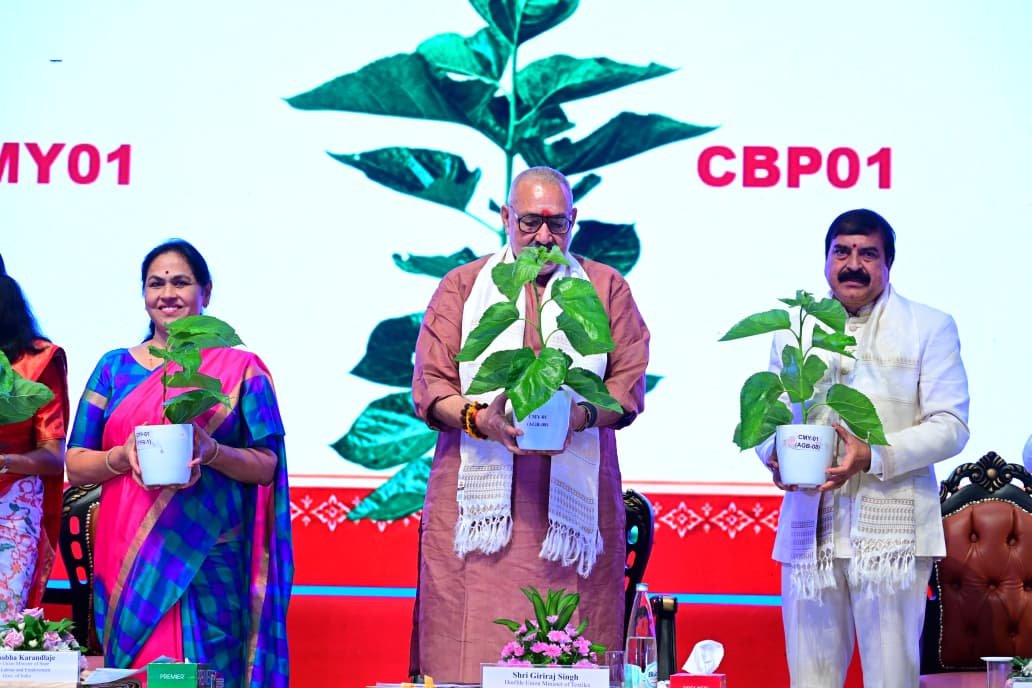
The variety was formally dedicated to the nation by Union Textiles Minister Giriraj Singh at a function in Bengaluru on Sunday to mark the 77th Foundation Day of the Central Silk Board.
The new variety has been developed to address the specific requirements of temperate and cooler sericulture regions of North India, with researchers focusing on its performance under cold to moderate agro-climatic conditions.
According to the institute, CPP-01 (PPR-1) has good rooting ability, early sprouting after winter dormancy, favourable leaf nutritional quality and improved leaf yield. It is also suitable for high-bush and tree-type mulberry cultivation systems used in several sericulture regions of North India.
The development is particularly significant for Kashmir’s temperate sericulture sector, where Goshoerami, an exotic mulberry variety introduced from Japan into the Kashmir Valley during the 1970s, has been widely used but has limitations in propagation and post-winter sprouting.
The institute said Goshoerami has relatively poor rooting ability through stem cuttings and delayed sprouting after winter dormancy, making vegetative propagation more cumbersome and potentially delaying the availability of mulberry foliage for spring silkworm rearing.
In comparison, CPP-01 (PPR-1) has demonstrated more than 90 per cent rooting through stem cuttings, indicating greater ease of vegetative multiplication. It has also shown earlier sprouting after winter dormancy compared with Goshoerami.
Researchers said the earlier sprouting could help establish foliage sooner and facilitate the timely start of spring silkworm rearing.
The combination of higher rooting ability, early post-winter sprouting and favourable leaf production is expected to improve the availability of quality mulberry foliage and strengthen mulberry-based sericulture in cooler climatic regions.
The variety is the outcome of a long-term breeding, characterization, selection, field evaluation and multi-location testing programme supported by the Central Silk Board and the Ministry of Textiles.
Dr Shamim Baksh, Scientist and Breeder, initiated the breeding work, while Dr Aftab Ahmad Shabnam and his team contributed to the initial characterization, evaluation and selection through successive field assessments.
Dr Pawan Saini and his team subsequently evaluated the variety at the national level under the All India Co-ordinated Experimental Trials for Mulberry (AICEM-IV), contributing to its wider scientific assessment.
The Central Sericultural Research and Training Institute has acknowledged the contributions of scientists and research teams involved at different stages of the development and evaluation process.
The variety is expected to provide sericulture farmers in temperate regions with an additional climate-specific mulberry option, particularly by making planting-material production easier and improving the synchronisation of leaf availability with spring silkworm rearing. (PIB)


Comments are closed.