(This short story is set against the difficulties an ordinary person may face while seeking justice. It does not seek to blame any particular institution or individual. Instead, it raises a simple but difficult question: who understands the struggles of a person trying to reach the last door of justice?)
Sahil was sitting at home when suddenly his phone rang. It was his childhood friend, Aslam.
“Sahil! Do you recognize me?”
Sahil laughed.
“How could I not recognize your voice? So many years have passed, but your voice is still the same.”
For a while, they asked each other about their lives. Then Aslam said, “Friend, I have been feeling tired and restless in my area for the last few days. I thought I would come and stay with you for a day or two, see some places around your area and clear my mind.”
“What is there to ask?” Sahil replied immediately. “Come whenever you want. My home is your home.”
Aslam arrived at Sahil’s place the very next day. They remembered their childhood days together. They talked about the games they used to play and about the years that had passed since then.
After two days of rest, Sahil said, “Come on. Today I will show you my area.”
They set out together. Sahil showed him natural, historical and scenic places. There was a spring here, a beautiful spot where people came for a walk and peace of mind there, a historic building somewhere else, and then a shrine, a mosque, a temple or a dargah. They also passed colleges and a university.
Aslam looked at everything with interest and kept asking Sahil about the places they visited.
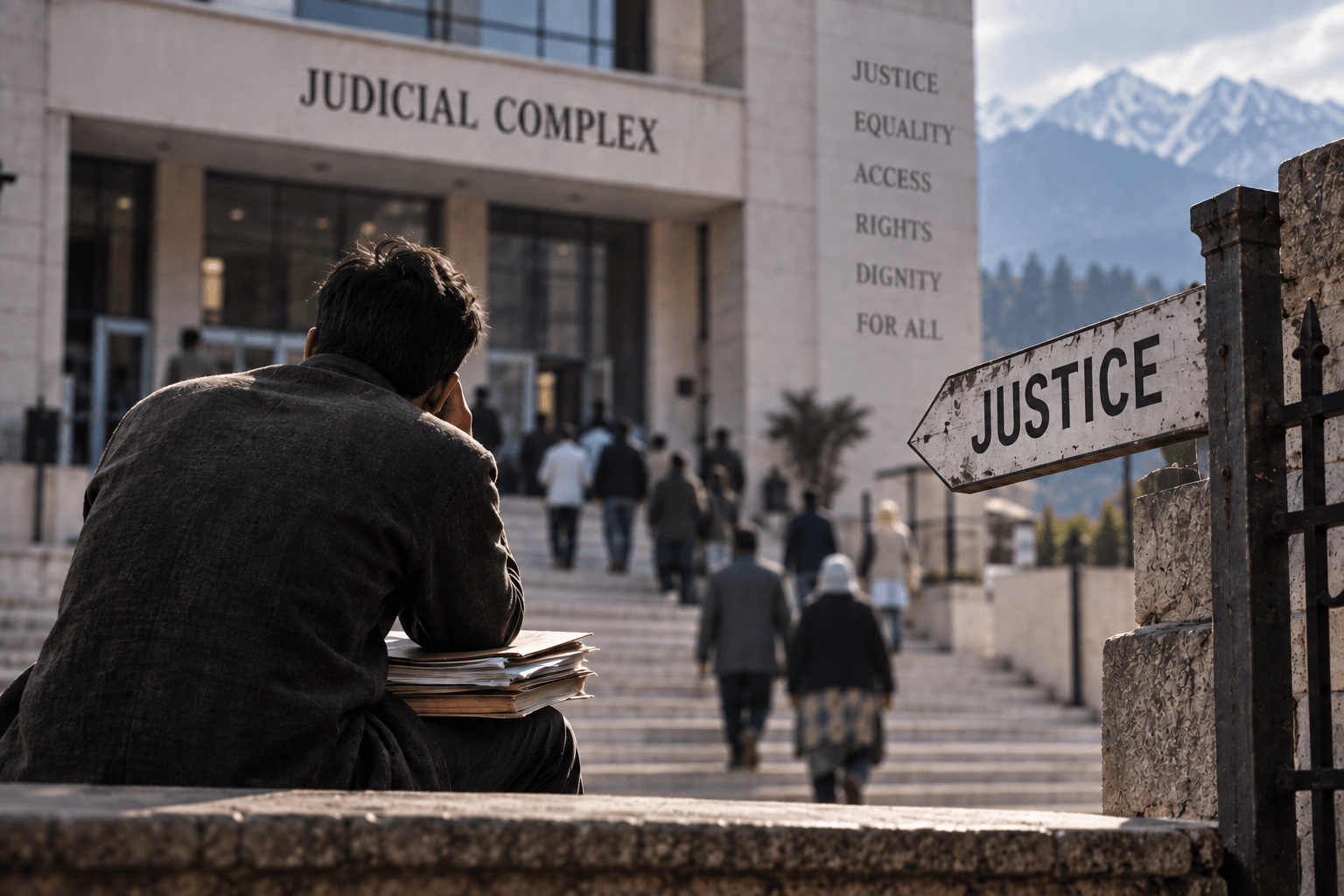
On their way back, Sahil said, “There is one more place I want to show you. A new judicial complex has been built in our area. The building is quite large and beautiful.”
“Let’s see that too,” Aslam said.
A short while later, they were standing in front of the judicial complex. The building was indeed impressive. There was a large open space, a grand structure and an atmosphere that looked dignified from a distance.
As soon as they got out of the car, an employee at the gate stopped them.
“The car cannot go inside.”
Sahil looked at the large open space in front of them.
“There is plenty of space here. I have a guest with me.”
The employee replied, “Sir, we are not allowed to let cars in. You will have to leave it outside.”
Aslam looked at Sahil and smiled.
“Come on. We can walk today.”
They parked the car outside and entered the building.
Inside, Aslam looked at the stairs and corridors. There was dust in many places. Cigarette butts and empty packets could be seen here and there, and in some places there were marks of spitting.
When they reached the third floor, Aslam wanted to use the washroom. He was surprised by its condition.
When he came back, he said to Sahil, “The building looks so impressive from outside, but look at the condition inside. So many people come here every day. Does no one feel responsible for its cleanliness?”
Just then, Aslam noticed an employee nearby. He asked, “Brother, if there is a problem here, whom should we complain to?”
The employee replied, “I am an employee here, but I am only a junior employee.”
With a slight smile, Aslam asked, “If a person who has come here seeking justice faces a problem, where should he go?”
The employee said, “For that, there are the senior judges.”
“And what if the problem is with the management of this very building?”
The employee paused for a moment and then said, “Then an application has to be submitted to the association.”
Aslam looked at Sahil and said, “That is strange. People come here to find solutions to their problems, yet if they have a problem here, they also have to submit an application.”
They moved on.
There was a crowd in different parts of the court. Someone held a file in his hand. Someone was asking for directions to an office. Someone was waiting for a lawyer, while another stood anxiously waiting for his turn.
Aslam quietly said to Sahil, “These people look so worried.”
Sahil replied, “Everyone who comes to court comes with some problem or another.”
“But why do they look so troubled?”
“Sometimes a document is incomplete. Sometimes a new requirement comes up. Sometimes they are given another date.”
Just then, Aslam noticed a young man. His eyes were red and his face clearly showed exhaustion.
Aslam went up to him.
“Son, why are your eyes so red? Are you feeling unwell?”
The young man said nothing at first. Then he replied, “No, sir. I am fine. I am just worried.”
“What happened?”
“I have a matter going on here in the court.”
“What kind of matter?”
“My father passed away. He was a government employee and the only earning member of our family. He had been suffering from a serious illness for quite some time. After enduring a lot of pain, he passed away.”
Aslam said sympathetically, “May Allah grant him a place in Paradise.”
“Ameen.”
The young man lowered his eyes.
“Now we need an important certificate after his death so that the legal and financial matters can move forward. Several people in our family depended on him. Things were already difficult after he passed away.”
Aslam asked, “Then what is the problem?”
The young man replied in a tired voice, “The problem is that the work is not moving forward. On the first day, they checked the papers and pointed out a missing document. I completed it. Then I was given another date.”
“And then?”
“Then another document was asked for. Sometimes an identity card, sometimes a photograph, sometimes some other document. Then a guarantor, then a surety bond. For one matter, I have to keep coming again and again.”
“How long has this been going on?”
“Several months.”
Arif remained silent for a while. Then suddenly his voice became heavy. As he spoke, tears began to roll down his cheeks.
Aslam immediately wiped his tears.
“Son, why are you crying?”
Arif looked up.
“Sir, I am not crying because I am emotional. The truth is that we have gone to bed hungry for the last three nights. The food at home ran out. We had to skip one meal, and then another. We remained hungry for three nights.”
Aslam’s face became serious.
Wiping his eyes, Arif said, “My mother also suffers from several illnesses. I had to bring her medicine, but I could not even buy the medicine. Even the fare to come to the court has to be borrowed.”
For a few moments, Aslam had no answer. Then he asked quietly, “Did you hire a lawyer?”
“Yes. I have paid the fee too. There are good lawyers as well, but sometimes we feel that some lawyers do not take enough interest in the matter. The fee is one thing, but a worried person also needs attention and proper follow-up of his case.”
Aslam asked, “Are all lawyers like that?”
Arif quickly replied, “No, I am not talking about everyone. There are good and experienced lawyers too. But there are some who show less interest in their work. Sometimes people feel the same about some employees.”
Aslam said, “Then what is an ordinary person supposed to do?”
Arif remained silent for a while and then said, “Just keep making rounds. Go from one person to another. Sometimes complete a document, sometimes get another date, sometimes look for the lawyer, sometimes look for an employee.”
Then he said quietly, “We are not saying that the legal requirements of the court are wrong. The court has its own procedure. Our own knowledge may also be limited. Whatever is required by law should be done. But if even a small deficiency means several more days and several more appearances, where can a poor man find so much time and money?”
Aslam remained silent.
Arif said, “My father was the earning member of our family. After his death, the family was already in difficulty. If we now have to keep coming for months even for an important certificate related to the legal and financial matters left behind by him, what is a person supposed to do?”
He remained silent for a few moments and then said, “The most painful thing is that a person does not understand where he should go in the end.”
Sahil looked at Arif. His eyes were still moist.
As they were leaving, Aslam looked once again at the court building. From outside, it still looked magnificent, but the scenes he had witnessed inside kept moving through his mind.
He said to Sahil, “We came out to see the beautiful places of your area. But today I saw something here that is greater than any building.”
Sahil asked, “What?”
Aslam replied, “The helplessness of an ordinary person.”
Sahil remained silent.
After a while, Aslam asked again, “Sahil, if a person faces injustice somewhere outside, he goes to court, doesn’t he?”
“Yes.”
“But if he reaches this very last door and still finds himself helpless, where does he go then?”
Sahil had no answer.
The two walked on in silence. The tall court building was left behind, but Aslam’s question continued to walk with them.
“If even the last door of justice becomes difficult for an ordinary person, where does he go?”


Comments are closed.