

Shabeer Ahmad Lone
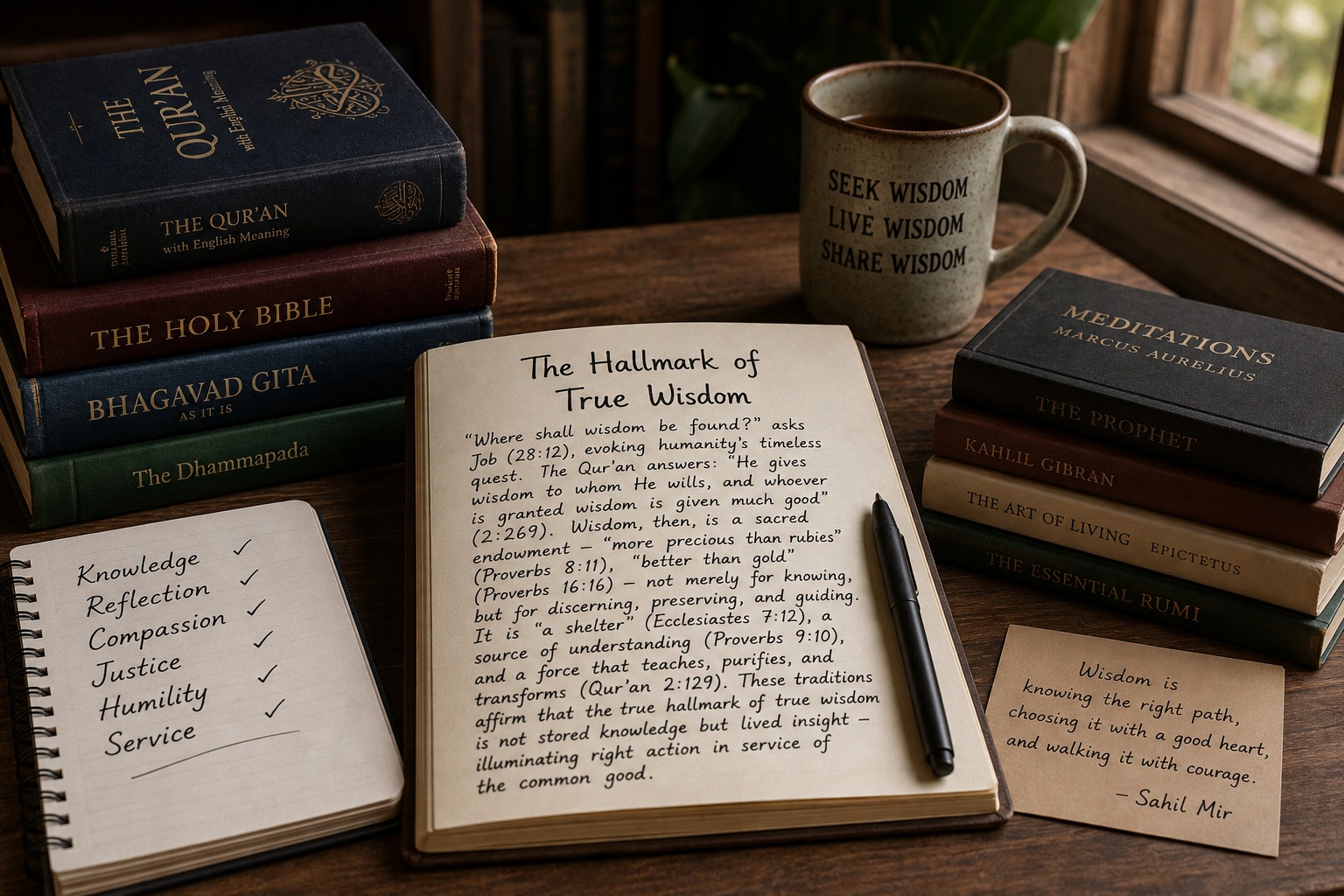
“Where shall wisdom be found?” asks Job (28:12), evoking humanity’s timeless quest. The Qur’an answers: “He gives wisdom to whom He wills, and whoever is granted wisdom is given much good” (2:269). Wisdom, then, is a sacred endowment-“more precious than rubies” (Proverbs 8:11), “better than gold” (Proverbs 16:16)-not merely for knowing, but for discerning, preserving, and guiding. It is “a shelter” (Ecclesiastes 7:12), a source of understanding (Proverbs 9:10), and a force that teaches, purifies, and transforms (Qur’an 2:129). These traditions affirm that the true hallmark of true wisdom is not stored knowledge but lived insight-illuminating right action in service of the common good.”
Wisdom, as a concept and lived reality, has captivated human thought across cultures, disciplines, and centuries-yet its true essence remains both profoundly timeless and urgently contemporary. At its core, wisdom transcends the mere accumulation of facts or intellectual prowess; it embodies a holistic integration of cognitive, emotional, ethical, and social capacities.
It is the art of discerning what matters most amid complexity and uncertainty, coupled with the courage to act with compassion and integrity. In an era marked by rapid technological advances, escalating global crises, and deep social divides, the hallmark of true wisdom is the ability to navigate these challenges not with arrogance or blind certainty, but with humility, empathy, and an unwavering commitment to the common good.
The ancient Greeks, indigenous elders, and modern thinkers alike converge on this understanding: wisdom is both a beacon and a compass, illuminating paths that balance self-interest with collective flourishing.
The hallmark of true wisdom transcends mere knowledge, embodying deep self-awareness, ethical integrity, and compassionate engagement. Rumi reveals wisdom as transformative love; Ibn Arabi, as unveiling divine unity; Saint Augustine and Meister Eckhart emphasize openness to mystery and detachment. Al-Ghazali connects wisdom with ethical action, while Simone Weil highlights radical attentiveness and compassion.
Paul Tillich frames wisdom as the courage to affirm being amid existential anxiety, integrating faith and reason. Contemporary thinkers like Charles Taylor describe wisdom as an ongoing dialogue among self, other, tradition, and innovation; Diana Eck advocates humility amid pluralism; Marilyn McCord Adams stresses moral insight responding to suffering with practical compassion. Together, these voices illuminate wisdom as a dynamic synthesis of reflection, courage, and care-guiding humanity through complexity with clarity and heart.
Aristotle said, “Knowing yourself is the beginning of all wisdom,” and Einstein saw wisdom as the lifelong pursuit—not a degree.
By cultivating wisdom as a living practice and societal imperative, we prepare not only to face the crises of our time but to envision and create a world where technology serves humanity’s highest values, and progress is measured not by domination or accumulation, but by regeneration, equity, and the flourishing of all life.
Comments are closed.