We live in a time when almost every moment of life can become content. A meal, a journey, a family celebration, a personal achievement, a place visited—even a private emotion—can be photographed, recorded and uploaded within seconds. Social media has made sharing effortless. But it has also quietly changed the way we experience and present our lives.
Among the things increasingly entering this culture of constant documentation is charity.
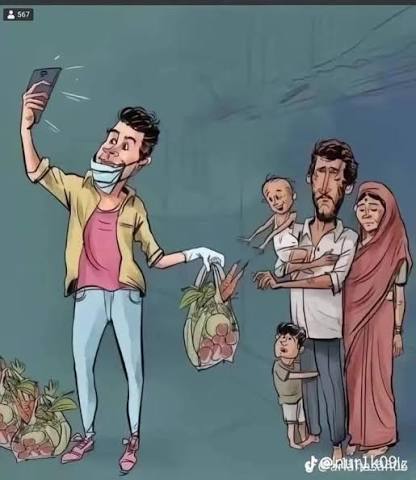
Giving Zakat, Sadaqah or helping someone in need is among the noblest expressions of compassion. It is an act that can restore hope, ease suffering and remind people that they are not alone. Yet today, it is increasingly common to see charitable acts being recorded and shared online. A person gives money, food, clothing or other assistance, while a camera captures the moment and the resulting video reaches thousands of viewers.
Sometimes the intention is undoubtedly positive. The person may want to encourage others to donate, raise awareness about a genuine need or inspire a culture of generosity.
But a difficult question remains: When does sharing charity stop being about helping someone and start becoming about displaying ourselves?
That question deserves more than a quick answer.
When Kindness Needs No Camera
Islam places extraordinary emphasis on sincerity in charity. The value of a good deed is not determined by how many people witness it but by the intention behind it.
The Prophet Muhammad ﷺ mentioned among the seven people who will receive Allah’s shade on the Day when there will be no shade except His, a person who gives charity so secretly that the left hand does not know what the right hand has given. The hadith, recorded in both Sahih al-Bukhari and Sahih Muslim, captures the profound beauty of anonymous generosity.
There is something powerful about helping another person without needing recognition. Imagine quietly paying a struggling student’s school fee, leaving groceries at the door of a family facing hardship, paying someone’s medical expenses or assisting a person who has fallen into financial difficulty—all without revealing who provided the help. The recipient receives assistance. The giver receives the satisfaction of having done good. And nobody is placed under the pressure of public gratitude. That is the beauty of charity when dignity remains at its centre.
Not Every Good Deed Needs to Be Posted
The culture of social media has created an unusual pressure: the feeling that if something is not documented, it somehow did not happen.
We photograph what we eat. We record where we travel. We announce our achievements. We share celebrations. Increasingly, even acts of kindness are being turned into short videos designed for public consumption.
But charity involves another human being—often someone already experiencing vulnerability.
A person receiving food because they cannot afford it may not want their face displayed before thousands of strangers. Someone receiving financial assistance may not want neighbours, colleagues or relatives to know about their circumstances. A child receiving help may not understand the long-term consequences of having their image permanently placed online.
A charitable act can therefore become humiliating if the recipient’s consent and dignity are ignored.
The Qur’an offers an important principle in this regard. It states that openly giving charity is good, but concealing it and giving it to the poor is better. (Qur’an 2:271).
This does not mean that every publicly shared charitable initiative is wrong. Public generosity can sometimes serve an important purpose. It can encourage donations, draw attention to neglected issues, mobilise communities and help raise funds for people who genuinely need support. The distinction lies in intention, necessity and method.
Are we sharing the need or exploiting the needy?
Are we raising awareness or displaying someone’s vulnerability?
Are we encouraging generosity or seeking applause?
Most importantly, does the person receiving help remain respected?
These questions should guide anyone who chooses to combine charity with social media.
When Content Can Become a Service
There is also another side to this discussion.
Content creation is no longer merely a hobby. For many young people, it is a profession. Creators educate, entertain, inform, influence and build communities. Many earn an honest livelihood through digital platforms.
There is nothing inherently wrong with creating content or earning from it.
The important question is what that content contributes to society.
A creator who uses social media to explain an important issue, promote education, spread awareness, encourage charitable giving or connect genuine beneficiaries with donors can create meaningful social value.
In such cases, the camera can become a tool for service rather than self-promotion.
A fundraising campaign, for example, may need visibility. A community kitchen may need public support. An organisation working with disadvantaged families may need to demonstrate its work to attract donors and volunteers.
But even then, there is a crucial difference between documenting the work and documenting the vulnerability of the people being helped.
The former may inspire participation.
The latter can reduce a person to content.
That distinction is easy to overlook in the race for views.
The Recipient Is Not Content
One principle should remain non-negotiable: a person in need is not a prop for someone else’s digital image.
Charity should never turn poverty into entertainment.
It should never make a struggling person feel that they must perform gratitude before a camera to receive assistance.
And it should never suggest that someone’s dignity is a fair price for receiving help.
Before recording a beneficiary, genuine consent matters. But even consent should not be treated as an automatic justification for everything. A person facing financial or emotional hardship may agree to being filmed because they urgently need assistance. That does not necessarily mean they fully understand how widely the footage may travel or how permanently it may remain online.
Creators therefore have an additional responsibility: to ask not merely, “Can I post this?” but “Should I post this?”
Sometimes the ethical answer will be no.
Rethinking Success in the Digital Age
Perhaps this conversation also requires us to rethink what success means online.
A video with a million views is not automatically more valuable than one seen by a hundred people. A post with thousands of comments is not necessarily more meaningful than a quiet act that changed one person’s life.
A creator who teaches one useful lesson, encourages one young person to make a better decision or inspires one family to help another may have created greater value than an algorithmically successful video.
The same applies to charity.
The greatest reward for helping someone does not necessarily come when strangers write “MashAllah” in the comments.
Sometimes the greatest reward is knowing that someone slept peacefully because of your assistance.
Sometimes it is knowing that a child continued school because someone quietly paid the fee.
Sometimes it is simply knowing that you made another person’s difficult day a little easier.
There is a kind of goodness that does not need an audience.
Three Questions Before We Post
Technology has placed a camera in nearly every pocket and an audience within reach of almost everyone. But the ability to record something does not create an obligation to publish it.
Before uploading a charitable act, perhaps we should stop for a few seconds and ask ourselves:
Is this post helping the person, or helping my image?
Am I inspiring people to give, or am I seeking recognition for giving?
Would I still do this if nobody could see it?
That last question may be the most revealing.
If the answer is yes, then perhaps the intention is already in the right place.
Social media itself is neither good nor bad. It is a tool. It can spread misinformation or knowledge, vanity or compassion, exploitation or dignity. The responsibility lies in how we choose to use it.
Charity, meanwhile, is fundamentally about another person’s need—not our public image.
When the two meet, the order of priorities must remain clear: the dignity of the person being helped comes before the visibility of the person helping.
In a world where almost everything is becoming content, perhaps some good deeds should remain private.
Not because kindness should be hidden from society, but because sincerity sometimes grows best away from the gaze of others.
The most beautiful charity may be the one that leaves no photograph, generates no applause and receives no public recognition.
Only the person helped remembers it.
And perhaps that is enough.
Because when charity is truly about giving, it does not need a camera to make it valuable.
Sometimes, the most powerful act of kindness is the one witnessed only by the person who received it—and the Creator who knows the intention behind it.
The writer is a student, content creator and observer of today’s digital world. He writes about issues concerning youth, society and character building. He can be reached at wafiqimtiyaz@gmail.com.


Comments are closed.