

How Bharat Taxi Could Redefine Urban Mobility Through Cooperation

S Ahmad


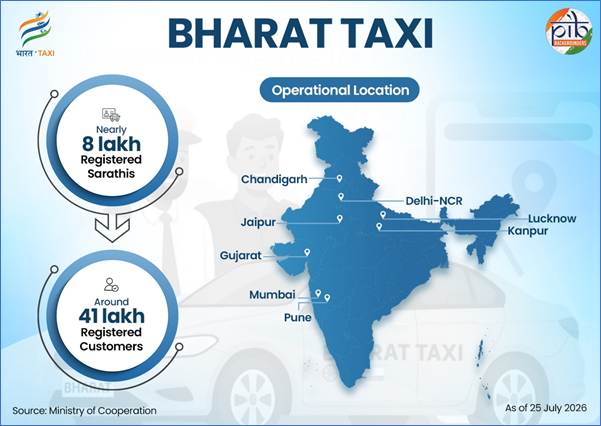
Bharat Taxi is India’s first cooperative-led ride-hailing platform, established on 6 June 2025 under the Multi-State Cooperative Societies Act, 2002. Supported by eight national cooperative institutions, it combines digital mobility with a member-owned model. The platform follows a zero-commission model, enabling Sarathis to retain full fare earnings while participating as member owners. As of 25 July 2026, Bharat Taxi has nearly 8 lakh registered drivers and around 41 lakh registered customers across several cities. It offers transparent pricing, multiple ride categories, women-centric mobility initiatives, digital integration, and social security support. With institutional partnerships, nationwide expansion planned by 2029, and technology-enabled services, Bharat Taxi advances the vision of Sahkar se Samriddhi through inclusive and cooperative urban mobility.

The story of India’s urban mobility revolution has largely been told through the language of technology. Smartphones replaced roadside searches for taxis. Digital payments replaced cash transactions. GPS transformed navigation, while app-based platforms connected passengers and drivers with unprecedented speed.

Yet behind this technological transformation lies a more fundamental question: Who benefits from the platform economy?

For millions of drivers who depend on mobility platforms for their livelihoods, the answer has often been complicated. Technology has undoubtedly expanded access to customers and created new employment opportunities. But the relationship between drivers and platforms has also generated continuing debates around commissions, income stability, incentives, working conditions and the degree of control that drivers exercise over the businesses through which they earn their living.

It is against this backdrop that Bharat Taxi assumes significance.

The platform is not merely attempting to enter India’s increasingly competitive ride-hailing market. Its larger proposition is based on a different idea of ownership: that the people who provide the service should have a meaningful stake in the platform itself.

This is the principle behind its cooperative model, captured in the idea of “Saarthi Hi Maalik”—the driver is not merely a service provider but a stakeholder.

If this model succeeds at scale, Bharat Taxi could represent something more significant than another alternative to existing mobility platforms. It could become an experiment in whether India’s cooperative tradition can be adapted to the digital economy.

The platform economy needs a new conversation

India’s urban transport sector has undergone enormous change over the past decade. App-based mobility has made it easier for passengers to find vehicles, track journeys, make digital payments and access transportation at different price points.

For drivers, these platforms have opened access to a much larger customer base.

But convenience for consumers does not automatically translate into economic security for service providers.

The central tension of the platform economy lies here.

A driver may own the vehicle, pay for fuel, bear maintenance costs, absorb depreciation and spend long hours on the road, while the digital platform controls access to customers and determines significant aspects of the transaction.

This does not make technology inherently exploitative. Platforms provide genuine value by bringing together fragmented supply and demand.

But it does raise a legitimate question: Can the people whose labour makes the platform possible have a greater say in how the platform operates and how the economic value it generates is distributed?

Bharat Taxi’s answer is the cooperative model.

Rather than treating drivers merely as participants on a privately controlled platform, the model seeks to make them central to ownership and governance.

That is a potentially important shift.

From driver-partner to driver-owner

The phrase “Saarthi Hi Maalik” carries a significance beyond its simplicity.

In the conventional platform model, the driver is often described as a “partner”. Yet partnership can mean many things. A driver may be able to choose when to work, but may have limited influence over commission structures, pricing systems, incentives or broader platform policies.

Ownership changes the conceptual relationship.

If drivers have a stake in the cooperative, then the platform is not simply a company through which they earn money. It becomes an institution in which their economic interests are directly represented.

The source material places Sarathis at the centre of Bharat Taxi’s ownership and governance framework. That principle is important because it attempts to align the interests of the platform with those of the people who actually deliver the service.

The challenge, however, will be ensuring that ownership is substantive rather than symbolic.

A cooperative cannot be judged merely by the language it uses. Its credibility will ultimately depend on how much influence members actually exercise, how transparent its decision-making processes remain and whether economic benefits reach the drivers.

The idea is promising.

Its implementation will determine its legacy.

The zero-commission proposition

One of Bharat Taxi’s most consequential propositions is its zero-commission model.

For drivers, the distinction between gross earnings and actual income is crucial. A passenger sees the fare paid for a journey. The driver sees something very different: fuel expenses, maintenance, insurance, vehicle depreciation, financing costs and the platform’s commission or service charges.

When a significant portion of the fare does not reach the driver, the pressure to work longer hours increases.

A zero-commission model attempts to address one part of this equation directly.

If drivers retain the full fare from their rides, their earning structure becomes easier to understand and potentially more favourable.

But there is an important distinction between zero commission and zero cost.

Running a large digital mobility platform requires technology infrastructure, customer support, payment systems, safety mechanisms, mapping, marketing and administration. The sustainability of the model will therefore depend on how these costs are managed without recreating financial pressures elsewhere.

This is where cooperative economics becomes particularly interesting.

A conventional platform seeks profit for its owners or shareholders.

A cooperative platform has a different objective: creating sustainable value for its members.

If Bharat Taxi can maintain technological efficiency while keeping the economic burden on drivers low, it could offer an important alternative model for India’s gig economy.

Can cooperation work in the digital age?

India has a long cooperative tradition.

From dairy cooperatives to agricultural societies and credit institutions, cooperative models have played an important role in giving dispersed individuals collective bargaining power.

The digital economy, however, presents a new challenge.

Traditional cooperatives often operate within geographical boundaries and relatively familiar organisational structures. Digital platforms operate at enormous scale, across cities and sometimes across states, while relying on sophisticated technology.

Bharat Taxi is therefore attempting to combine two seemingly different worlds: the collective ownership principles of cooperation and the technological infrastructure of the platform economy.

That combination could be transformative.

A driver working alone has limited bargaining power. Thousands of drivers acting collectively can influence the economics of a mobility network.

Technology can provide the infrastructure.

Cooperation can provide the ownership model.

The real innovation may lie in bringing the two together.

A different idea of efficiency

The conventional platform economy often defines efficiency in terms of speed, scale and transaction volume.

How quickly can a passenger get a ride?

How many vehicles can the platform connect?

How efficiently can demand and supply be matched?

These are important questions, but a cooperative platform introduces another measure of efficiency:

How effectively does the system improve the economic security of its members?

This is a more human measure.

If a platform helps drivers earn more predictably, reduces unnecessary deductions, provides social-security benefits and gives them a voice in governance, then its success cannot be measured only through market share.

It must also be measured through improved livelihoods.

That could ultimately become Bharat Taxi’s strongest argument.

Technology with a social purpose

The cooperative model does not mean that Bharat Taxi is rejecting technology.

On the contrary, technology is central to its proposition.

Digital booking, GPS-enabled services, digital payments, identity verification, customer support and real-time tracking are essential components of contemporary mobility.

The larger question is who controls the technology and for what purpose.

Digital tools can be designed primarily to maximise platform efficiency.

They can also be designed to strengthen the economic position of workers.

The distinction matters.

If technology is treated simply as a mechanism for extracting greater efficiency from labour, the platform economy can deepen existing inequalities.

If technology is used to organise workers, reduce transaction costs, increase transparency and distribute value more equitably, it can become an instrument of empowerment.

Bharat Taxi’s experiment is significant because it attempts the latter.

The human face of mobility

Every discussion about ride-hailing eventually returns to numbers—fares, commissions, rides, waiting time and market share.

But behind every trip is a human being.

A driver may be supporting a family, paying school fees, repaying a vehicle loan or trying to build a more secure future.

The economic consequences of platform design therefore extend far beyond individual transactions.

A small change in commission can affect household income. A stable flow of rides can determine whether a driver can meet monthly expenses. Access to insurance or social-security schemes can make a major difference when illness, accident or economic disruption occurs.

Bharat Taxi’s emphasis on social-security and welfare measures therefore deserves attention.

The future of the gig economy cannot be built entirely around flexibility.

Workers also need security.

Flexibility without protection can become vulnerability.

Women entering the mobility economy

Another potentially important dimension is women’s participation.

Initiatives such as Sarathi Didi and Bike Didi, as outlined in the source material, seek to expand opportunities for women in the mobility ecosystem.

This matters because women’s participation in transport is not simply an employment issue.

It has wider social implications.

When women become drivers, entrepreneurs or mobility providers, they gain an independent source of income and greater control over their economic lives.

At the same time, women passengers often feel more comfortable when safe and reliable mobility options are available.

A mobility platform that actively creates space for women can therefore influence both sides of the equation: employment and access.

But again, the success of such initiatives will depend on implementation.

Women drivers need not only recruitment opportunities but also safe working environments, appropriate support systems, training and mechanisms to address harassment or other risks.

Technology can help through identity verification, trip tracking and emergency-response systems, but institutional support remains equally important.

Safety must become non-negotiable

Any mobility platform that hopes to build public trust must place safety at its centre.

For passengers, the concerns are obvious: Who is driving the vehicle? Can the journey be tracked? What happens in an emergency?

For drivers, there are corresponding questions: Who is the passenger? What protections exist if a driver faces a threat? Is there a reliable mechanism to report incidents?

Bharat Taxi’s focus on KYC, tracking and emergency-response mechanisms addresses this critical dimension.

But safety should not be treated as a technological feature alone.

It is a culture.

A safe platform requires responsive customer support, clear protocols, trained personnel and accountability when something goes wrong.

Trust is built not when everything works perfectly, but when a system responds effectively when something does not.

Digital India and the next stage of mobility

India’s rapid expansion of digital infrastructure provides a favourable environment for new mobility models.

Digital payments have become routine. Smartphone adoption has expanded. Government digital platforms have connected citizens to services that were once difficult to access.

The mobility sector is naturally becoming part of this transformation.

Integration with broader digital systems can reduce transaction costs, simplify payments and create more seamless interactions between drivers, passengers and institutions.

But India’s digital transformation must remain inclusive.

A platform designed only for technologically sophisticated users will leave behind precisely those people who may benefit most from new opportunities.

Drivers should be able to use the system without requiring advanced digital literacy. Passengers should find the booking process simple. Support should be available when technology fails.

Digital inclusion is not achieved simply by creating an app.

It is achieved when ordinary people can use the technology confidently.

Scaling the model will be the real test

The early promise of Bharat Taxi is significant, but the real challenge lies ahead.

It is relatively easy to present an alternative model at a small scale.

It is much harder to maintain its principles while expanding across a vast and diverse country.

India’s mobility market is intensely competitive. Large private platforms have significant technological capabilities, established customer bases and substantial financial resources.

Bharat Taxi will therefore need to compete not only on ideology but also on service.

Passengers will expect availability, reliability, reasonable fares, easy booking and responsive support.

Drivers will expect consistent demand, fair earnings and genuine participation in governance.

A cooperative model cannot become an excuse for poor service.

If anything, it must demonstrate that fairness and efficiency can coexist.

That is perhaps the biggest test of the experiment.

The danger of becoming just another platform

There is another challenge that Bharat Taxi must confront as it grows.

Every successful organisation develops systems and professional management structures. That is necessary for scale.

But there is a risk that a cooperative can gradually become distant from its members.

If drivers become shareholders on paper but have little practical influence over decision-making, the cooperative promise could weaken.

The principles of transparency and democratic participation must therefore remain central.

Drivers should understand how decisions are made, how revenues are used and how their cooperative stake translates into actual benefits.

The more successful Bharat Taxi becomes, the more important this transparency will become.

Scale should strengthen the cooperative—not dilute it.

A possible new model for the gig economy

The significance of Bharat Taxi extends beyond taxis.

If its model proves successful, it could encourage a broader discussion about worker ownership in the digital economy.

Why should platform workers always remain dependent on companies that own the technology?

Could delivery workers collectively own delivery platforms?

Could freelancers develop cooperative digital marketplaces?

Could other gig workers pool resources and create technology-enabled institutions in which they share both risks and rewards?

These questions are becoming increasingly relevant as technology transforms employment.

The gig economy has demonstrated that work can be organised differently.

The cooperative digital economy asks whether ownership can also be organised differently.

Bharat Taxi is therefore participating in a much larger experiment.

From “platform users” to stakeholders

The most important change may ultimately be conceptual.

For years, the digital economy has trained us to think of people as users.

Passengers are users.

Drivers are users.

Customers are users.

But cooperative platforms introduce another category: stakeholders.

A stakeholder has a deeper relationship with the institution.

They do not simply consume a service. They have an interest in how that service is produced and governed.

For drivers, this could mean moving from dependency to participation.

That distinction is fundamental.

Economic empowerment is not simply about earning more money. It is also about having greater control over the conditions under which that money is earned.

The road ahead

Bharat Taxi’s journey will ultimately be judged not by its slogans but by its outcomes.

Can drivers genuinely become owners?

Can zero-commission operations remain financially sustainable?

Can passengers receive reliable and competitive services?

Can women participate safely and meaningfully?

Can technology remain accessible?

Can the cooperative maintain transparency as it scales?

And most importantly, can the model demonstrate that economic efficiency does not have to come at the expense of worker dignity?

These are difficult questions.

But they are precisely the questions worth asking.

India is entering an era in which millions of people will earn their livelihoods through technology-enabled platforms. The choices made today will influence the character of that economy for decades.

If the platform economy is going to be a defining feature of India’s future, then the people who power it should not remain invisible within it.

They should have a voice.

They should have protection.

And where possible, they should have ownership.

A cooperative future for a digital India

The larger significance of Bharat Taxi lies in its attempt to combine two powerful Indian ideas: technological innovation and cooperative enterprise.

Technology provides scale.

Cooperation provides collective strength.

Digital platforms provide convenience.

Ownership can provide dignity.

The success of the model could demonstrate that these ideas are not contradictory.

India does not have to choose between innovation and inclusion. It can attempt to build systems in which technological progress creates broader economic participation.

That will not happen automatically.

It will require strong governance, financial discipline, technological investment, transparency and continuous engagement with the people the platform is designed to serve.

But the opportunity is considerable.

The taxi may appear to be the simplest part of the story. A passenger books a ride, a driver arrives and the journey begins.

Yet behind that ordinary journey lies a larger question about the future of work.

Who owns the platform?

Who receives the value?

Who makes the decisions?

And who benefits when technology succeeds?

Bharat Taxi’s answer is ambitious: the people who make the journey possible should have a stake in the journey itself.

If that principle can survive the pressures of scale and competition, Bharat Taxi could become more than another name in India’s mobility market.

It could become a case study in how the cooperative spirit can find new relevance in the digital age.

The future of mobility, after all, should not be measured only by how quickly a passenger reaches a destination.

It should also be measured by whether the people driving the journey are able to reach a more secure economic destination of their own.

And that is where the real promise of Bharat Taxi lies: not simply in changing how India travels, but in exploring who gets to own, shape and benefit from the systems that move India forward.


The article is based on the inputs and background information provided by the Press Information Bureau (PIB). Author is Writer, Policy Commentator. He can be mailed at kcprmijk@gmail.com

Comments are closed.