India’s solar story is no longer confined to vast solar parks, ambitious government targets or impressive gigawatt figures. Its most meaningful transformation may be taking place much closer to home — on rooftops, in farms and increasingly on water bodies. The real test of India’s renewable-energy transition is not simply how many solar panels the country installs, but whether ordinary households and farmers can feel the economic benefits of that transition in their everyday lives.
Consider the experience of Sudhanshu Dubey of Gwalior. For years, his family struggled with electricity bills that routinely crossed Rs 10,000 a month — a significant burden for a below-middle-class household. As consumption increased and the bills became increasingly difficult to manage, Dubey opted to install rooftop solar under a government scheme. More than a year later, he has reportedly paid virtually nothing towards his electricity bills.
One household’s experience could easily be dismissed as anecdotal. But when the same transition is replicated across millions of homes, it begins to tell a much larger story. India’s solar revolution is acquiring significance precisely because it is moving from the level of national infrastructure to the level of household economics.
The scale of that transformation is striking. India had only around 3 GW of installed solar capacity in 2014. By 2026, that figure has crossed 162 GW — a more than fiftyfold increase in just over a decade. In the current financial year alone, the country has added 44.61 GW of solar capacity, almost twice the addition recorded in the previous year. India has consequently emerged as the world’s second-largest solar growth market.
These numbers are impressive, but numbers alone do not explain the transformation. The more important question is what made solar power move from an expensive alternative to a mainstream component of India’s energy architecture.
The answer begins with cost.
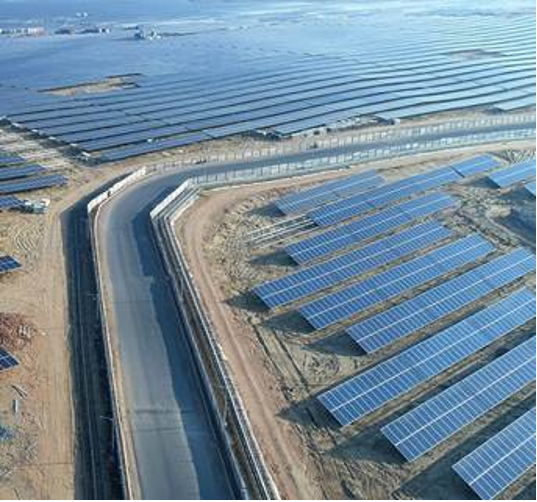
In 2010, solar electricity in India cost around Rs 18 per unit. Competitive bidding and reverse auctions gradually pushed tariffs down as developers competed for large-scale projects. At the Bhadla Solar Park auction in Rajasthan in 2017, tariffs fell to a record Rs 2.44 per unit. The barren landscape of Bhadla itself became symbolic of the change. Land once considered unsuitable for much economic activity was transformed into one of the world’s major solar hubs, with an installed capacity of 2,245 MW.
India’s solar economics have since become among the most competitive globally. The levelised cost of solar power is estimated at around $35 per MWh, compared with a global average of approximately $44. Falling costs have made solar not merely an environmental choice but an increasingly compelling economic proposition.
Yet the most consequential policy decision may have been to take solar beyond large power plants.
India’s renewable-energy transition could have remained a story of utility-scale projects, industrial investment and government procurement. Instead, policy increasingly moved towards decentralisation. Schemes such as PM Surya Ghar: Muft Bijli Yojana brought rooftop solar into the homes of ordinary citizens, while PM-KUSUM extended solarisation into the agricultural economy.
PM Surya Ghar is particularly significant because it changes the relationship between the consumer and the electricity system. With more than Rs 14,771 crore disbursed and around 7.7 lakh households already benefiting to the extent of having no electricity bills, rooftop solar is demonstrating what distributed energy can mean in practical terms.
The larger ambition is even more consequential. More than 43 lakh households have reportedly installed rooftop solar under the broader programme. Every additional rooftop potentially represents not merely another solar installation but a small unit of decentralised power generation.
That is an important psychological and economic shift. For decades, the average electricity consumer had little influence over how power was produced. Electricity was generated elsewhere, transmitted through a large network and consumed at home. Rooftop solar turns some consumers into producers. The citizen is no longer simply paying the electricity bill; the citizen can become part of the energy system.
The same principle is visible in agriculture.
Through PM-KUSUM, solar pumps have been installed for farmers, reducing dependence on conventional electricity and diesel while creating opportunities to sell surplus electricity to the grid. Nearly 11.49 lakh solar pumps have been installed, benefiting more than 21 lakh farmers.
This is where the solar transition begins to intersect with rural economics. A solar pump is not merely a piece of renewable-energy equipment. It can potentially reduce the recurring cost of irrigation, improve energy access and create an additional income stream where surplus power can be supplied to the grid.
The growth of distributed solar therefore deserves as much attention as the headline figures from large solar parks. Rooftops and farms together now account for more than a third of new solar capacity being added annually. That matters because decentralised energy is harder to view as an abstract national target. It is visible on a family’s roof and in a farmer’s field.
India’s next challenge is to find space for even more solar generation.
Land is increasingly becoming a constraint as renewable capacity expands. This makes the emerging focus on floating solar particularly relevant. The recently approved Pradhan Mantri Surya Sarovar Yojana proposes 5,000 MW of floating solar capacity, supported by battery storage, across reservoirs and industrial ponds.
The idea is both practical and forward-looking. India is estimated to possess more than 102 GW of floating solar potential. If water bodies can be used for energy generation without competing extensively with agricultural or other productive land, floating solar could open another major avenue for renewable expansion.
But India’s solar journey should not be romanticised. The difficult phase is far from over.
The country’s target of achieving 500 GW of non-fossil fuel capacity by 2030 is extraordinarily ambitious. Adding generation capacity is only one part of the equation. Transmission networks must expand to carry electricity from renewable-rich regions to centres of demand. Battery storage and other forms of energy storage must become more affordable and scalable. Distribution companies must be financially and operationally capable of managing increasingly decentralised generation.
Manufacturing is another critical frontier. India has made progress in building domestic solar manufacturing capacity, supported by initiatives such as the Production Linked Incentive scheme. But achieving genuine self-reliance across the solar value chain will require sustained investment, technological innovation and competitiveness rather than simply assembling imported components.
The next stage of India’s solar revolution, therefore, cannot be measured only in gigawatts. It must be measured in affordability, reliability, domestic manufacturing, jobs, rural incomes and the ability of the grid to accommodate millions of small producers.
This is also why the human dimension of solar policy matters.
A national target can be announced in a government document. A megawatt can be added to a power plant. But a family that sees its monthly electricity burden fall experiences the energy transition differently. A farmer who can irrigate a field with a solar pump experiences it differently. A young person trained to install or maintain solar systems experiences it as an employment opportunity.
As Prime Minister Narendra Modi has observed, solar initiatives extend beyond energy production to new skills, services and investment opportunities at the grassroots.
That is ultimately the measure of whether India’s solar expansion becomes a genuine transformation. The country’s energy future will not be built by large projects alone. It will be built auction by auction, solar park by solar park, rooftop by rooftop and, increasingly, water body by water body.
Dubey’s near-zero electricity bill is therefore more than a personal success story. It is a glimpse of what national energy policy looks like when it reaches the household. The real solar revolution begins when a gigawatt on a government dashboard becomes a saving in a family’s monthly budget.
India has travelled an extraordinary distance in little more than a decade. The task now is to ensure that the next phase of that journey is not simply about producing more solar power, but about making the benefits of clean energy broader, cheaper and more deeply rooted in everyday Indian life.
The article is based on the inputs and background information provided by the Press Information Bureau (PIB). Author is Writer, Policy Commentator. He can be mailed at kcprmijk@gmail.com


Comments are closed.