

SAMREEN HAMDANI
The Qur’anic choice of language reminds us that a home is not merely a piece of property belonging to the person whose name appears on a document. For the woman who lives there, a home can represent security, belonging, memories, sacrifice and the centre of her family life.
There are certain ideas that become so familiar in our everyday lives that we rarely stop to question them. One such idea is that the house shared by a husband and wife is naturally “the man’s house”. We routinely say “my house” or “my home”, often treating the woman living there as though she is merely a resident. Yet, when we turn to the Qur’an, its language offers a perspective that deserves closer attention. In several verses, Allah attributes the marital dwelling to the woman, using expressions such as “her house” and “their houses”. This is not, of course, a statement about legal ownership of property; rather, it raises an important question about a woman’s sense of belonging, security and dignity within the home.
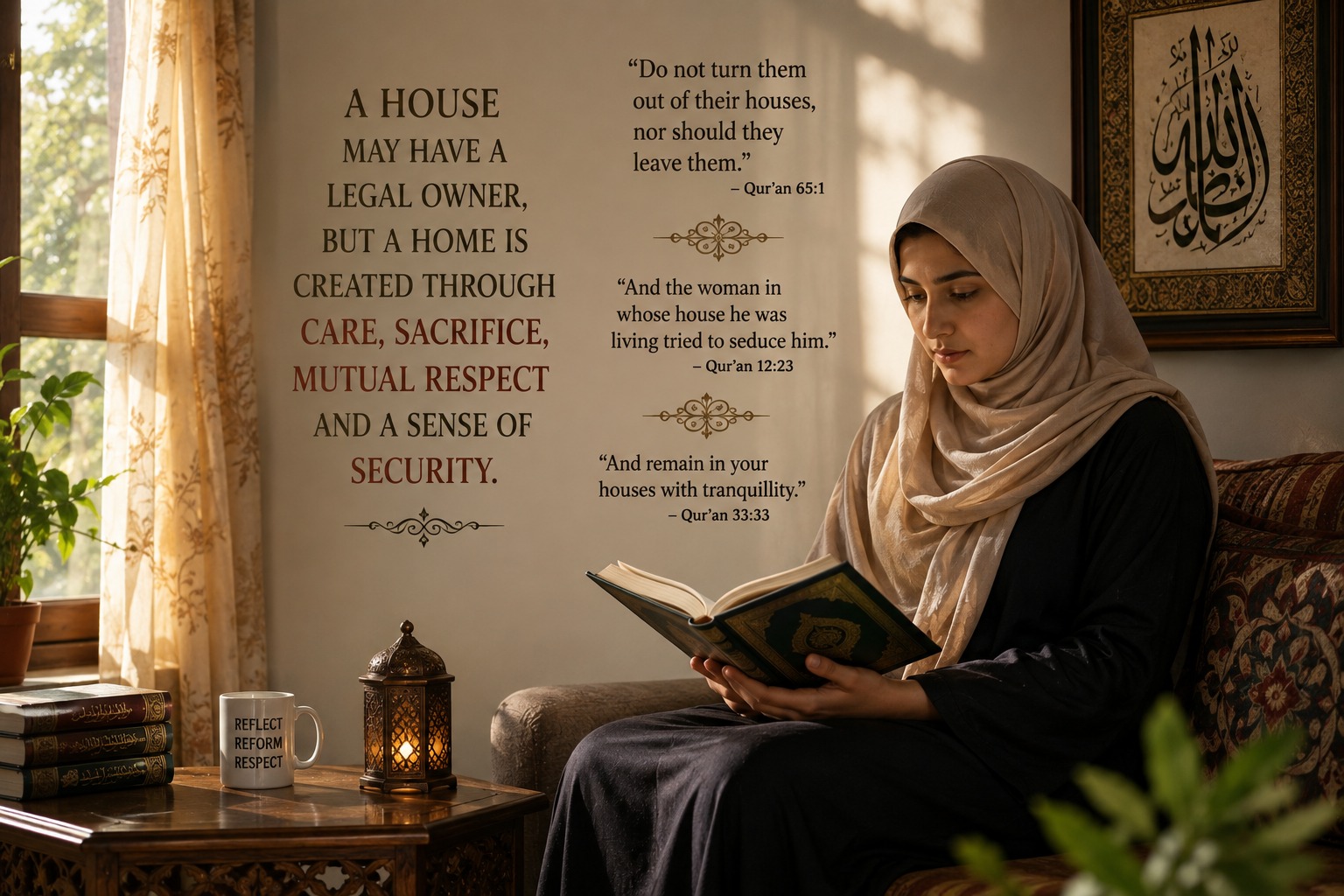
Consider the words of Allah in Surah At-Talaq, in the context of divorce and the waiting period (`iddah): “Do not turn them out of their houses, nor should they leave them” (Qur’an 65:1). The Arabic expression used here is buyutihinna, literally “their houses”. Even in a situation where a marriage has reached the point of separation, the Qur’anic language does not portray the woman as someone who has no claim to the space she has been living in. The verse instructs that she should not simply be expelled from it. This is particularly striking when considered against the common assumption that a marital home is automatically and exclusively “the man’s house”.
A similar expression appears in the story of Prophet Yusuf (Joseph). When describing the wife of the Aziz of Egypt, Allah says: “And the woman in whose house he was living tried to seduce him” (Qur’an 12:23)). The Qur’an uses the expression baytiha—“her house”. Again, the emphasis is not on establishing a legal title to the property but on the language through which the woman’s relationship with the dwelling is described. The same pattern appears in Surah Al-Ahzab, where Allah addresses the wives of the Prophet Muhammad ﷺ: “And remain in your houses with tranquillity” (33:33), followed by, “And remember what is recited in your houses of the verses of Allah and wisdom” (33:34). These were the homes of the Prophet ﷺ, yet the Qur’an addresses them as buyutukunna—“your houses”.
It is important not to turn these verses into a simplistic claim that Islamic law declares every marital home to be legally owned by the woman. Property ownership is a separate legal matter, determined by ownership documents, inheritance, marriage arrangements and other relevant circumstances. The point here is different. The Qur’anic choice of language reminds us that a home is not merely a piece of property belonging to the person whose name appears on a document. For the woman who lives there, it can represent security, belonging, memories, sacrifice and the centre of her family life.
This understanding becomes even more meaningful when we consider how the Qur’an describes the purpose of marriage itself. In Surah Ar-Rum, Allah says: “And among His signs is that He created for you spouses from among yourselves so that you may find tranquillity in them” (Qur’an 30:21). The concept of sakinah, generally understood as tranquillity, peace and emotional security, lies at the heart of this verse. Marriage is not presented merely as an economic or social arrangement. It is meant to provide a place of comfort and reassurance, where two people find peace in one another.
This brings us to a question that is often overlooked: does the woman in the home experience the same tranquillity that the man expects to receive from it? A husband may return home after a difficult day and think of his house as his place of rest. Yet the woman who has remained there may have spent her own day carrying responsibilities that are rarely recognised. She may have cared for children, managed the household, supported other family members, dealt with emotional burdens and quietly put aside some of her own ambitions. She may have left behind the familiarity of her parental home and spent years adapting herself to a new environment. Much of this work is invisible precisely because it is done without announcement or applause.
And yet, a woman can live in a house for years and still not feel at home. Physical violence is not the only way in which a person can be made to feel unsafe. Harsh words, humiliation, constant criticism, intimidation, shouting and deliberate disregard can leave wounds that are not visible to others. The absence of physical violence should not become the standard by which a husband measures whether he is treating his wife well. A person can refrain from striking someone and still cause considerable emotional harm.
A man’s strength, therefore, should not be measured by how loudly he can speak or how much authority he can exercise within his home. It should also be measured by the sense of safety he creates for the people closest to him. If a woman becomes afraid to speak freely in her own home, if she constantly anticipates anger or humiliation, or if she begins to believe that she has no value in the very place where she should feel secure, then something fundamental has gone wrong. The home that was meant to provide sakinah has ceased to perform its most important function.
The Prophet Muhammad ﷺ placed considerable emphasis on the treatment of one’s family. He said, “The best of you are those who are best to their families.” This is a demanding standard because good character is easiest to display when others are watching. The more meaningful test comes within the home, where there may be no audience and no reputation to maintain. A person may be respected in society, successful in his profession and admired by those outside, yet his character is also revealed by the manner in which he treats the person who shares his private life.
A house may have a legal owner, and property rights must certainly be respected. But a home is more than a legal title. It is created through care, sacrifice, mutual respect and a sense of security. The Qur’an’s repeated references to women’s homes should therefore make us pause before reducing the marital home to a man’s possession. The question is not simply whose name appears on the property papers. The more meaningful question is whether the person living inside that home feels that she belongs there, that she is respected there and that she can find peace there.
Perhaps, then, the next time a man says, “This is my house,” he should ask himself a more important question: Is this also a home in which my wife feels safe, valued and at peace? Because a home is not truly made by walls, furniture or ownership alone. It is made when the people living within it can find dignity, security and tranquillity in one another.
Comments are closed.