
Bullets for rhetoric, blockades for truth: Pakistan’s Kashmir double standard exposed as PoK bleeds

Suhail Khan


‘The strongest challenge to Pakistan’s Kashmir narrative now comes from the people of Pakistan-occupied Kashmir themselves. A narrative built on slogans cannot survive when confronted by the lived reality of those it claims to represent.”

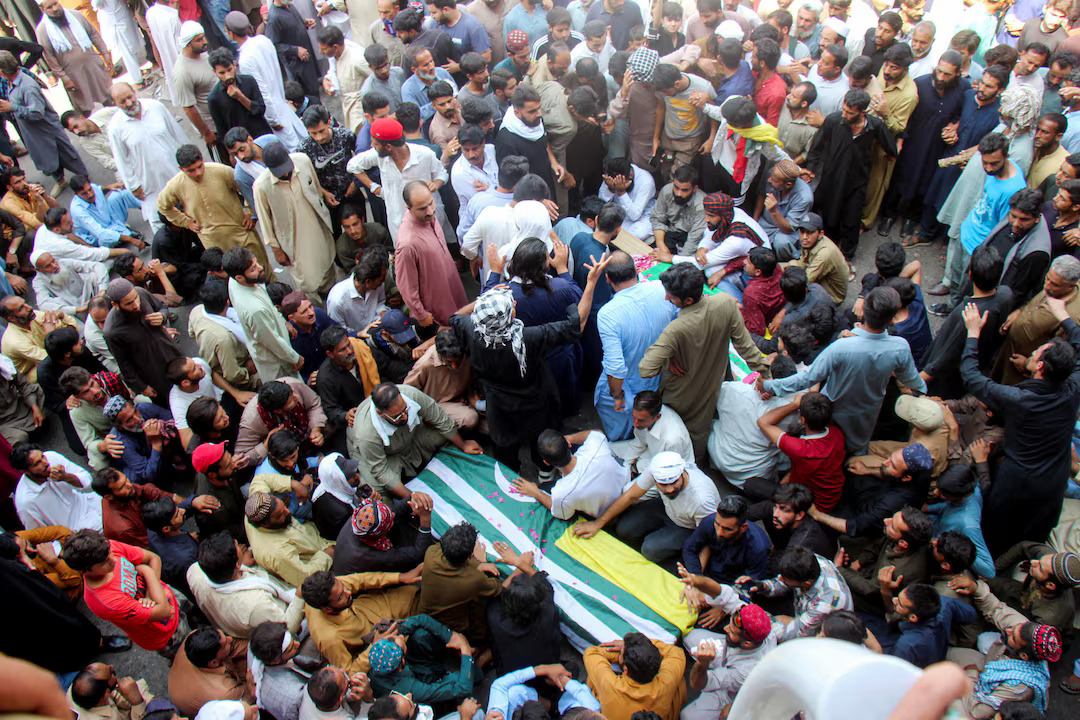
For seven decades, Pakistan has wrapped itself in the Kashmiri flag, thumping its chest at every international forum as the sole champion of Muslim rights in the valley. It has built its national identity on the Kashmir cause, trained its rhetoric on India, and poured billions into a narrative of liberation. But as blood flows in the streets of Pakistan-occupied Kashmir (PoK) this week, that narrative lies in tatters — exposed not by India, but by the bullets of Pakistan’s own security forces.

A detailed report by Canada-based Geopolitical Monitor has laid bare the brutal crackdown unleashed by Islamabad on civilians in the very territory it claims to “protect.” With several dead and hundreds injured, Pakistani forces have turned their guns on Kashmiris who dared to demand bread, electricity, and dignity — the same people for whom Pakistan claims to have fought three wars.

Pakistan’s establishment has perfected the art of the Kashmir narrative. In Islamabad’s telling, India is the sole oppressor, the “Hindu-dominated” state crushing Muslim aspirations. Indian-administered Jammu and Kashmir is portrayed as a jailhouse, while PoK is projected as a model “Azad” territory — free, prosperous, and waiting for the day of reunification.

But the reality, as the current crisis exposes, could not be further from the fiction.

The Joint Awami Action Committee (JAAC), a grassroots movement born in 2023 out of sheer economic desperation, began with humble demands lower flour prices, affordable electricity, an end to ration shortages. But as the Pakistan administration — acting on orders from Rawalpindi’s military headquarters — ignored every plea, the movement grew teeth. It began demanding self-rule. It began questioning the writ of Pakistan’s security establishment.

And for that, the people of PoK are now being punished.

In a damning revelation, JAAC leader Sardar Aman Khan has alleged that the Pakistani military, for years, actively encouraged PoK residents to take up arms against the Indian Union Territory of Jammu and Kashmir. Islamabad supplied weapons, provided training, and stoked militancy — all while maintaining a public facade of moral righteousness.

“Pakistan armed us to fight India. But when we asked for our own rights, they turned those same guns on us,” a protester was quoted as saying by local sources.

The irony is staggering. Pakistan’s military has long used Kashmiris as cannon fodder in its proxy war against India, while simultaneously denying them the most basic political and economic rights. The current crackdown, the report notes, is not an aberration — it is the logical conclusion of a system that treats Kashmiri lives as expendable, their aspirations as inconvenient.

Sardar Aman Khan in a video message said that if the blockades continued, the people of PoK may have no choice but to look towards India — the very nation Pakistan has taught them to hate.

That statement alone reveals the depth of the crisis. When a people are driven to consider aligning with their “enemy” as the lesser evil, it signals a complete and total failure of the state that claims to represent them.

The Kashmiri diaspora, long a vocal supporter of Pakistan’s position on Kashmir, has now turned against its erstwhile patron. In the United Kingdom — home to one of the largest Kashmiri communities outside South Asia — thousands have taken to the streets, not to condemn India, but to denounce Pakistan.

“Pakistan is the oppressor. Pakistan is the violator,” chanted protesters outside the Pakistani High Commission in London. “We will not be used as pawns anymore.”

The diaspora’s anger is significant. It signals a rupture in Pakistan’s carefully curated image as the leader of the “Kashmiri cause.” For the first time, the world is seeing Kashmiris protest not against India, but against the country that has held them captive for over seven decades.

The report draws a damning parallel between the treatment of Kashmiris in PoK and Pakistan’s brutal suppression of other ethnic minorities — the Baloch and the Pashtuns. In Balochistan, forced disappearances and extrajudicial killings have been documented for years. In Khyber-Pakhtunkhwa, military operations have displaced entire communities. The Pashtun Tahafuz Movement (PTM) has been crushed with an iron fist.

Now, Kashmir joins this list of Pakistan’s internal colonies — territories rich in resources, poor in rights, and policed by an army that views its own citizens as enemies.

“Kashmiris find solidarity and common cause with the also intensely persecuted Baloch and Pashtun communities,” the report observes. This is a dangerous development for Islamabad. When oppressed minorities begin to see themselves as part of a larger whole, Pakistan’s fragile federation faces a threat far greater than any external enemy.

The unrest in PoK does not exist in a vacuum. It comes at a time when Balochistan is engulfed in a growing insurgency, Khyber-Pakhtunkhwa is reeling from terrorist attacks, and Pakistan-occupied Gilgit-Baltistan (PoGB) has seen its own wave of protests over political marginalisation.

The convergence of these crises is not coincidental. It reflects a deep structural rot in Pakistan’s governance — one where the military establishment prioritises its strategic interests over the welfare of its people, where ethnic minorities are treated as subjects rather than citizens, and where the loudest propaganda is reserved for issues that can be weaponised against India.

For New Delhi, the events in PoK are a vindication of what it has long asserted that Pakistan has no moral authority to speak on Kashmir. India has consistently accused Islamabad of supporting and facilitating terrorist networks across the Line of Control, of using Kashmir as a staging ground for cross-border violence, and of denying its own citizens in PoK the very rights it claims to fight for.

“This is the real face of Pakistan,” a senior Indian official said, speaking on condition of anonymity. “They speak of freedom for Kashmiris while crushing them under their boots. They shed crocodile tears for our citizens while killing their own.”

India has also pointed to the plight of minorities in Pakistan — Hindus, Sikhs, Christians, and Ahmadis — who face systemic discrimination and violence. The country’s blasphemy laws, forced conversions, and temple desecrations stand in stark contrast to its self-proclaimed image as a defender of Muslim rights.

The crackdown in PoK has not only exposed Pakistan’s double standard — it has fundamentally unravelled the myth that has sustained Pakistan’s Kashmir policy for seven decades. That myth, built on a cocktail of religious fervour, anti-India propaganda, and military ambition, has now collided with the harsh reality of a people demanding their due.

Pakistan’s rulers have always found it convenient to talk about Kashmir when it served their domestic and geopolitical purposes. But when Kashmiris in their own backyard rise up, the response is not dialogue — it is death.

The world is watching. The United Nations, which has remained largely silent on Pakistan’s internal repression while issuing periodic statements on Indian-administered Kashmir, faces a moment of reckoning. Human rights organisations, too, will have to calibrate their narratives.

But more than anything, it is a moment for the people of PoK. Having tasted the steel of Pakistan’s boots, they are now confronting an uncomfortable truth: that the country which promised them liberation has only delivered subjugation. And that the fight for their dignity may require them to look beyond the rhetoric, beyond the borders, and beyond the false promises of Islamabad.

As the protests continue and the death toll rises, the Pakistani establishment finds itself caught between its own contradictions. To suppress the protests is to admit that it rules PoK through force, not consent. To concede to the protesters’ demands is to set a precedent that could embolden Baloch, Pashtun, and Gilgit-Baltistan activists.

The bloodshed in PoK is not just a humanitarian tragedy — it is the unmasking of a pretender. Pakistan’s Kashmir narrative, once its most potent weapon, now lies exposed as a hollow shell, filled not with the spirit of liberation, but with the smoke of its own guns.


Author is a Journalist  and can be mailed at khansuhail309@gmail.com

Comments are closed.