
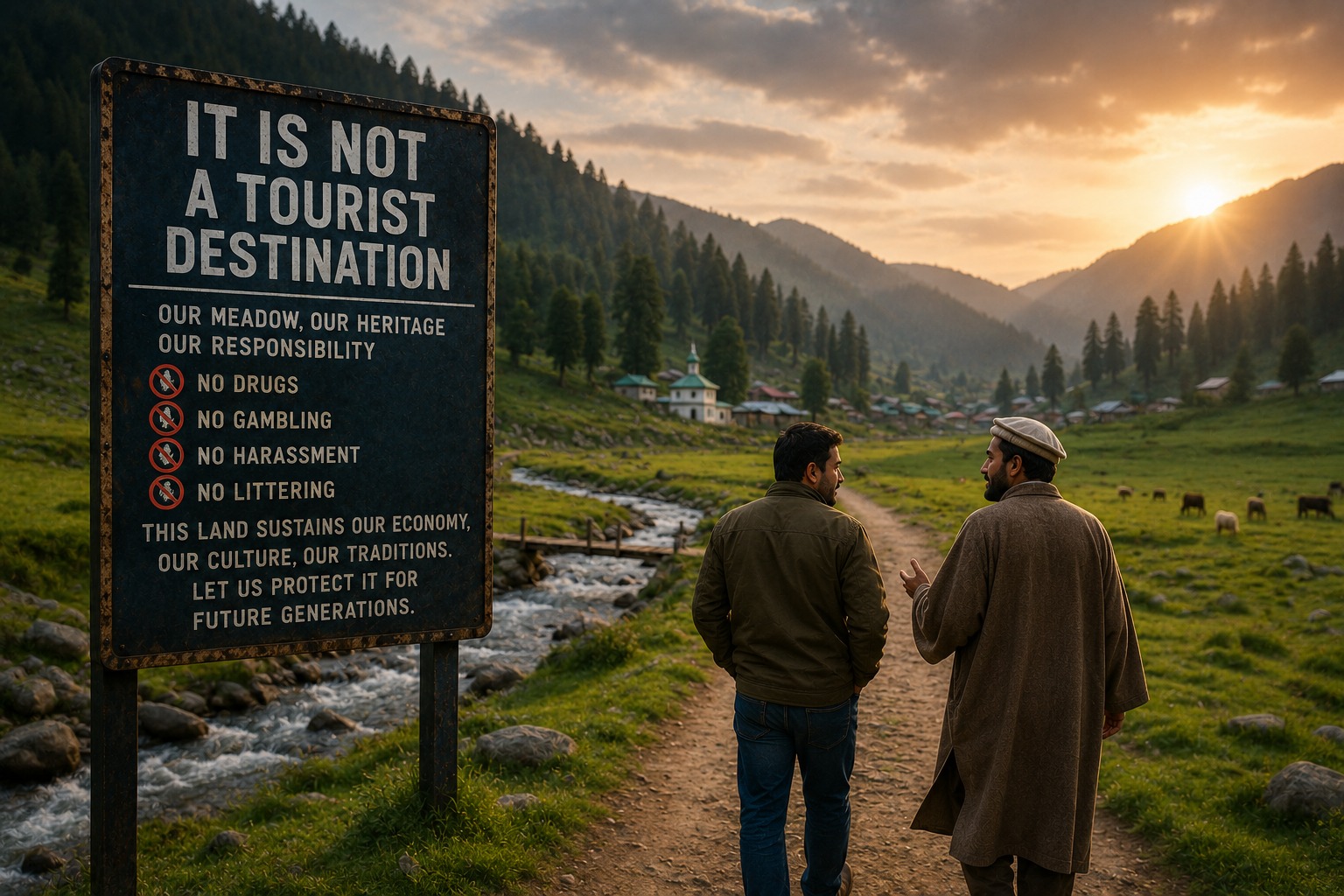
It is not a Tourist Destination

(This short story highlights the truth that the true identity of a place lies not only in its natural beauty, but also in its culture, livelihood, traditions, and the collective responsibility of its people.)

Usuf Mir


“The true beauty of a land does not lie only in its mountains, springs or green meadows. Its real beauty lives in its culture, its livelihood, its character and in the people who protect it.”

After his retirement, Sahil spent nearly eight months within the four walls of his home. He had devoted twenty years of his life to guarding the country’s borders as a soldier. Now he wished to spend time with his mother and the rest of his family, who had been deprived of his company for years because of the demands of military service.

During those months, he met several old friends, travelled through different places and gradually began to experience life from a new perspective.

Then, on Sunday, the fifth of August, after breakfast, he got into his car and drove away. He was alone and had no particular destination in mind. The only decision he had made was that, that day, he would take the road that turned to the right.

After travelling about twenty kilometres, he noticed a natural spring. He stopped the car, washed his hands and face in the icy water, and drank to his heart’s content. The cold, crystal-clear water instantly awakened memories of his childhood, when he and his friends used to drink from the springs of Gorimarg while playing there.

At that very moment, he decided that the rest of his journey would lead to Gorimarg.

It had been many years since he had last visited the area. The roads had changed and several new ones had been built. To make sure he chose the correct route, he opened GPS on his mobile phone. Gorimarg was about nine and a half kilometres away. Fortunately, the road leading there also branched to the right, the very direction he had already chosen.

About forty minutes later, Sahil reached Gorimarg. He parked his car in front of a small shop and greeted the shopkeeper with a smile.

“Assalamu Alaikum, brother. Could you please tell me where I can find Mr. Munawar?”

“Wa Alaikum Assalam. Certainly,” the shopkeeper replied warmly. “But which Munawar? We have three people here by that name. One works at the hospital, another served in the army, and the third owns a shop near the bus stand.”

“I’m looking for my friend who served in the army.”

“Oh, now I know who you mean.”

“Thank you very much,” Sahil said politely. Then, smiling, he added, “Though I think I’ve already found a friend. I wasn’t planning to come here today. I only asked about Munawar because we served together in the army.”

The shopkeeper smiled.

“You’re most welcome. My name is Yaqoob, but everyone here calls me Kuba.”

As they continued talking, the feeling of unfamiliarity gradually disappeared. Before long, it seemed as though they had known each other for years.

By then, it was nearly five in the evening. After closing his shop, Kuba turned to Sahil and said, “Come with me. Today, you are my guest.”

The moment they entered the house, Sahil felt as though he were visiting an old family friend.

Kuba’s mother was an elderly, kind-hearted woman who welcomed her son’s guests with genuine warmth. She churned fresh homemade yoghurt into buttermilk, added crushed mint and a pinch of salt, and served it to Sahil with motherly affection.

The very first sip carried him back to his childhood. He remembered his late mother, who used to prepare buttermilk for him with the same love and care.

“My friend… where have you gone?” Kuba asked with a smile.

Sahil came back to himself and smiled faintly.

“Nowhere… I was just remembering my mother.”

Kuba gently held his hand.

“Come, let me show you around Gorimarg.”

The two friends stepped out together and slowly made their way towards the vast meadow of Gorimarg.

Evening was spreading its last shades of beauty across the valley. The sun was sinking behind the hills, casting a soft golden glow over the meadow. Tree-covered hills surrounded the valley like silent guardians. Gentle breezes rippled through the green grass and whispered through the branches. Birds were returning to their nests, while the distant sounds of grazing livestock blended peacefully with the stillness of nature.

Sahil stood quietly for a while, taking in the beauty before him.

Then he drew a deep breath.

“Kuba… so many years have passed, yet this place still carries the same fragrance. It feels as though I have returned to my childhood.”

Kuba smiled.

“Some places never leave a person’s heart. It is we who drift away from them.”

They continued walking slowly across the meadow. Sahil admired the evening landscape while childhood memories filled his mind.

Suddenly, he noticed a large iron board standing ahead.

He stopped in his tracks.

Written on it in bold letters were the words:

“It is not a Tourist Destination.”

Sahil looked at the board in surprise.

“Kuba, what does this mean? Why has this board been placed here? I came here many times as a child, but I never saw anything like this.”

Kuba looked at the board for a long moment.

“The story behind this board is much longer than these few words,” he said quietly. “If you have the patience to listen, today I will show you not only Gorimarg, but also the forgotten history of this village.”

He began to narrate how the meadow had once been the backbone of the village economy, how livestock, farming and traditional livelihoods had sustained generations, how neglect had slowly replaced responsibility, and how the abandoned meadow had eventually become a gathering place for gambling, drugs, littering and other anti-social activities.

He spoke of the village girls who once walked safely along the footpath to the spring, but later became afraid because of harassment and indecent behaviour. He described how a group of young men tried to justify their actions by claiming they were turning the place into a “Tourist Destination”, even putting up a decorated banner with those words.

Under that banner they organised a noisy celebration filled with drinking, disorder and irresponsible behaviour. The following morning, the village elders found the meadow covered with rubbish, empty bottles, plastic bags and leftover food. Several young men were still lying there intoxicated.

The elders realised that if they failed to save the meadow, they would lose far more than a piece of land. They would lose their culture, their livelihood and their identity.

A few days later, the village elders, respected citizens and representatives of neighbouring villages called a joint meeting. The young men were invited as well.

No one was humiliated. No one was punished.

Instead, the elders spoke with patience, wisdom and compassion.

“My sons,” the committee head said, “we are not here to punish you. We are here to make you the guardians of this meadow. Mistakes can be corrected, and those who reform themselves often become the finest members of society.

“This meadow is not merely a piece of land. It represents our economy, our culture, our traditions and our collective heritage. If you truly wish to bring development, then restore this place instead of destroying it.

“With modern scientific methods, this land can support dairy farming, livestock rearing, sheep farming, goat farming, poultry farming and many other rural livelihood projects. That is real development. That is self-reliance. That is the future.”

The elders’ words touched the hearts of the young men. They admitted their mistakes, apologised and promised to protect the meadow.

The very next day, the elders, the youth and even the village children joined hands to clean and restore it.

The first thing they did was remove the banner that read:

“This is a Tourist Destination.”

In its place, they installed a permanent iron board bearing the words:

“It is not a Tourist Destination.”

Beneath it was written that the meadow was part of the village’s economy, culture, traditions and collective heritage; that drugs, gambling, harassment, littering and every form of immoral activity were strictly prohibited; and that the land should be used for scientific and productive rural livelihood projects for the benefit of future generations.

Sahil stood silently before the board for a long time.

Then he turned towards Kuba.

The two friends quietly began walking back towards the village.

Evening had almost faded, and the valley lay wrapped in peaceful silence.

After a while, Sahil broke the silence.

“Kuba, today I have understood that the true beauty of a land does not lie only in its mountains, springs or green meadows. Its real beauty lives in its culture, its livelihood, its character and in the people who protect it.”

Kuba smiled gently.

“That is why… it is not a Tourist Destination.”

The two friends continued their walk in silence.

From that day onward, Gorimarg was no longer just a meadow in Sahil’s memory. It had become a living trust, reminding him that every generation shares the responsibility of protecting its heritage.


Author is former District Information Officer. He can be mailed at  yousufmir555@gmail.com


Comments are closed.