


Dr. Rizwan Rumi
“A modern city is judged not by its cobblestones or decorative lighting, but by whether its hospitals, markets, government offices and neighbourhoods remain accessible after ordinary rainfall. Urban resilience begins below the surface, not above it.”
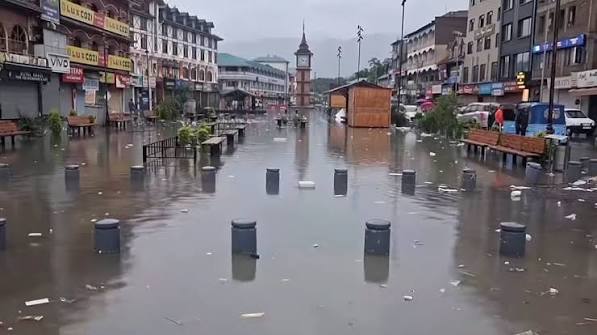
It takes less than 120 minutes of summer rainfall to completely dismantle the multi-billion-rupee illusion of urban modernization in Kashmir. In July 2026, an ordinary monsoon spell delivered approximately 45 millimeters of rain over the summer capital. Within hours, Srinagar’s central commercial zones, hospital access corridors, government centers, and residential colonies were transformed into stagnant waterways.
From the newly cobblestoned pedestrian promenades of Ghanta Ghar at Lal Chowk to the ground floor of the J&K Civil Secretariat, civic life ground to an absolute halt. Electronic stores in Baba Demb suffered losses as rainwater surged over thresholds. Key healthcare institutions like SMHS and JVC Bemina became virtually inaccessible. Commuters were stranded on submerged arterial routes from Downtown’s Saraf Kadal to Uptown’s Boulevard Road.
The scene was as frustrating as it was familiar. It triggered immediate outrage from trade bodies, civil society, and political leaders, prompting official calls for an independent third-party technical audit. However, this recurring crisis requires more than temporary indignation; it demands an honest, scientific, and administrative critique: Why does a city that has absorbed thousands of crores under urban development schemes continue to drown under routine precipitation?
The answer lies in a fundamental civil engineering failure: a persistent administrative bias toward high-visibility, surface-level cosmetics at the direct expense of basic hydraulic design.
-
The Financial & Engineering Disconnect
To understand the depth of Srinagar’s urban crisis, one must trace the flow of public money against the reality on the ground. Under the flagship Srinagar Smart City Limited (SSCL) portfolio—implemented via a Special Purpose Vehicle—projects worth over ₹3,600 crore were proposed, with hundreds of crores spent across surface upgrades. Yet, the city’s fundamental stormwater resilience remains utterly compromised.
-
Misdirected Recovery Capital: Following the catastrophic 2014 deluge, over ₹300 crore was allocated under the World Bank-assisted Jhelum Tawi Flood Recovery Project (JTFRP) for urban flood mitigation. From this fund, ₹103 crore was directed to the Srinagar Municipal Corporation (SMC) specifically to build and upgrade 49 specialized stormwater pumping stations designed to flush rainwater out of low-lying neighborhoods.
-
Regulatory & Engineering Violations: Rather than building dedicated, closed-loop stormwater evacuation lines, several upgraded stations were illegally connected to raw, untreated sewage networks. During intense downpours, the combined hydraulic load overloads the pumps, choking filtration grids with solid waste and driving polluted water backward into residential streets. This practice triggered regulatory penalties from the National Green Tribunal (NGT) totaling over ₹33 crore for environmental violations.
-
Mobile Dewatering as a Permanent Policy: Following recent storms, civic officials admitted to deploying mobile dewatering pumps across 60 identified waterlogging hotspots. Relying on diesel-driven emergency pumps during every routine shower proves that the city’s primary underground static drainage network fails by default.
-
Suffocating the Natural Buffers
Srinagar was historically shaped by geography as an ecological sponge. A delicate network of natural streams (khols), spillways, and expansive wetland depressions—such as Hokersar, Bemina, Zainakote, Hyderpora, and Rawalpora—acted as natural absorption buffers for the Jhelum River. Over the last three decades, environmental research shows that Kashmir has lost over 90 square kilometers of wetland area to unmonitored earth-filling and concrete encroachment.
This loss of natural absorption has been compounded by major infrastructure projects executed without adequate hydrological foresight:
-
Choking the Spill Corridors: Linear development projects—including highway expansions like NH-44 and the Srinagar Semi-Ring Road corridor—have dumped thousands of tons of fill dirt directly into low-lying agricultural depressions and wetland fringes near Gallander, Khanda, and Pampore.
-
Interrupted Irrigation Networks: These highway embankments severed traditional zamindar khols (local irrigation and drainage streams), turning highway corridors into artificial dams that trap surface runoff inside adjacent residential colonies during heavy rainfall.
-
Burying the Surface Inlets: Continuous road-raising (macadamisation) by the Roads & Buildings (R&B) Department has systematically raised street levels above existing shop thresholds and buried roadside drain inlets. Without functional entry points into primary outfall canals, water accumulates on the asphalt with nowhere to go.
-
The Smart City Paradox: Aesthetics Over Hydraulics
The primary operational flaw of Srinagar’s recent urban transformation has been the prioritization of high-visibility, surface-level aesthetics over the invisible, essential infrastructure below the pavement.
Project Domain |
Execution Focus |
Real-World Hydrological Outcome |
Riverfront Promenades |
Decorative embankments, seating, and lighting along the Jhelum. |
Visually appealing waterfronts, while the immediate city grid behind them lacks outfall discharge capacity. |
Commercial Plazas |
Pedestrian-friendly cobblestones (e.g., Polo View, Lal Chowk). |
Impermeable decorative stone traps surface water; plazas flood under knee-deep water during standard rain. |
Road Resurfacing |
Applying fresh macadam layers repeatedly over old roads. |
Road levels rise above existing roadside drainage inlets, severing runoff paths to primary canals. |
Stormwater Dewatering |
Interconnecting dewatering machinery with local sewers. |
Pumps choke on solid waste and sewage, leading to localized backflow during peak runoff. |
-
Establishing Engineering & Executive Accountability
When multi-billion-rupee urban hubs collapse under ordinary monsoon showers, it cannot be written off as an unavoidable natural calamity. It represents a clear failure of planning, execution, and oversight. The third-party technical and financial audit ordered by the UT administration must mark a turning point toward structural accountability.
To build long-term urban resilience, responsibility must be established across three distinct lines:
-
Forensic Technical Auditing of DPRs: Audits must verify whether ground execution matches approved Detailed Project Reports (DPRs). Chief engineers, consulting hydrologists, and agency directors who signed off on civil designs that bypassed, choked, or buried established natural drainage lines must be held answerable for design negligence.
-
Penalizing Civil & Environmental Malpractice: Interconnecting stormwater infrastructure with raw sewage networks violates basic sanitary engineering standards and environmental regulations. Executing agencies responsible for approving or building these improper connections must face direct administrative penalties and recovery of wasted public funds.
-
Creating a Unified Drainage Authority: The routine shifting of responsibility between Srinagar Smart City Limited (SSCL), the Roads & Buildings (R&B) Department, and the Srinagar Municipal Corporation (SMC) must end. Srinagar requires a single, empowered Urban Drainage Authority with complete jurisdiction over the catchment area, mandatory pre-monsoon capacity certifications, and public accountability for every kilometer of drain.
Comments are closed.