
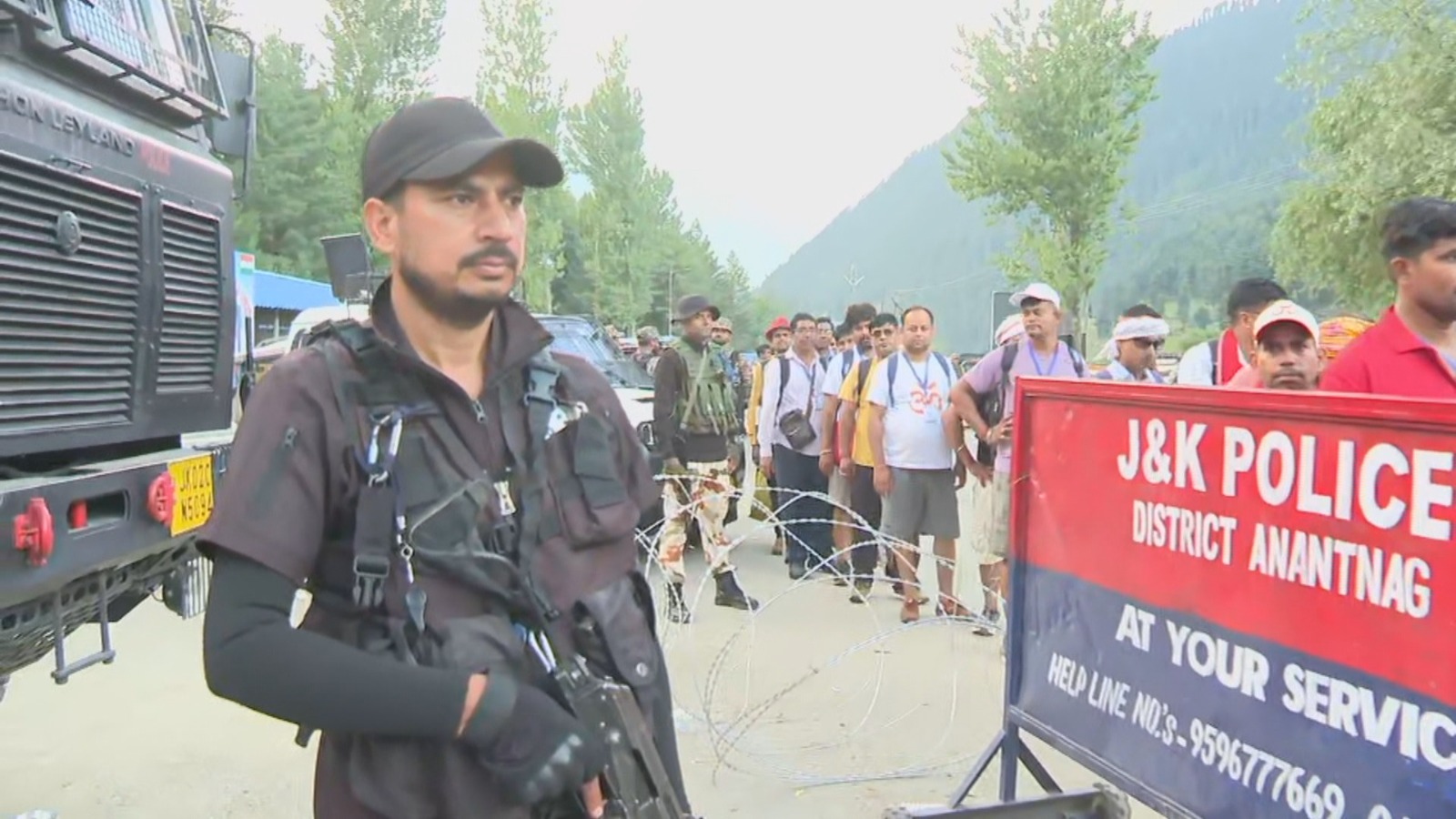
Anantnag police’s tech-savvy, people-first approach turns Amarnath Yatra into ‘model of Kashmiriyat’

From AI surveillance to 24/7 langars, free SIM cards and 'red carpet' welcome at railway stations, pilgrims return with stories of safety and warmth as J&K Police rewrite the narrative of the annual pilgrimage

Suhail Khan


Srinagar, July 16: For decades, the annual Amarnath Yatra has been viewed through the prism of security challenges and logistical nightmares. But the 2026 edition is quietly rewriting that narrative. At the Nunwan Base Camp in Pahalgam, the Anantnag Police have orchestrated what many are calling a blueprint for people-centric policing — blending cutting-edge surveillance technology with the old-fashioned warmth of Kashmiriyat.

From the moment pilgrims step off trains at Anantnag railway station, they are met not by the stern faces of security personnel but by police teams waiting to welcome them, arrange cabs, and ensure a seamless commute to the base camp. It is a gesture that has left thousands of devotees from across the country astonished — and deeply grateful.

‘Police welcoming us — it doesn’t happen on an ordinary day’

Sisters Shweta and Nidhi from Hyderabad arrived with the usual anxieties that have long coloured perceptions of travel to the Valley. What they encountered instead was a red-carpet welcome that shattered every preconceived notion.

“Something that really surprised us — when we got down at Anantnag railway station, a police team was waiting to welcome us. They asked if we had come for the yatra, kept us aside, ensured we got a proper cab, and took our pictures. It was a seamless commute to this base camp,” Shweta told Kashmir Convener.

“Anyone spreading false information about Kashmir should be punished. Looking at the arrangements here, we feel like VIPs. Police welcoming us — it doesn’t happen on an ordinary day. We are glad,” she added.

“Since the time we entered Srinagar, Jammu, and Kashmir — auto drivers, police, and railway workers — everyone has been so helpful and welcoming. If you want to witness and experience the city, you should be coming here,” said Shweta. “There is no harm. Good arrangements, good security. Thanks to everyone — thanks to the police.”

Manish Kumar from Punjab, who found the facilities at the base camp exceeding all expectations. “First of all, Har Har Mahadev. I have come from Punjab. We have got very good facilities from the police and army here. Everything is available in the market here — food and accommodation are all good,” he said.

The success of this year’s yatra is no accident. The Anantnag Police have deployed an elaborate security architecture that includes 416 high-resolution CCTV cameras, Facial Recognition Systems at 58 vulnerable points, five drones for aerial surveillance, and 28 elevated observation posts — all part of ‘Project Hawk Eye’.

But it is the human touch that appears to be making the real difference.

At the help desk, PSI Shruti Kanani explained the operational philosophy driving the arrangements. “To make this Amarnath Yatra successful, we have five help desks throughout the route. At Nunwan Base Camp, under the leadership of SO Ruhail Mircha and Inspector Javed, all grievances are addressed promptly — missing baggage, lost persons, RFID issues, accommodation, medical emergencies, and found-and-lost items,” she said.

“All grievances are taken into prompt action. CCTV footage is provided from the control room. Everything is handled through a proper procedure.”

Kanani also praised the new RFID card system introduced this year. “There is a new RFID card system — the whole tour will be with us, and if there is any problem, our full name will appear in it. So that is also very good.”

The Nunwan Base Camp has effectively become a model township. Round-the-clock langars are feeding thousands, while a fully functional mini-market caters to every conceivable need — from SIM cards to daily essentials. Pilgrims without mobile connectivity can register and receive SIM cards from multiple companies immediately at the camp.

Health stalls have been set up along the route, with first aid and necessary medical actions available at all times. Pilgrims recounted instances of security forces going beyond the call of duty — like the time police rushed oxygen to an elderly pilgrim struggling to breathe on the route.

For local vendors and youth, the yatra has emerged as a vital economic opportunity in a region grappling with unemployment. The tent city and associated infrastructure have generated substantial employment, creating a virtuous cycle where pilgrim satisfaction translates directly into local livelihoods.

“You know, there is a lot of unemployment here in Kashmir. Our annual income depends on tourists. This year, all previous records will be broken,” a local vendor told this newspaper. “It seems security here is very tight, and facilities are all here. The people coming here are happy. We are happy — they are also happy.”

Piyush Kanani from Jamnagar, Gujarat, on his fourth Amarnath Yatra, drew a direct connection between pilgrim welfare and regional stability. “When pilgrims come, the youth here also get employment. When there is a problem, they don’t have a job, they don’t have money — then there can be some problems. But this time, it was very good,” he said.

The transformation of the Amarnath Yatra into a model of hospitality has not gone unnoticed at the highest levels. Lieutenant Governor Manoj Sinha recently visited the Nunwan base camp to review arrangements, directing officials to prioritise the safety, security, and convenience of all pilgrims while assuring devotees of a hassle-free journey.

For the pilgrims returning to their home states, the message from the ground is unequivocal: Kashmir is safe, welcoming, and ready.

Another pilgrim, speaking from Ground Zero, summed up the sentiment of many. “As soon as we got down, we got a lot of help from the police. They helped us get the cab, and wherever we turn, we can see police deployed. They are at our service — there is no fear about security. This is my first time too, and it’s absolutely, absolutely helpful. I just salute the Anantnag police and all the police deployed for our security.”

Notably, More than 3.25 lakh pilgrims have offered prayers at the 3,880-metre-high cave shrine till now.

With Thursday’s departure, a total of 1,04,488 pilgrims have left the Jammu base camp for Kashmir since the yatra commenced on July 2.

Comments are closed.