SRINAGAR, JULY 14: Across Kashmir, the irony is hard to miss. The same land that once inspired poets to call it paradise is now battling an environmental crisis of its own making: its famous water bodies clogged with plastic, its tourist spots buried under garbage, and its drains overflowing with waste that no one wants to claim.
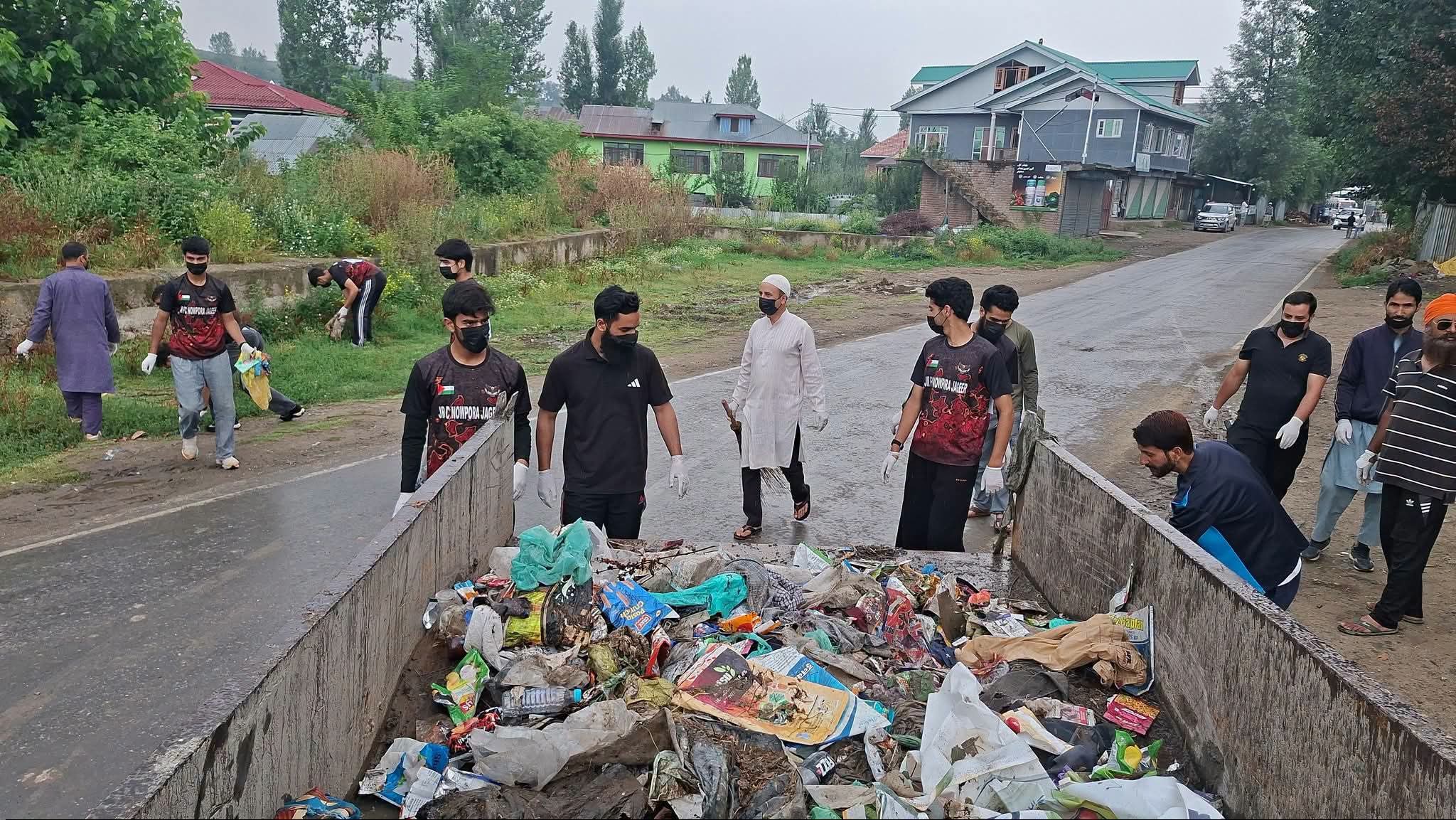
But in Nowpora, a village in north Kashmir’s Baramulla district, a group of young men and women is refusing to accept this as fate. On Sunday, over 50 youth volunteers from the Youth Welfare Committee (YWC) fanned out across the locality, clearing garbage from drains, public pathways, and vacant plots that had become dumping grounds. The waste was segregated and handed over to municipal sanitation workers for disposal.
The drive, organisers said, was not about a one-time cleanup. It was about making a point.
“The government has its limitations. We cannot keep blaming authorities while we continue to litter our own surroundings. Every individual must own this responsibility for their own well-being,” Imtiyaz Khanday, a senior functionary of the committee, told Kashmir Convener.
The numbers paint a grim picture. Urban centres across Jammu and Kashmir generate over 1,500 metric tonnes of solid waste every day. Most of it ends up in open dumps, clogging drains, polluting water bodies, and scarring the landscape. Dal Lake, the jewel of Srinagar, has lost nearly 50 per cent of its original water spread due to siltation and pollution. Gulmarg, Pahalgam, and Sonamarg—the Valley’s most visited tourist destinations—have become synonymous with mounting piles of garbage during peak seasons.
And yet, the blame game continues. Residents point fingers at the municipality. The municipality points at the tourism department. The tourism department points at the government. The government points at the lack of public cooperation. This Baramulla village’s initiative, however, cuts through this cycle of blame.
The response from local residents was immediate. Many stepped out to assist the volunteers, clearing debris and helping with segregation.
“This is what we need—people taking the lead instead of waiting for the municipality to act. If every locality does this, half our problems are solved,” said Ghulam Nabi, a shopkeeper in the area.
The YWC has now announced plans to conduct similar drives every Sunday. The group is also preparing to launch an awareness campaign in local schools, with the aim of inculcating cleanliness habits among children from an early age.
“Cleanliness is not a one-day event. It is a continuous process. Our goal is to make Nowpora a model for other localities to follow,” said Lone Mehraj, a senior member of the group.
The drive ended with a pledge ceremony, where residents vowed to keep their neighbourhood clean and discourage open dumping of waste.
This is not the first time community action has made a difference in Kashmir. Earlier this year, a similar initiative in South Kashmir’s Kulgam district led to the restoration of the polluted Sandran rivulet. What was once a drain for waste is now flowing clean again—a testament to what collective action can achieve when citizens refuse to wait for the government.
The government, for its part, has rolled out multiple schemes under the Swachh Bharat Mission. But officials concede that without public cooperation, even the best policies remain on paper.
The Nowpora model addresses precisely this gap. It is not about grand gestures. It is about taking small, consistent steps—and inspiring others to do the same.
Dr. Raja Muzaffar Bhat, an environmental activist, issued a stark warning in an interview with Kashmir Convener. “We often speak of ‘acting locally for global impact,'” he said, “but our actions tell a completely different story. We are destroying nature with our own hands—felling forests, choking our water bodies, draining wetlands, and dumping waste without any scientific treatment. We are polluting our land, our air, and our future. And this is no longer a local issue; the damage we are inflicting on Kashmir will soon be felt globally. We are acting, yes—but in a deeply destructive manner.”
He lamented the widespread apathy, saying, “It is tragic that we have become the architects of our own environmental ruin. What we are witnessing today is nothing less than a cancer spreading through our ecosystems and communities. How much longer will we remain silent? How many more warnings do we need before it becomes too late?”
Dr. Bhat stressed that the time for empty assurances is over. “We have heard enough government promises that have failed to translate into meaningful change. Now, we must act—not tomorrow, but today. We still have a window to reverse the damage, but only if we wake up from our deep slumber. Through legal mechanisms like the National Green Tribunal, we can push for accountability. However, what we truly need is a people’s movement. Every citizen must raise their voice because this is not merely about nature—it is about our very survival.”
“The truth is simple,” he added. “We have polluted our own home. We have betrayed our environment. And now, we have no choice but to fight back—together, urgently, and with everything we have.”
Notably, the Nowpora community action builds upon the significant initiative recently undertaken by authorities in north Kashmir’s Gurez Valley, who have intensified efforts to safeguard the region’s fragile ecology. With its breathtaking landscapes, the Gurez Valley is now emerging as a testing ground for stricter environmental norms.
Renowned for its pristine vistas, snow-capped peaks, and the roaring Kishanganga River, Gurez has, in recent years, fallen victim to its own popularity. Officials report that unchecked plastic waste accumulation has transformed parts of this tourist haven into a garbage dump, with littering often going unnoticed, thereby inflicting lasting damage on the local ecosystem.
In a decisive response, the civil administration has imposed a comprehensive ban on single-use polythene across the valley. The decision, reached during a recent high-level meeting, reflects growing official concern over the escalating waste crisis. Tourists found violating the ban now face stringent penalties, including a heavy fine of ₹5,000. This measure is designed not only to preserve Gurez’s ecological sensitivity but also to deliver a clear message that environmental transgressions will be met with firm action.
If such endeavours gain momentum, the paradise that appears to be slipping away may yet be reclaimed—not by governments alone, but by the people themselves.


Comments are closed.