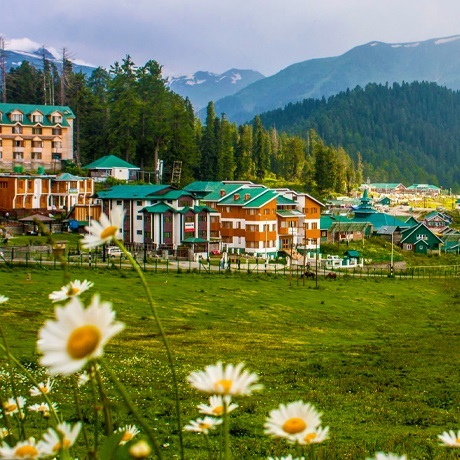
Gulmarg, July 13: The meadow of flowers is in full bloom—and so are its parking lots, its hotels, and its challenges. As Gulmarg witnesses an unprecedented summer rush, the Gulmarg Development Authority (GDA) is scrambling to upgrade infrastructure without compromising the pristine ecology that has made this resort town a household name across the subcontinent.
Tariq Hussain Naik, Chief Executive Officer of GDA, told Kashmir Convener that while winter remains Gulmarg’s calling card, this year’s summer footfall has exceeded all expectations. “We are in peak season right now in summer, but Gulmarg is always known for winter tourism more than summer—summer is always a bonus,” Naik said.
What has caught the administration by surprise is the changing profile of the visitor. “This year we have seen a new trend—tourists from neighbouring states like Punjab, Haryana, Delhi, and Uttarakhand are driving down by car. This has given a substantial boost to our local stakeholders and economy,” he said, adding that hotel, guest house, and homestay bookings are running at near-full capacity.
But the numbers tell a cautionary tale. According to the environmental impact assessment, Gulmarg’s daily carrying capacity is estimated at a mere 3,000 to 4,000 visitors—a figure that is routinely breached during peak days, raising alarm bells among conservationists and administrators alike.
“Our tourism is nature-based except for the cable car. Balancing nature and development is a very challenging task,” Naik admitted, acknowledging the fine line the GDA must tread.
To decongest the core area, the administration is actively promoting dispersal to offbeat destinations such as Afarwat Peak, Drangg, and Shranz Waterfall. “The government wants to develop new destinations. This will not only reduce pressure on Gulmarg but also open up new livelihood opportunities,” he said.
Traffic congestion remains the most visible symptom of Gulmarg’s success. With parking capacity for barely 1,000 vehicles, the town’s narrow roads often grind to a halt during peak hours. “We are trying to augment more parking facilities,” Naik said, revealing that a multi-storey parking project is in the pipeline.
In a first for Gulmarg, the GDA is also planning a dedicated pedestrian walkway to separate tourists from vehicular movement—a move aimed at enhancing safety and the overall visitor experience.
The heritage golf course, counted among the oldest and highest green courses in the world, is set to get new fencing, while the crumbling Maharaja Palace—a relic of the Dogra era—will undergo renovation. “We will also try to renovate the Maharaja Palace, a heritage building,” Naik confirmed.
Solid waste management, too, is emerging as a pressing concern, with the town generating mounting garbage that strains its limited disposal infrastructure.
The CEO GDA said that Gulmarg offers vast potential across adventure, leisure, heritage, and cultural tourism—but none of it can be realised at the cost of the environment.
“The challenge is to develop without destroying,” he said. “We are committed to that balance.”
For now, Gulmarg’s summer story is one of cautious optimism—a town that is learning to grow without losing its soul, even as the world beats a path to its door.


Comments are closed.