
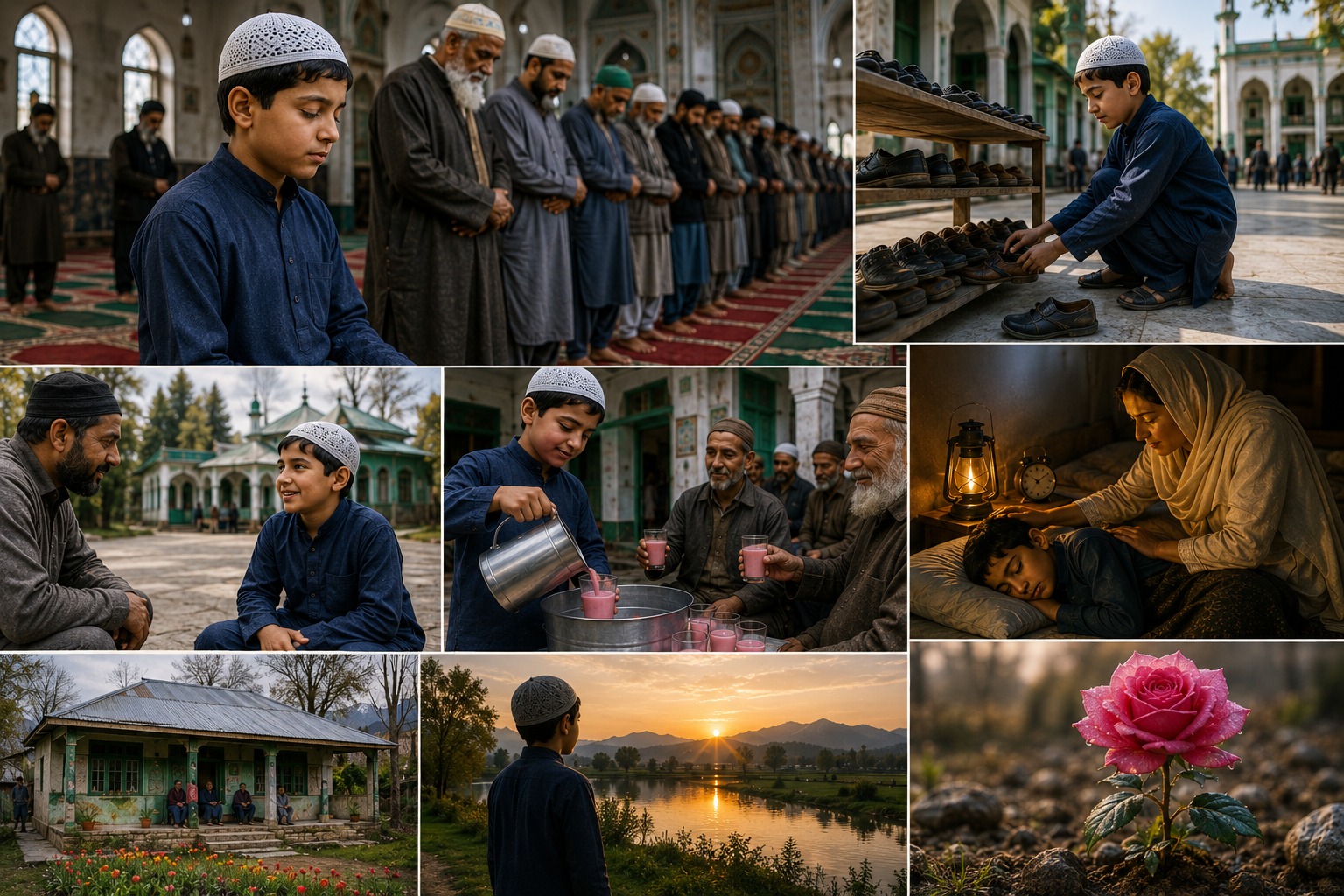
The Boy in the First Row
(This story is about a mother's silent nurturing and the values that often emerge from ordinary homes to create extraordinary human beings.)


Usuf Mir
“The first row, the discipline, the humility, the kindness, and the desire to serve—all of it pointed to someone standing quietly behind the scenes: a mother who had chosen to build character rather than simply raise a child.”
After the Fajr prayer (dawn prayer), the worshippers quietly made their way home. They stepped out, one by one, into the cool morning air. Sahil remained seated in a quiet corner of the mosque, as he often did these days.
Over the past few months, prayer had given a new rhythm to his life. After Fajr, he no longer rushed back home. Sometimes he recited the Qur’an. At other times, he sat in silent remembrance, enjoying the peace and tranquility that settled over his heart in those early hours of devotion.
It was during those mornings that he began noticing a young boy who stood in the first row for Fajr prayers every single day without fail.
The child could not have been more than ten years old. What caught Sahil’s attention was not his age but his consistency. Day after day, the boy stood in the first row.
At first, Sahil paid little attention. But as the days passed, his interest in the boy deepened. Many elderly men occasionally arrived late for prayer, yet this young boy was always there before everyone else.
Who was he?
One morning, after the prayer, Sahil approached him.
“What is your name, son?”
“Dawood.”
“And where do you study?”
Sahil expected to hear the name of a well-known religious seminary. But to his surprise, the boy replied simply,
“I study at the government school in our village.”
“Not in a madrasa?”
Dawood shook his head.
“No.”
Sahil was surprised. His first assumption had been wrong.
A few days later, during the noon prayer, he noticed the boy again. Outside the mosque, near the veranda, a bucket, a jug, and several glasses had been arranged neatly. Dawood was serving a sweet drink to the worshippers. He greeted each person politely, handed them a glass, and quietly returned to his place.
There was no sign of pride on his face. No desire for praise. He seemed genuinely happy to serve.
Sahil watched him for a long time. The boy’s maturity was unusual for someone so young, and with each passing day, Sahil’s curiosity and wonder deepened.
A few days later, he asked another question.
“Is your mother from Zarla village?”
The people of Zarla were known for their simplicity and deeply traditional way of life. Perhaps, Sahil thought, the secret lay there.
But Dawood smiled and replied,
“No. My mother is from Shagoobagh.”
Once again, Sahil’s assumption proved wrong.
The boy did not study in a religious seminary. His family did not come from the background Sahil had imagined. Yet there was something different about him—something that set him apart.
One afternoon, while passing through the neighbourhood, Sahil happened to see Dawood’s home. It was a small single-storey house where two brothers and their families lived under the same roof.
The house was modest, but it was clean and orderly. There was little comfort, yet there was dignity.
From the villagers, Sahil learned that Dawood’s father earned barely enough to support the family. Some months he earned about ten thousand rupees. In other months, he earned between twelve and fifteen thousand.
People also spoke of him as an ordinary man with many shortcomings. He was not known for his attachment to the mosque, nor for setting an example for others.
That revelation only deepened Sahil’s curiosity and wonder.
If the boy had belonged to a wealthy family, if his father had been a respected religious figure, or if he had studied at a famous madrasa, everything would have made sense.
But none of it did.
So what was the secret?
The answer came one morning after prayer.
“Dawood,” Sahil asked gently, “who wakes you up for Fajr every day?”
A smile appeared on the boy’s face.
“My mother.”
“Every day?”
“Every day. She wakes up before me. Sometimes she prepares everything before I get up. Then she reminds me not to be late for prayer.”
For a moment, Sahil said nothing.
The answer was simple.
Yet it explained everything.
The first row.
The discipline.
The humility.
The kindness.
The desire to serve.
All of it pointed to someone standing quietly behind the scenes.
His mother.
Not a school.
Not a madrasa.
Not wealth.
Not status.
A mother.
A mother who had chosen to build character rather than simply raise a child.
Days later, Sahil watched Dawood once again standing near the mosque entrance, carefully arranging the worshippers’ shoes.
As he looked at the boy, images of that small house returned to his mind—the limited income, the simple life, and the daily struggles.
And in the middle of it all was a woman quietly planting seeds of goodness in her son’s heart.
At that moment, Sahil felt a deep respect for a woman he had never even met.
It seemed to him that some of the finest flowers do not grow in perfect gardens.
They bloom in difficult places.
They push through hard soil.
They survive among thorns.
And yet, they blossom.
As he stepped out of the mosque and looked toward the brightening sky, a gentle smile crossed his face.
He finally understood.
Sometimes the most beautiful roses grow where no one expects them to.
Comments are closed.