

S. Ahmad
More than seven decades after Independence, one of India’s greatest challenges remained the gap between policy and people. Governments announced schemes, budgets were allocated, and development plans were drafted, yet millions of citizens continued to live on the margins of economic and social progress. Tribal communities in remote forests, Scheduled Castes in underserved villages, nomadic groups without formal identities, sanitation workers performing hazardous jobs, and minority communities facing barriers to education and employment often remained outside the mainstream development narrative.
The true measure of governance, however, is not how much is spent but how effectively development reaches those who need it the most. It is in this context that the philosophy of Antyodaya—the rise of the last person—has acquired renewed significance in India’s development journey.
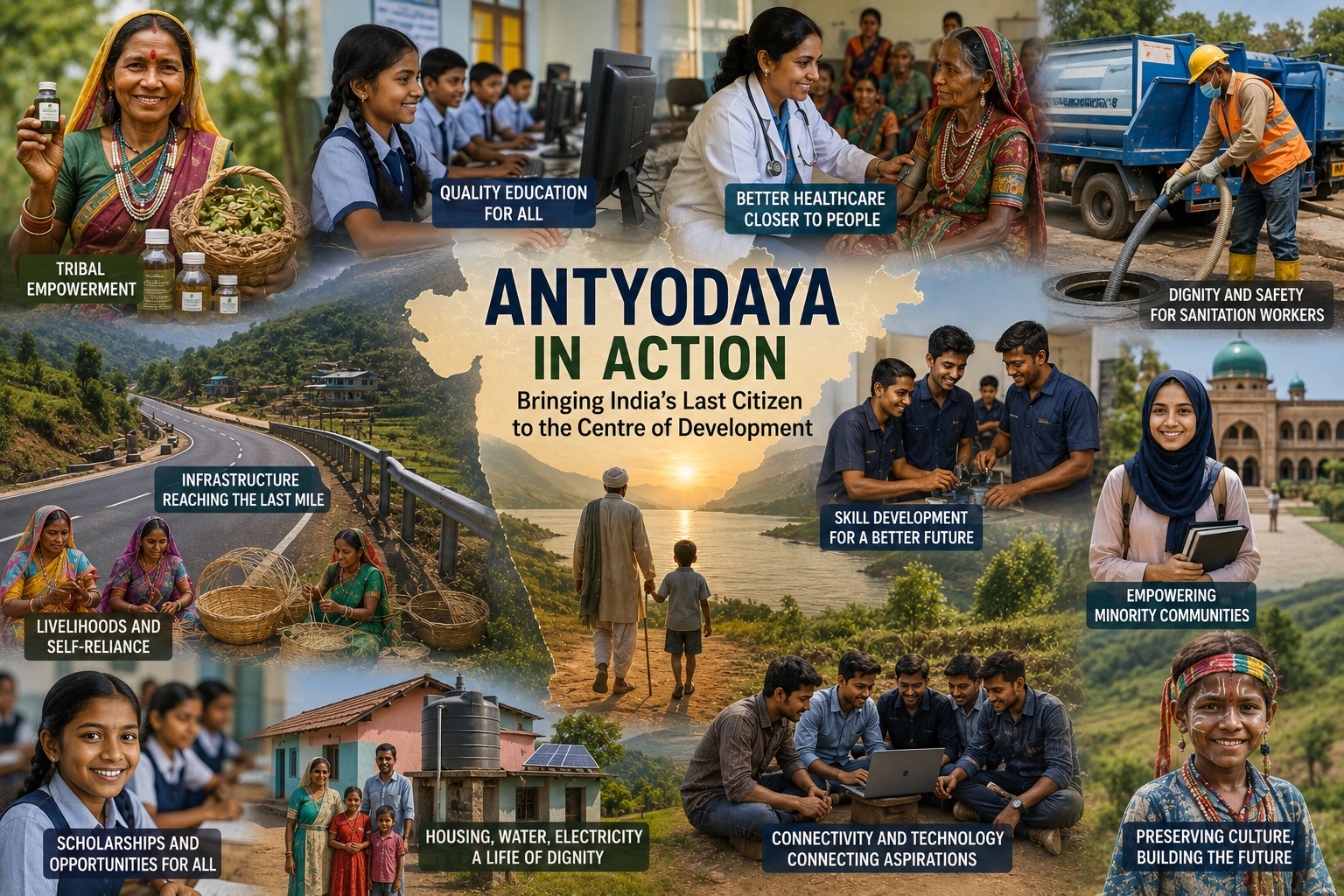
Rooted in the ideals of Mahatma Gandhi and later articulated by Pandit Deendayal Upadhyaya, Antyodaya represents a simple but profound principle: the success of public policy should be judged by its impact on the poorest, weakest, and most disadvantaged sections of society. Over the past twelve years, this principle has increasingly shaped governance priorities, transforming welfare delivery from fragmented interventions into a more integrated and inclusive framework aimed at ensuring dignity, opportunity, and growth for all.
The story of contemporary India’s social welfare landscape is therefore not merely about schemes and statistics. It is about a deliberate effort to bring historically excluded communities into the centre of national development.
From Welfare Delivery to Inclusive Development
For decades, welfare programmes often struggled with leakages, uneven implementation, and limited reach. Many communities remained disconnected from government services because of geographical isolation, social disadvantages, inadequate infrastructure, or lack of institutional support.
The recent shift in governance has sought to address these challenges through a saturation-based approach—ensuring that benefits reach every eligible citizen rather than a limited segment of the population. This approach has been particularly visible in tribal regions, aspirational districts, remote habitations, and areas inhabited by vulnerable social groups.
The emphasis has not only been on providing financial assistance but also on creating opportunities through education, skilling, entrepreneurship, healthcare, housing, connectivity, and cultural recognition. By converging the efforts of multiple ministries and agencies, the government has attempted to address long-standing development deficits through coordinated action rather than isolated interventions.
This transformation becomes particularly evident when examining the initiatives aimed at India’s tribal communities.
Tribal Development: Bridging Historical Gaps
India’s tribal population possesses rich cultural traditions, extensive ecological knowledge, and remarkable resilience. Yet for generations many tribal communities lacked access to basic services such as roads, electricity, healthcare, education, and communication networks.
The challenge was even greater for Particularly Vulnerable Tribal Groups (PVTGs), many of whom lived in remote and inaccessible regions with minimal engagement with formal development systems.
Recognising these gaps, the government launched the Pradhan Mantri Janjati Adivasi Nyaya Maha Abhiyan (PM JANMAN) in 2023. With a budgetary outlay exceeding ₹24,000 crore, the initiative seeks to improve the living conditions of 75 PVTG communities across 18 states and one Union Territory.
The programme addresses multiple dimensions of deprivation simultaneously. Housing, road connectivity, drinking water supply, healthcare services, electrification, telecommunications, hostels, vocational training, and livelihood opportunities are all part of a comprehensive development framework.
What distinguishes PM JANMAN is its focus on transforming tribal communities from passive beneficiaries into active participants in economic growth.
A compelling example comes from the Kamar tribal women of Gariyaband district. Traditional knowledge of medicinal herbs had long existed within the community, but economic returns remained limited. Through the Van Dhan Vikas Kendra initiative, women entrepreneurs received training, certification, and market access, enabling them to transform indigenous knowledge into commercially viable products. The result was not only increased income but also greater self-confidence and economic independence.
Such examples illustrate how targeted interventions can create sustainable livelihoods while preserving traditional knowledge systems.
Education as the Great Equaliser
No instrument of social transformation is more powerful than education. For historically disadvantaged communities, access to quality education often determines whether poverty continues across generations or is broken permanently.
The expansion of Eklavya Model Residential Schools (EMRS) represents one of the most significant educational interventions in tribal areas in recent years.
These residential schools have brought modern educational infrastructure to some of India’s most remote regions. Smart classrooms, science laboratories, computer facilities, libraries, sports infrastructure, and hostel accommodations have become accessible to students who previously had limited educational opportunities.
Today, more than 1.56 lakh students study in nearly 500 EMRS institutions, with hundreds of additional schools under construction.
Beyond infrastructure, these schools are creating aspirations.
The story of Jatin Negi from Himachal Pradesh’s remote Sangla village demonstrates the transformative potential of quality education. Growing up in a region cut off by harsh winters and limited resources, Jatin entered an Eklavya school in Class VI. Supported by dedicated teachers and structured learning, he eventually secured an impressive rank in the Joint Entrance Examination and gained admission to IIT Jodhpur.
His success symbolizes a broader shift occurring across tribal India. Students from regions once considered educationally isolated are increasingly entering premier institutions and competing successfully at national levels.
The rise in the number of EMRS students qualifying prestigious examinations such as JEE and NEET reflects not merely academic achievement but a widening of opportunity itself.
Preserving Culture While Promoting Progress
Development is often mistakenly viewed as a process that requires abandoning traditional identities. However, sustainable progress depends equally on preserving cultural heritage and indigenous knowledge.
The support extended to Tribal Research Institutes (TRIs) reflects an acknowledgment that tribal communities are not simply beneficiaries of welfare programmes but custodians of valuable linguistic, ecological, and cultural traditions.
These institutions document endangered languages, preserve oral histories, promote traditional knowledge systems, and contribute to policy development. Research on subjects such as community forest rights, traditional medicine, and indigenous livelihoods helps ensure that development remains culturally sensitive and locally relevant.
Similarly, the establishment of Tribal Freedom Fighter Museums and the observance of Janjatiya Gaurav Divas have sought to bring tribal contributions to India’s freedom struggle into the national consciousness.
Recognition itself can be empowering. When communities see their history and heritage acknowledged, development acquires a deeper sense of dignity and belonging.
Advancing Social Justice for Scheduled Castes
The pursuit of social justice remains incomplete without addressing the challenges faced by Scheduled Caste communities.
Although constitutional safeguards and affirmative action policies have expanded opportunities over the decades, significant disparities continue to exist in education, employment, infrastructure, and economic participation.
The Pradhan Mantri Anusuchit Jaati Abhyuday Yojana (PM-AJAY) represents an attempt to address these disparities through area-based development. Covering tens of thousands of villages across hundreds of districts, the programme focuses on infrastructure development, skill enhancement, and livelihood creation.
The initiative’s emphasis on village-level planning and infrastructure assessment has enabled a more systematic identification of developmental gaps. Roads, water supply, sanitation, educational facilities, and connectivity are increasingly being addressed through targeted interventions.
Complementing these efforts is the Development Action Plan for Scheduled Castes (DAPSC), which integrates SC-focused expenditure across multiple ministries and sectors. By ensuring dedicated allocations for welfare programmes, the framework seeks to institutionalize social justice within government planning processes.
The result is a more coordinated approach to addressing structural inequalities.
Education and Scholarships: Unlocking Human Potential
Financial constraints continue to prevent many talented students from pursuing higher education. Scholarship programmes therefore play a critical role in expanding educational opportunities.
The SHREYAS initiative has emerged as a significant platform supporting students from Scheduled Castes, Other Backward Classes, and Economically Backward Classes. By combining scholarships, coaching support, overseas education opportunities, and research fellowships, the programme reduces financial barriers to academic advancement.
Similarly, the SHRESHTA scheme focuses on providing quality residential education to Scheduled Caste students from low-income families.
The experiences of students such as Doli and Urmila demonstrate how educational support can alter life trajectories. Their stories are reminders that talent is widely distributed across society, but opportunities often are not. Effective public policy helps bridge that gap.
The growth in Scheduled Caste enrolment in higher education, increasing participation of female students, and improvements in Gross Enrolment Ratios suggest that these interventions are contributing to broader educational inclusion.
Reaching Nomadic and Backward Communities
Among India’s most overlooked communities have been nomadic tribes, denotified tribes, and economically backward groups.
Historically excluded from many welfare systems due to mobility, lack of documentation, and social marginalization, these communities often faced multiple layers of disadvantage.
Programmes such as PM-YASASVI, PM DAKSH, VISVAS, and SEED have sought to address these challenges through scholarships, skill development, credit support, livelihood assistance, and healthcare coverage.
Skill development under PM DAKSH, for example, focuses on connecting marginalized individuals directly to employment and entrepreneurship opportunities. By equipping beneficiaries with market-relevant skills, the programme seeks to promote long-term economic independence rather than short-term assistance.
Meanwhile, SEED provides a combination of educational support, health insurance, livelihood assistance, and housing support for denotified and nomadic tribes.
Such interventions recognize that inclusion requires addressing both economic and social barriers simultaneously.
Empowering Minority Communities
Inclusive development must also encompass religious and linguistic minorities who often face unique educational and economic challenges.
The recently introduced PM VIKAS framework aims to consolidate multiple welfare programmes into a more integrated model focused on skill development, entrepreneurship, leadership, and cultural preservation.
The emphasis on industry-oriented training reflects changing labour market realities. By aligning skills with contemporary employment opportunities—from aviation and healthcare to technology and creative industries—the programme seeks to improve employability among minority youth.
The initiative also highlights an important shift in welfare thinking: moving beyond assistance toward empowerment through capacity building.
Restoring Dignity to Sanitation Workers
Perhaps no aspect of social welfare illustrates the importance of dignity more clearly than the situation of sanitation workers.
For generations, many sanitation workers have performed hazardous tasks under unsafe conditions, often without adequate social recognition or protection.
The NAMASTE scheme seeks to change this reality by promoting mechanized sanitation systems and eliminating hazardous manual cleaning practices.
The programme is significant not merely because it improves workplace safety but because it challenges deeply entrenched social inequalities. By providing safer technologies, skill development, and livelihood support, it recognizes sanitation workers as essential contributors to public health and urban development.
True inclusion requires dignity as much as economic opportunity.
Aspirational Districts: Geography Should Not Determine Destiny
One of the most innovative aspects of India’s recent development strategy has been the Aspirational Districts Programme.
The initiative emerged from a simple observation: certain districts consistently lagged behind national averages across indicators such as health, education, nutrition, and financial inclusion.
Rather than viewing these regions as permanent problem areas, the programme adopted a results-oriented approach focused on measurable improvements.
The outcomes have demonstrated the power of localized governance. In Assam, mobile medical units expanded healthcare access to remote populations. In Tamil Nadu, innovative digital monitoring systems helped improve maternal healthcare outcomes.
The subsequent expansion into Aspirational Blocks reflects an understanding that development challenges often require hyper-local solutions supported by strong administrative accountability.
The programme has shown that effective governance can overcome geographical disadvantages when resources, data, and institutional commitment converge.
Beyond Statistics: The Human Face of Antyodaya
While policy discussions often focus on budgets, beneficiaries, and implementation metrics, the true significance of Antyodaya lies in its human impact.
It is reflected in the tribal woman who transforms traditional knowledge into a successful enterprise.
It is seen in the student from a remote village who enters an IIT.
It is evident in the sanitation worker who gains safer working conditions and social dignity.
It is visible in villages receiving roads, electricity, healthcare, and educational facilities after decades of neglect.
These stories may differ in geography and context, but they share a common theme: the expansion of opportunity.
Development becomes meaningful only when it changes lives at the individual level.
The Road Ahead
Despite notable progress, significant challenges remain. Social inequalities, educational disparities, healthcare gaps, and economic vulnerabilities continue to affect millions of Indians.
The task ahead is not merely to maintain welfare programmes but to strengthen their effectiveness, transparency, and sustainability. Greater emphasis on quality outcomes, skill relevance, digital inclusion, environmental sustainability, and local participation will be essential.
At the same time, the principles underlying Antyodaya must remain central to governance. Economic growth alone cannot guarantee social justice. Development must be measured not only by GDP figures or infrastructure projects but by whether the most disadvantaged citizens experience tangible improvements in their lives.
As India advances toward the vision of Viksit Bharat 2047, the challenge will be ensuring that prosperity is widely shared and that no community remains excluded from national progress.
The philosophy of Antyodaya offers a powerful framework for achieving that goal. It reminds policymakers that the strength of a nation is ultimately reflected in the well-being of its weakest citizens.
A truly developed India will not be defined merely by its economic achievements, technological capabilities, or global influence. It will be defined by its ability to ensure dignity, opportunity, and hope for every citizen—especially those who for generations stood at the margins of development.
That, ultimately, is the promise of Antyodaya in action.
Comments are closed.