Srinagar, June 05: For years, the Sopore Municipal Council saw Wular Lake as a convenient answer to a perennial question: where to dump the town’s garbage? The catchment area was large, the resistance local, and the protests easily ignored.
Until one man decided he would not breathe in peace.
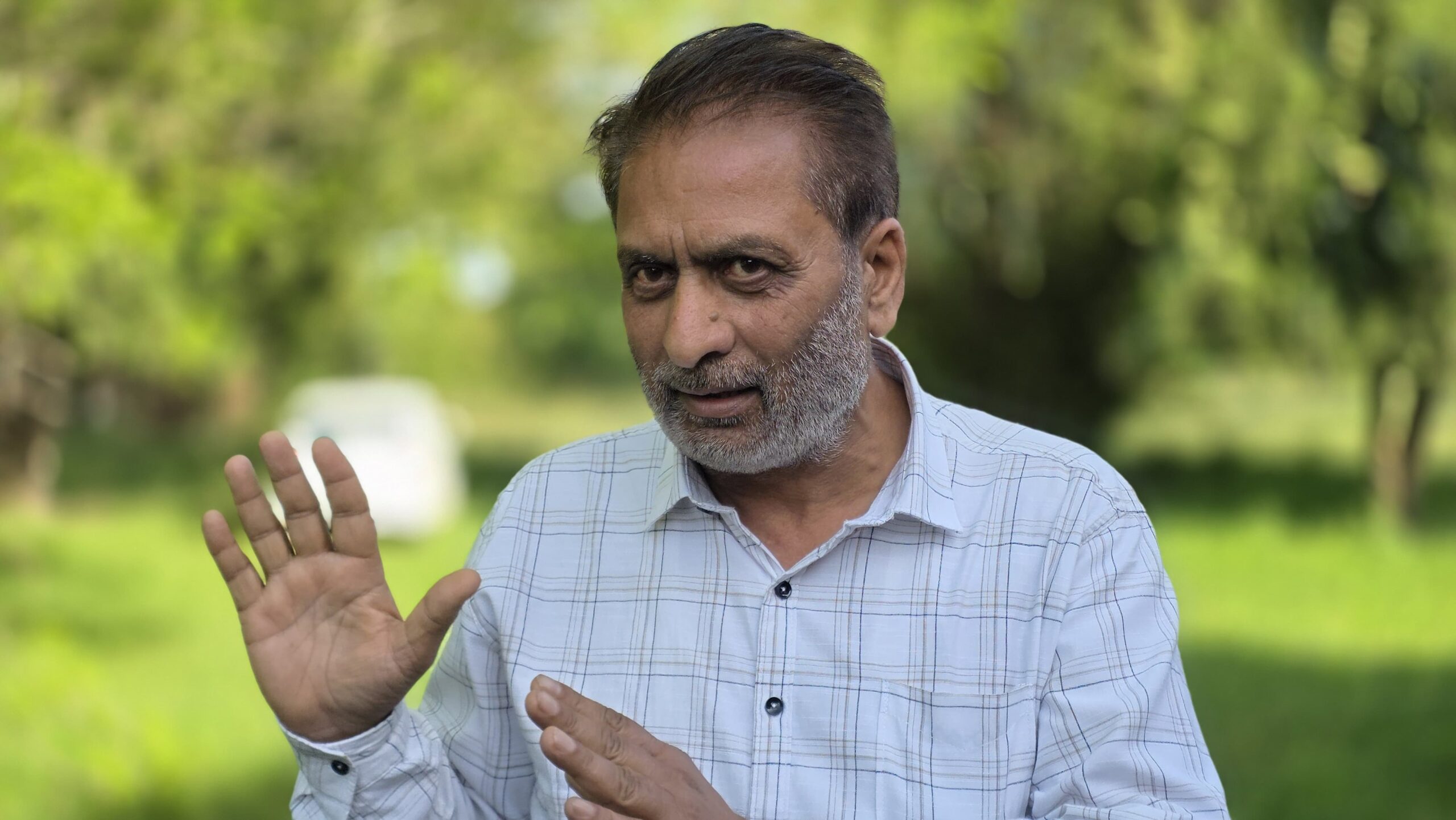
Meet Aijaz Ahmad Dar, a social activist and environmentalist from Tazroo village in north Kashmir’s Sopore. On World Environment Day, Dar walks Kashmir Convener through a battle that began with a PIL, reached the Chief Justice’s chamber, and ended with an on-site inspection that rewrote the fate of Asia’s largest freshwater lake.
“When we were young, the entire area was lush green. Wular Lake had a distinct identity. The Haigam wetlands were our lifeline,” Dar said. “Today, nearly 60 percent of our green belts are destroyed. We raised slogans of development, and we ruined our water bodies. Illegal encroachment. Garbage. We are all responsible.”
The court moves in
While protests fizzled out, Dar did something unusual. He filed a writ petition in public interest through the Central Auqaf Committee Tarzoo, represented by advocate Shafqat Nazir. The prayer was simple: stop the Municipal Council from dumping garbage within the boundary pillars of Wular Lake.
The response was anything but routine.
Then Chief Justice of J&K Gita Mittal, along with Justice Sanjay Dhar, traveled to the disputed site at Ningli Tarzoo, Sopore, for an on-site assessment. What they saw — municipal waste spilling into the lake’s catchment — left little room for legal ambiguity.
“After a thorough inspection, the Chief Justice issued on-site directions to the then Deputy Commissioner of Baramulla and MC Sopore to immediately stop garbage dumping in Wular,” Dar recalled. “She refused to allow the use of the Wular catchment area for dumping.”
The court also noted, with evident disapproval, that nearly ₹33 lakh of public money had been spent by MC Sopore on developing a garbage site within Wular’s boundaries — despite clear resentment from locals and environmentalists.
The Chief Justice then conducted a detailed survey of the lake itself — from the Wular Barrage site to Watlab Zuri Manz to the Wular Vintage Park at Garoora Bandipora.
Dar’s fight did not stop at Wular’s edge. He recently organized a joint site visit to the Haigam Wetland Reserve — a Ramsar-designated site and a key wetland along the Central Asian Flyway. Legislators participated. Environmentalists assessed the damage.
“We examined ecological degradation, encroachments, water management challenges, weakening embankments, and habitat loss for both domestic and migratory birds,” Dar said. Restoration of the once-prominent Boog Jheel and development of an eco-tourism park on encroachment-free land at Ningli also figured in the discussions.
For his work, the Environmental Policy Group (EPG) recently awarded Dar for highlighting degradation at Haigam and Wular — both Ramsar sites in Baramulla district.
‘I will fight alone’
“I am trying every possible means to ensure our water bodies are not destroyed further,” Dar said. “Although it is everyone’s responsibility, as much as I can, I will fight all alone to save our water bodies until my last breath.”
He added, “No doubt, people are illegally encroaching and dumping waste, but that does not mean that as responsible citizens, we will allow them to destroy our water bodies. Silence is not an option anymore. If we keep looking away, soon there will be nothing left to save.”
Dar warns that the loss is happening right before our eyes. “We are day by day losing our water bodies. We are moving towards destruction. But it is time — it is a wake-up call for all of us to come forward to save these bodies, to save our green belt. Kahin na phir dair ho jaye — before it is too late.”
He reflects on the speed of environmental decline. “We are day by day affecting our nature. The days are not far when we will see disastrous consequences: floods, droughts, loss of livelihoods, and a generation that will never know what a healthy wetland looks like. The birds are already leaving. The fish are dying. The weeds are taking over. And yet, we sit idle.”
Dar insists that change must begin at the grassroots. “One person started this fight — but one person cannot finish it. I need every citizen, every student, every leader to stand up. This is not my battle alone. This is a battle for Kashmir, for our children, and for our future.”
On this World Environment Day, that is not an activist’s slogan. It is the legal record of a man who has already won — in court, on the ground, and at the water’s edge.


Comments are closed.