

S Ahmad
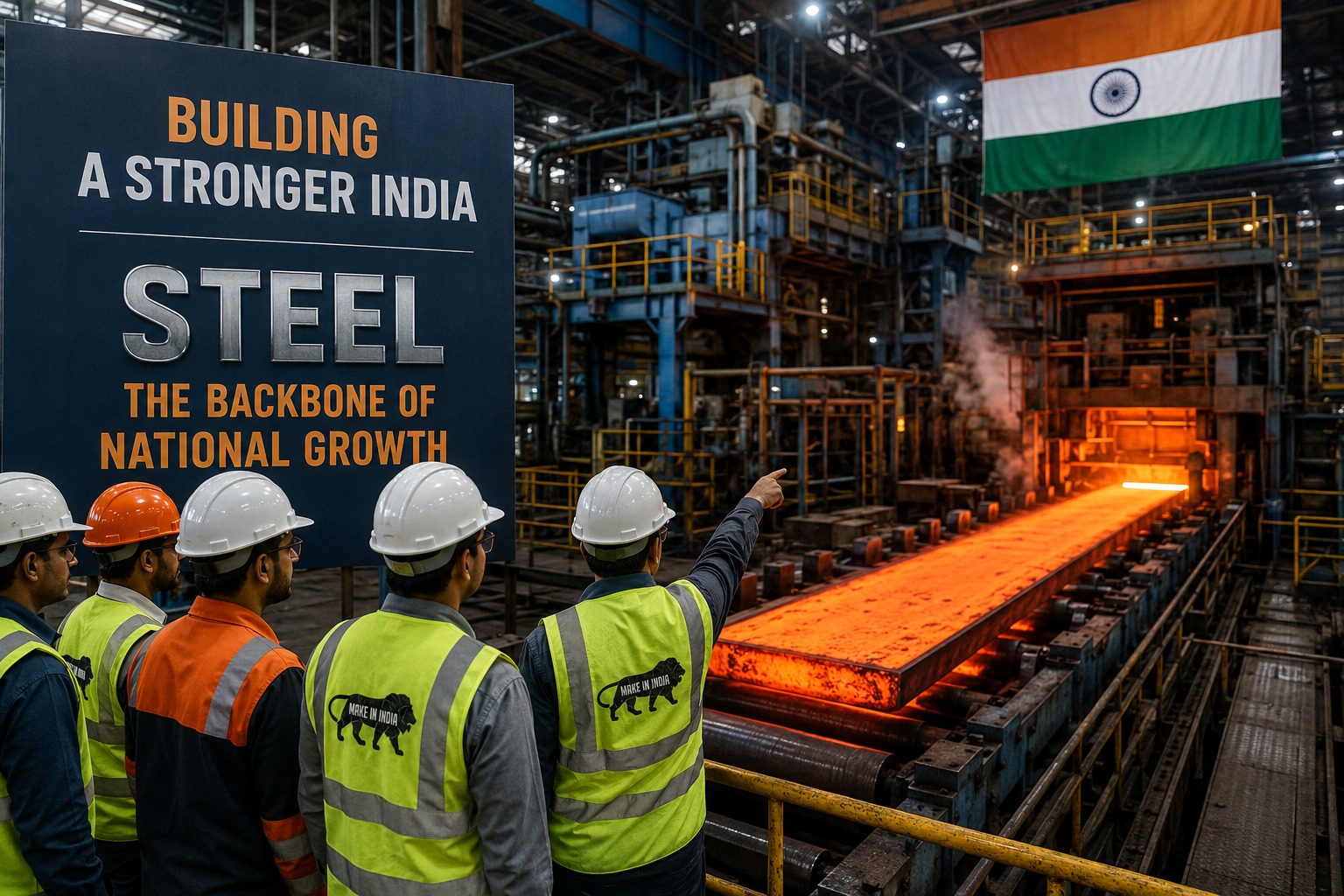
India’s steel sector is a key “sunrise sector” with strong and steady growth. It became the world’s second-largest steel producer in 2018 and has retained this position. At the same time, steel consumption has more than doubled over the past 12 years. As demand increased, exports rose while imports declined, improving self-reliance. To support this growth, the government ensured raw material availability and reduced production costs. It also improved access to global markets for Indian steel producers. Under the PLI scheme, ₹23,022 crore investment supported specialty steel production and job creation. This resulted in 2.4 million tonnes of output and over 13,000 new jobs. India has achieved about 66% of its National Steel Policy production target. Going forward, green steel aims to reduce emissions by avoiding use of fossil fuels to reduce the carbon footprints. India is also committed to decarbonising the sector and achieving net zero emission by 2070.
Few industries reflect the rise of a nation as clearly as steel. From bridges and railways to automobiles, housing, defence manufacturing, renewable energy, and digital infrastructure, steel forms the skeletal framework of modern economic development. In India’s journey toward becoming a major global economic power, the steel sector is increasingly emerging not merely as an industrial contributor but as a strategic pillar of national transformation.
Over the past decade, India’s steel industry has undergone a remarkable shift. What was once seen largely as a conventional heavy industry has evolved into one of the country’s most dynamic “sunrise sectors,” marked by expanding domestic capacity, rising exports, increasing technological sophistication, and growing self-reliance. The sector’s transformation reflects a broader national ambition: building an industrial ecosystem that is globally competitive, technologically advanced, environmentally sustainable, and strategically independent.
Today, India stands as the world’s second-largest steel producer, a position it first achieved in 2018 and has consistently retained since then. Yet the significance of this achievement lies not merely in rankings. It lies in what the steel sector now represents for India’s economic resilience, infrastructure ambitions, employment generation, manufacturing strength, and geopolitical confidence.
Steel as the Backbone of India’s Economic Expansion
Steel remains the most widely used engineering and construction material in the world. In India, its importance has multiplied alongside rapid urbanisation, expanding infrastructure, industrialisation, and manufacturing growth.
The numbers themselves reveal the scale of this transformation.
India’s finished steel consumption has risen dramatically from 77 million tonnes in 2014–15 to 163.7 million tonnes in 2025–26. This more than doubling of demand reflects the enormous pace at which roads, highways, metro systems, airports, ports, railways, housing projects, industrial corridors, and smart cities are being developed across the country.
The construction and infrastructure sector alone accounts for nearly 68 percent of steel demand, while engineering, packaging, and automobile manufacturing continue to expand their consumption steadily.
This growth is not accidental. It reflects the convergence of multiple national initiatives including infrastructure modernisation, manufacturing expansion, logistics reforms, urban housing, renewable energy projects, and industrial diversification.
Steel, in many ways, has become the silent enabler of India’s developmental aspirations.
India’s Rise as a Global Steel Power
India’s rise in global steel production represents one of the most significant industrial success stories of recent decades.
The country’s share of global crude steel production increased from 5.2 percent in 2014 to nearly 7.9 percent in 2024, reinforcing its growing importance in global industrial supply chains.
Crude steel production has shown sustained expansion:
-
88.98 million tonnes in 2014–15
-
127.2 million tonnes in 2022–23
-
168.4 million tonnes in 2025–26
This trajectory highlights India’s strong production ecosystem and rising industrial capacity.
Importantly, growth is visible across the entire steel value chain. Hot metal, pig iron, sponge iron, finished steel, and specialty steel segments have all shown strong production growth. Such broad-based expansion indicates not only increased capacity but also deeper industrial integration and technological advancement.
India’s steel sector is no longer confined to basic production alone. It is increasingly moving toward higher-value manufacturing and advanced steel products critical for defence, aerospace, automotive manufacturing, renewable energy systems, and strategic infrastructure.
The Atmanirbhar Bharat Vision and Steel Self-Reliance
The strengthening of the steel sector aligns directly with the broader national vision of Atmanirbhar Bharat or self-reliant India.
For decades, India depended heavily on imports for specialized steel grades and strategic materials. Such dependence created vulnerabilities in critical sectors including defence manufacturing, infrastructure, and advanced engineering.
The current policy direction seeks to reverse this dependence by building strong domestic capabilities across the steel value chain.
This transition toward self-reliance is visible in several areas:
-
Rising domestic production
-
Declining imports
-
Expanding exports
-
Growth in specialty steel manufacturing
-
Increased domestic raw material security
-
Improved logistics infrastructure
-
Greater technological adoption
India’s steel trade data reflects this changing balance. Steel exports rose sharply by 29.1 percent in March 2026, while imports declined by 9.5 percent. Finished steel exports also increased substantially during FY 2025–26, even as imports witnessed a steep decline.
These trends indicate that India is gradually shifting from being a major steel importer to becoming a more competitive global supplier.
Specialty Steel and the Production Linked Incentive Push
One of the most transformative interventions in recent years has been the Production Linked Incentive (PLI) scheme for specialty steel.
Specialty steel represents the advanced end of the steel manufacturing spectrum. It includes high-strength, coated, alloyed, and technologically sophisticated steel products used in strategic industries such as automobiles, defence, electrical equipment, engineering, and energy systems.
Historically, India imported significant volumes of such products. The PLI scheme aims to change this dynamic.
Launched with a financial outlay of ₹6,322 crore, the scheme has already generated major results:
-
₹23,022 crore investment realised
-
2.4 million tonnes specialty steel production
-
13,264 direct jobs created
-
₹6,000 crore import substitution achieved
-
24 million tonnes specialty steel capacity created
These figures reflect far more than industrial output. They represent a strategic industrial shift toward technological independence and higher-value manufacturing.
The recently expanded PLI 1.2 scheme further strengthens this direction by encouraging investments in advanced and emerging steel categories.
Importantly, specialty steel development is critical for India’s future manufacturing competitiveness. Modern economies increasingly rely on advanced materials, and steel remains central to sectors ranging from electric vehicles to defence systems and renewable energy infrastructure.
Government Policy and Institutional Support
The transformation of India’s steel sector has not occurred in isolation. It has been strongly supported by policy reforms, institutional interventions, infrastructure investments, and regulatory changes.
The National Steel Policy 2017 laid out ambitious long-term goals:
-
300 million tonnes crude steel capacity by 2030–31
-
255 million tonnes production target
-
Higher per capita steel consumption
-
Reduced import dependence
-
Greater domestic value addition
India has already achieved nearly 66 percent of the production target envisioned under the policy.
Several policy measures have accelerated this progress.
Domestically Manufactured Iron and Steel Products Policy
The revised DMI&SP policy provides preference for domestically manufactured steel products in government procurement. By encouraging local sourcing, the policy strengthens domestic industries and reduces dependence on imports.
The introduction of the “melt and pour rule” further reinforces indigenous manufacturing by requiring steel to be manufactured entirely in India from the initial melting stage onward.
Raw Material Security
The government has also focused on improving raw material security by reducing customs duties on critical inputs such as ferro nickel and molybdenum ores.
The Steel Scrap Recycling Policy has been introduced to increase the availability of domestic scrap for steel production, reducing import dependence and supporting sustainable manufacturing.
Quality Control Measures
Steel Quality Control Orders (QCOs) ensure that only BIS-compliant steel products are available in domestic markets. This protects consumers while also improving the global credibility of Indian steel products.
Logistics and Infrastructure
Infrastructure remains central to steel sector growth.
The identification of major steel zones and the integration of over 2,100 steel units into the PM GatiShakti platform reflect efforts to build a more coordinated logistics ecosystem.
Efficient connectivity through railways, ports, roads, and multimodal transport systems reduces production costs and enhances competitiveness.
Employment, MSMEs, and Economic Multiplier Effects
The steel sector’s significance extends far beyond industrial output.
Steel production generates substantial employment across mining, logistics, transportation, construction, manufacturing, engineering services, equipment supply, and downstream industries.
The PLI schemes alone are projected to generate tens of thousands of direct jobs, while indirect employment effects are even larger.
Small and medium enterprises also benefit significantly from a growing steel ecosystem. MSMEs engaged in fabrication, construction materials, industrial machinery, and manufacturing depend heavily on steel availability and pricing.
A strong domestic steel industry therefore creates powerful multiplier effects throughout the economy.
The Green Steel Challenge
While the expansion of steel production is essential for economic growth, it also presents a major environmental challenge.
Globally, the steel industry is among the largest industrial sources of carbon emissions due to its dependence on coal-intensive production processes.
India now faces the complex task of balancing industrial expansion with climate commitments.
The country has committed to achieving net-zero emissions by 2070, and the steel sector will play a crucial role in that transition.
Recognising this, India became the first country in the world to introduce an official Green Steel Taxonomy in 2024.
Green steel refers to steel produced with significantly lower carbon emissions, particularly by reducing dependence on fossil fuels.
The government has outlined a phased decarbonisation strategy:
Short-Term Goals
-
Improve energy efficiency
-
Increase renewable energy use
-
Enhance resource efficiency
Medium-Term Goals
-
Deploy green hydrogen technologies
-
Expand carbon capture systems
-
Increase use of natural gas and cleaner inputs
Long-Term Goals
-
Transition toward disruptive low-carbon technologies
-
Achieve near net-zero steel production
As of March 2026, 89 steel units had already received green steel certification.
Green Hydrogen and the Future of Steel
One of the most promising areas in steel decarbonisation is green hydrogen.
Traditional steelmaking depends heavily on coal and coke. Green hydrogen offers the possibility of replacing these carbon-intensive fuels in iron reduction processes.
India has already initiated pilot projects under the National Green Hydrogen Mission for integrating hydrogen into steelmaking operations.
If scaled successfully, green hydrogen could fundamentally transform the environmental profile of the steel industry.
However, the transition will require massive investments, technological innovation, policy coordination, and global collaboration.
Technology, AI, and the Next Industrial Shift
India’s steel sector is also entering a new phase of technological transformation.
The launch of the AI in Steel Pavilion marks a significant step toward integrating artificial intelligence across the steel value chain.
AI applications can improve:
-
Production efficiency
-
Predictive maintenance
-
Logistics optimisation
-
Quality control
-
Energy management
-
Safety systems
-
Environmental monitoring
Comments are closed.