

Wani Arfat
“The NEET-UG 2026 fiasco is not merely an examination controversy; it is a warning about deeper failures of accountability, transparency, fairness, and institutional integrity within the educational system itself.”
India often calls its youth the future of the nation. Every year, millions of students work hard to achieve their dreams and build a better future for themselves and their families. Among all competitive examinations in the country, NEET-UG is considered one of the toughest and most stressful. For lakhs of students who dream of becoming doctors, NEET is not just an examination. It is the result of years of sacrifice, hard work, pressure, and hope.
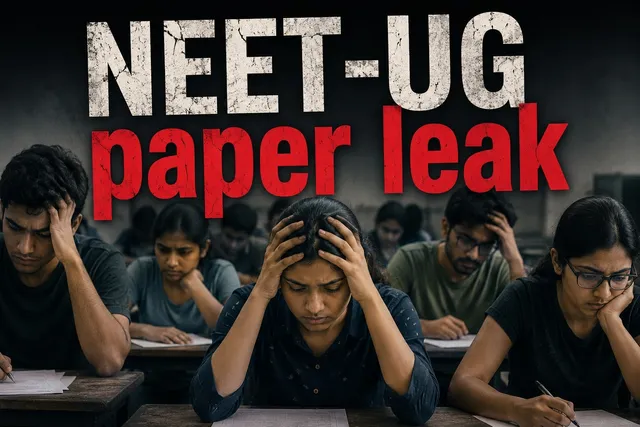
But today, millions of students across India are disappointed and emotionally broken after the cancellation of NEET-UG 2026. The examination, conducted on May 3 by the National Testing Agency (NTA), was cancelled after allegations of a paper leak and examination malpractice surfaced. More than twenty-two lakh students who appeared in the examination are now facing uncertainty about their future.
According to reports, the controversy started when a “guess paper” circulating in Rajasthan was found to closely match many questions from the actual NEET examination. Reports claimed that around 100 to 120 questions, especially from Biology and Chemistry, were similar to the original paper. The material was allegedly shared through WhatsApp and Telegram groups and sold to students for huge amounts of money before the examination.
As the matter became serious, Rajasthan’s Special Operations Group started an investigation and detained several people linked to the alleged paper leak network. Later, the case expanded to different states, and the Government of India handed the investigation over to the Central Bureau of Investigation (CBI). After discussions with authorities, the NTA officially cancelled the examination and announced that a fresh examination would be conducted on new dates.
For most individuals, it could be another exam related problem. For the students as well as the parents, it goes beyond that. Each and every NEET candidate behind is a saga of efforts and sacrifices. Students start preparing for NEET from Class 11 onwards.
There are several students who prepare for four years for this single exam. These students devote several hours every day, give up partying, skip family gatherings, stay stressed, and do everything that can help them crack the examination. There are thousands of students who shift from their hometowns to big cities such as Kota, Delhi, Hyderabad, Patna, and Srinagar to prepare for NEET examination.
Even the parents are equally sacrificing. There are many parents who spend lakhs of rupees on their children’s preparations for NEET examination. There are many parents who borrow money or even take money out of their own pockets just because they strongly believe in education for their children’s better future.
This preparation for these students does not only mean studying from books and practice test papers. It involves living with fear, stress, nervousness, and worries. Students devote twelve to sixteen hours each day thinking one day their hard work will prove beneficial for them.
But when an examination gets cancelled because of corruption and negligence, students feel helpless. The emotional damage caused by such incidents cannot be measured easily. Many students who expected good scores now fear that they may lose confidence and momentum before the re-examination. Others are mentally exhausted and worried about going through the same pressure once again.
This incident has once again exposed serious problems in India’s education system. Regrettably, NEET-UG 2026 is not the first exam to attract controversy either. In the last few years, some competitive exams in India have been mired in controversies pertaining to leaks, technological failure, cheating, disputes concerning grace marks, and poor conduct of the exams. These include CUET, SSC, railway recruitment exams, CTET, among others.
This shows that the problem is not limited to one examination. The problem is much deeper.
Today, competitive examinations have become highly commercialized. Coaching centres have turned into huge industries, and corruption networks take advantage of students’ desperation. In such an environment, paper leaks and cheating rackets continue to grow. Honest students suffer while those involved in corruption try to make money from the dreams of young people.
Another major issue is the excessive pressure created by India’s single-exam system. In a country with millions of students and limited opportunities, one examination often decides the future of an entire career. This creates extreme stress and unhealthy competition among students. A student’s future should not depend only on a few hours inside an examination hall.
The repeated failure of examination systems has also created a serious trust issue. Students are no longer afraid only of failure; they are afraid of unfairness. They fear that even after years of honest hard work, corruption and negligence can destroy their future.
This is extremely dangerous for any country.
It will weaken the educational system of the country if students begin to mistrust the institutes and colleges. In order for a nation to progress, its youth should have hope in their future and their voices heard.
Hence, the NEET-UG 2026 fiasco must become a lesson learned by the government and educational authorities. The people who were behind the exam leak and the cheating during the exam must be punished severely without giving room for any compromise. There should be transparency and security when it comes to examinations.
Meanwhile, it must be noted that students’ mental health must become an important concern. Students who have prepared themselves for examinations face enormous stress; however, mental well-being is completely ignored in Indian education system. Many of them suffer from anxieties, depression, loneliness, and mental exhaustion.
The most important thing about all of these is that policymakers need to realize that students are humans, not machines. They dream, feel, and are responsible. Every cancelled exam can affect many lives in terms of career and admissions; however, it will also affect their confidence and mental well-being.
India cannot become a strong and developed nation while ignoring the struggles of its students. A system where corruption defeats merit slowly destroys the future of the country itself.
The cancellation of NEET-UG 2026 is therefore not just an examination controversy. It is an indication of the fundamental flaws in the Indian educational system flaws in terms of accountability, transparency, justice, and integrity.
For if the nation really cares about its coming generations, it must make sure that no sincere student ever bears the brunt of the system’s shortcomings. For in the long run, the future of any nation is shaped in the classroom and the examination hall, where the students actually believe in their hard work and sincerity.
Comments are closed.