

Shabeer Ahmad Lone
“A society that glorifies material success while neglecting compassion, emotional well-being, spirituality, ethical reflection, and human connection gradually produces individuals who appear outwardly functional but inwardly exhausted.”
Civilizations rarely decline suddenly. Their erosion often begins quietly-in wounded homes, anxious minds, fractured relationships, lonely youth, moral confusion, and invisible despair. Before institutions collapse outwardly, human beings begin collapsing inwardly.
In this sense, the expanding crisis of drug addiction in Jammu and Kashmir is not merely a medical emergency or criminal problem; it is a profound revelation of deeper psychological, social, cultural, economic, and existential disturbances shaping contemporary life. Drugs do not spread meaningfully in emotionally healthy societies.
They flourish where loneliness deepens, purpose weakens, trust declines, and suffering loses language. Addiction therefore must be understood not simply as the consumption of intoxicants, but as the symptom of wounded consciousness and fractured social existence.
Sacred traditions across civilizations repeatedly warned humanity that inner emptiness eventually manifests as outer disorder. The Qur’an speaks of hearts becoming restless when disconnected from deeper remembrance and meaning: “Verily, in the remembrance of God do hearts find rest” (13:28). The insight is not merely theological but profoundly psychological.
Human beings deprived of inner balance frequently seek artificial forms of relief. The Bhagavad Gita similarly describes how uncontrolled desire and attachment gradually cloud judgment and destroy inner equilibrium.
Buddhist teachings identify craving and compulsive attachment as major sources of suffering, while Christian spiritual traditions speak of the “restless heart” searching endlessly for peace in transient pleasures. Across traditions, addiction appears not merely as chemical dependency but as a distorted search for tranquility, belonging, transcendence, or escape.
Drug addiction in Jammu and Kashmir is not merely a narcotics crisis but a crisis of loneliness, trauma, fractured belonging, and loss of meaning.Ibn Khaldun warned that civilizations decay when social cohesion and moral responsibility collapse, while Ibn Arabi saw human crisis as a loss of inner harmony, compassion, and Divine awareness.
The Dhammapada teaches that “the mind is everything; what you think, you become.” Mother Teresa warned that the deepest poverty is being “unwanted, unloved, and uncared for,” and Erich Fromm observed that modern humanity possesses comfort yet lacks inner peace. Friedrich Nietzsche and Viktor Frankl emphasized that human beings endure suffering when life retains meaning, while Johann Hari insightfully argued that “the opposite of addiction is not sobriety, but connection.”
Gabor Maté similarly observed that trauma is not merely what happens to people but what happens within them. Jalal ad-Din Muhammad Rumi, Seyyed Hossein Nasr, C. S. Lewis, Epictetus, Marcus Aurelius, Maya Angelou, and Elie Wiesel likewise warned against inner emptiness, emotional silence, and spiritual alienation. Arnold J. Toynbee warned that civilizations perish through inner decay, the struggle against addiction ultimately becomes a struggle to preserve human dignity, hope, and the civilizational soul itself.
What makes the present moment particularly alarming is not only the rise in narcotics consumption, but the changing character of the crisis itself. Earlier forms of substance use were often socially localized, culturally constrained, or episodic. Today the landscape has shifted toward more dangerous synthetic substances, heroin dependency, pharmaceutical abuse, and chemically intensified addiction patterns that affect increasingly younger populations.
Rehabilitation centres across Kashmir repeatedly report growing admissions involving adolescents, students, unemployed youth, and even school-going children. Behind these statistics lies a painful transformation in the emotional atmosphere surrounding youth life.
Many young people today inhabit worlds marked by uncertainty, overstimulation, social comparison, economic anxiety, emotional isolation, and existential fatigue. The modern crisis is not merely that youth are intoxicated by substances; many are exhausted by existence itself.
This exhaustion reflects a wider global condition. Across continents, psychologists, sociologists, philosophers, and neuroscientists increasingly describe humanity as living amid an epidemic of loneliness, anxiety, depression, and meaninglessness despite unprecedented technological advancement. Human beings have become hyperconnected digitally yet emotionally fragmented.
Social media promises connection while frequently producing isolation. It offers visibility without intimacy, stimulation without peace, and information without wisdom. Young minds are continuously exposed to unrealistic portrayals of success, beauty, pleasure, and achievement that generate chronic inadequacy and silent self-hatred. In such psychological climates, substances often become substitutes for belonging, tranquility, confidence, or emotional relief.
Thinkers across cultures long anticipated such crises. Erich Fromm warned that modern societies increasingly produce individuals who “have everything except themselves.” Martin Heidegger feared that technological civilization would reduce human beings to distracted, fragmented existence detached from authentic being.
Seyyed Hossein Nasr repeatedly argued that modern humanity suffers not merely from economic or political crises but from a profound spiritual and metaphysical dislocation. The Indian philosopher Jiddu Krishnamurti observed that societies driven by fear, comparison, ambition, and conformity inevitably generate inward disorder. These insights illuminate why addiction cannot be understood solely through criminal law or medicine; it emerges within wider crises of consciousness.
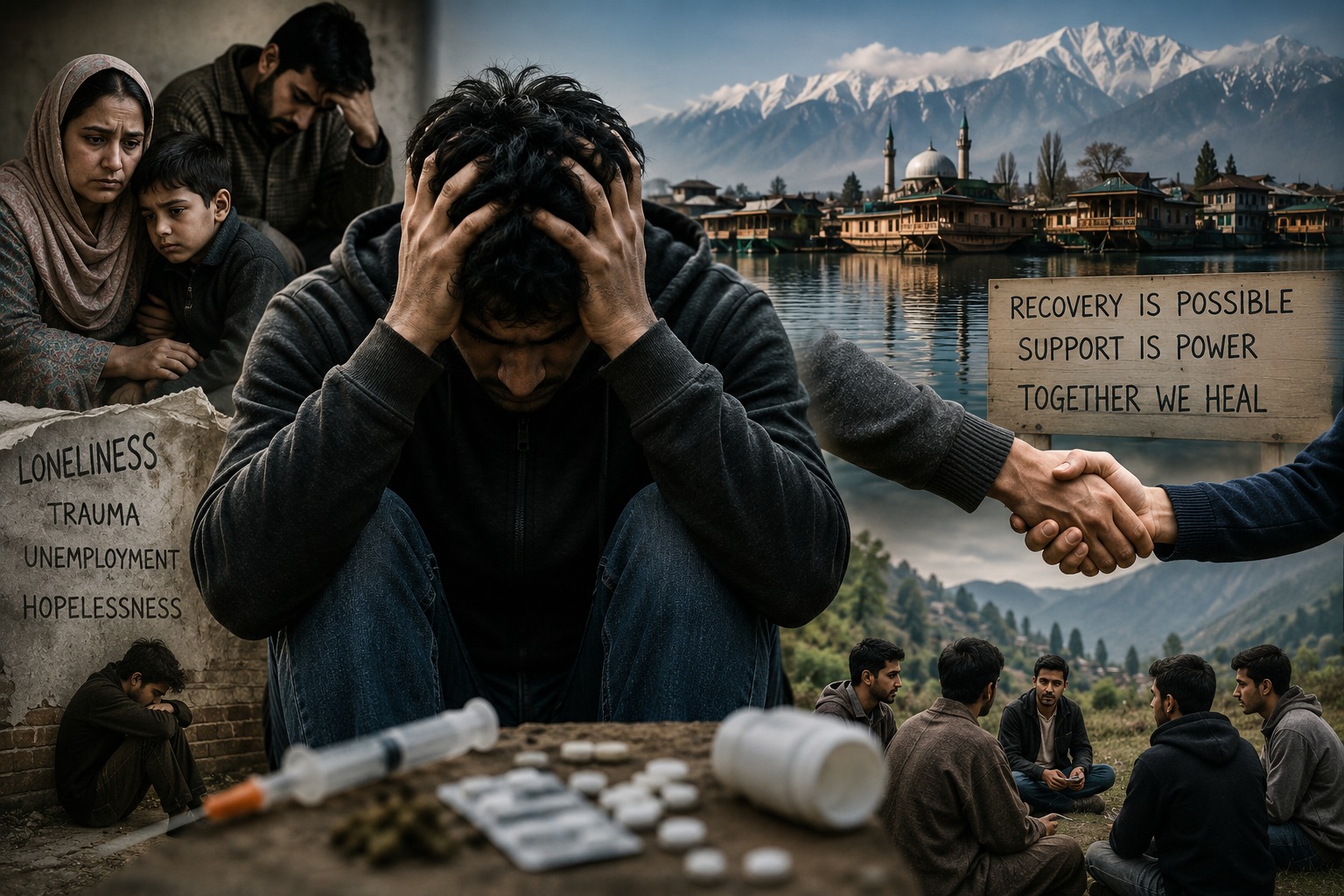
In Jammu and Kashmir, the deepening drug crisis-estimated to affect nearly 13.5 lakh people, including around 1.68 lakh minors-has evolved into a grave social, psychological, and moral emergency shaped by trauma, loneliness, unemployment, fractured families, emotional alienation, and the erosion of meaning and belonging; behind these statistics are wounded minds, grieving households, interrupted futures, and a generation suspended between despair and hope, making collective healing, humane rehabilitation, emotional resilience, and a renewed culture of compassion and responsibility an urgent civilizational imperative.
In Kashmir, these global pressures intersect with local realities shaped by prolonged instability, uncertainty, unresolved grief, political tension, economic pressures, and intergenerational trauma. Trauma is not only what happens visibly through dramatic events; trauma also accumulates silently through chronic fear, humiliation, insecurity, helplessness, interrupted normalcy, and emotional suppression.
Entire societies can internalize anxiety without openly acknowledging it. A child growing up in emotionally tense environments may carry invisible stress long before understanding its source. Over time, unprocessed psychological burdens seek outlets. Some individuals express pain through aggression, others through withdrawal, and many through self-destructive coping mechanisms including addiction.
Modern neuroscience increasingly confirms what human experience has long suggested: emotional pain and physical pain overlap neurologically in significant ways. Loneliness activates distress systems within the brain. Chronic stress alters emotional regulation and impulse control. Trauma reshapes psychological responses to fear and reward. Addiction therefore cannot be understood merely as weak morality or personal failure. Substances frequently function as temporary anesthetics against unbearable emotional states. They create fleeting illusions of relief, confidence, calmness, escape, or numbness. Yet the tragedy of addiction lies precisely in this paradox: the same substances initially used to escape suffering gradually deepen suffering itself.
The 13th-century mystic Jalal ad-Din Muhammad Rumi once wrote that human beings wander from room to room searching for the diamond necklace already hanging around their neck. Much of addiction reflects this tragic wandering-the attempt to seek externally what is internally absent. Contemporary consumer culture often intensifies this search by equating happiness with stimulation, acquisition, and endless distraction.
Yet neither intoxication nor consumption can permanently satisfy emotional or spiritual hunger. The more societies lose touch with silence, contemplation, beauty, compassion, and transcendence, the more restless human beings become.
One of the most misunderstood dimensions of addiction is its relationship with silence. Many societies continue to discuss addiction in whispers, shame, or denial, thereby intensifying the crisis. Families frequently conceal addicted members to preserve social reputation. Young people hide emotional distress because vulnerability is often mistaken for weakness. Men especially are socialized to suppress pain rather than articulate it. This culture of emotional concealment produces dangerous consequences. Human suffering that cannot express itself constructively eventually expresses itself destructively. Addiction thrives where dialogue disappears.
Particularly painful is the hidden suffering of women within the addiction crisis. Public attention overwhelmingly centers upon male addicts while ignoring mothers living in constant fear for their children, wives enduring domestic instability and violence linked to substance abuse, sisters carrying emotional burdens silently, and women addicts facing far harsher stigma than men.
Female addiction remains significantly underreported because many women fear social humiliation, abandonment, or moral condemnation if they seek treatment. In patriarchal social structures, women often carry the emotional consequences of addiction without receiving emotional recognition themselves. Their grief becomes invisible labor.
Equally neglected is the vulnerability of children growing up within addicted households. Addiction rarely harms only the user. Children exposed to domestic instability, violence, neglect, or emotional unpredictability frequently develop anxiety, fear, trust issues, emotional dysregulation, or trauma responses that continue into adulthood.
Some later reproduce similar cycles of self-destruction. Thus addiction often becomes intergenerational-not genetically alone, but psychologically and socially. A wounded environment reproduces wounded consciousness.
The crisis also reveals deeper transformations occurring within family structures themselves. Traditional Kashmiri society historically possessed dense emotional and communal networks where extended families, neighbors, elders, teachers, and spiritual figures collectively shaped social behavior. Young people rarely experienced complete emotional isolation because social life itself functioned as a protective web. Today rapid modernization, migration, urbanization, economic strain, and digital culture have weakened many of these bonds.
Families increasingly live together physically while drifting apart emotionally. Meals are shared with screens rather than conversations. Parents often provide material necessities yet remain emotionally unavailable due to stress, exhaustion, or distraction. Many children today are information-rich but affection-poor.
Educational systems too reflect profound imbalance. Across much of the modern world, education increasingly emphasizes competition, employability, examinations, and productivity while neglecting emotional intelligence, ethical reflection, psychological resilience, and self-understanding. Students learn how to secure careers but not how to confront grief, loneliness, failure, rejection, uncertainty, or existential confusion.
This creates intellectually trained yet emotionally fragile individuals. In Kashmir, where many young people already carry social and psychological pressures, the absence of robust counseling systems, arts engagement, sports culture, mentorship structures, and mental-health literacy within educational institutions intensifies vulnerability.
The philosopher Alasdair MacIntyre argued that modern societies increasingly produce morally fragmented individuals because traditions of shared meaning and virtue have weakened. Similarly, Charles Taylor described the “malaise of modernity” arising from individualism, instrumental thinking, and loss of transcendence. These reflections are deeply relevant to contemporary youth crises. When societies cease nurturing wisdom, compassion, beauty, restraint, and moral imagination, emotional fragmentation intensifies. Addiction then becomes not only a personal disorder but also a symptom of cultural exhaustion.
The economic dimension of addiction must also be confronted honestly. Unemployment is not merely lack of income; prolonged joblessness frequently becomes psychological erosion. Human beings require dignity, agency, usefulness, and hope regarding the future.
Educated youth unable to envision stable futures often experience humiliation, frustration, and existential stagnation. Drug economies exploit precisely such vulnerabilities. Addiction and trafficking frequently intersect within larger networks involving organized crime, smuggling systems, corruption, and illegal financial structures. Thus narcotics are not only substances; they are commodities circulating within economies of despair.
Yet reducing addiction solely to economics would remain inadequate. Some materially privileged youth also fall into addiction because emotional emptiness is not cured automatically by wealth. The crisis ultimately reveals a profound hunger for meaning. Human beings cannot survive psychologically on consumption alone.
When societies glorify material success while neglecting inner life, ethical reflection, beauty, compassion, spirituality, and belonging, emotional starvation emerges beneath outward prosperity. Philosophers from Erich Fromm to Viktor Frankl repeatedly warned that societies obsessed with consumption and performance risk producing spiritually exhausted individuals incapable of enduring suffering meaningfully.
Kashmir’s own intellectual and spiritual traditions offer profound insights into this crisis. The teachings of Sheikh Noor-ud-Din Noorani, Lal Ded, and generations of Sufi and Rishi thinkers emphasized inner purification, simplicity, compassion, self-awareness, restraint, and human interconnectedness. These traditions recognized that human beings collapse morally and psychologically when disconnected from deeper sources of meaning and ethical consciousness.
Spiritual traditions at their best do not merely prohibit harmful behavior; they cultivate inner balance and existential grounding. However, spirituality loses transformative power when reduced to ritualism, moral policing, or condemnation. Young people rarely heal through humiliation. They heal through dignity, understanding, guidance, and hope.
The Jewish philosopher Abraham Joshua Heschel warned that one of the greatest crises of modern humanity is not the loss of information but the loss of “radical amazement”-the capacity to experience wonder, reverence, and depth.
A society deprived of wonder becomes vulnerable to addiction because stimulation begins replacing meaning. Likewise, Thomas Merton observed that modern individuals are often “alienated from their own deepest self.” Such alienation drives restless attempts to fill inward emptiness through external intensity.
The media too occupies a morally significant position within this landscape. Sensationalist portrayals of addicts as social threats or moral failures dehumanize suffering and reinforce stigma. Responsible journalism should illuminate root causes, structural realities, recovery journeys, mental-health dimensions, and successful interventions.
Stories matter because they shape collective imagination. Societies become what they repeatedly narrate about themselves. If public narratives consist only of fear, shame, and condemnation, hopelessness deepens. But when stories of recovery, resilience, compassion, and transformation emerge, possibilities for healing expand.
One of the most neglected phases of addiction recovery is reintegration into ordinary life. Detoxification alone rarely guarantees transformation. Individuals leaving rehabilitation often return to environments shaped by unemployment, stigma, fractured relationships, emotional triggers, and social rejection. Without long-term psychological support, vocational opportunities, mentorship, and community acceptance, relapse becomes tragically common. Recovery therefore must be understood as social restoration rather than merely medical treatment.
At its deepest level, the addiction crisis in Jammu and Kashmir forces society to confront difficult civilizational questions. Why are increasing numbers of young people emotionally exhausted despite living in an age of unprecedented technological possibility?
Why are communities weakening despite constant rhetoric about progress and development? Why are loneliness, depression, anxiety, and escapism spreading globally across vastly different societies? Why do so many young people experience life not as wonder, meaning, or participation, but as pressure, fragmentation, and fatigue?
Perhaps addiction ultimately reveals something larger than drugs themselves. It reveals humanity’s struggle to remain emotionally, spiritually, and socially whole within increasingly fragmented conditions of modern existence. The narcotic crisis may therefore be understood as part of a wider crisis of meaning, belonging, and consciousness affecting contemporary civilization itself.
And yet despair is neither intellectually honest nor morally sufficient. Human beings possess extraordinary capacities for renewal. Across the world, countless individuals once destroyed by addiction have rebuilt meaningful lives through therapy, compassion, spirituality, family support, education, art, community acceptance, and purposeful work.
Entire societies too have transformed destructive trends through collective wisdom and sustained reform. Hope is not naïve optimism; it is disciplined commitment to the possibility of healing even amid brokenness.
The Qur’an reminds humanity that “God does not change the condition of a people until they change what is within themselves” (13:11), while the Dhammapada teaches that the mind shapes human destiny. Mahatma Gandhi insisted that the true measure of civilization lies in moral self-restraint and care for the vulnerable.
Rabindranath Tagore envisioned a society “where the mind is without fear,” recognizing that freedom from fear is essential for human flourishing. These insights collectively suggest that healing addiction ultimately requires more than detoxifying bodies; it requires restoring meaning to life, dignity to individuals, compassion to communities, and balance to civilization itself.
The struggle against addiction in Jammu and Kashmir is thus far more than a fight against drugs; it is a struggle for dignity, meaning, and collective renewal. Saving youth from addiction means more than reducing illness or crime-it means restoring trust, rebuilding relationships, and reviving hope.
Lasting healing requires compassion over stigma, understanding over punishment, and connection over isolation, so that society preserves not only public health but also its moral depth, human solidarity, and civilizational soul.
Comments are closed.