

Laiba Khan
“Kashmir has never been merely a beautiful landscape or a tourist destination called ‘Paradise on Earth.’ It is a living civilization shaped by centuries of Hindu, Buddhist, and Islamic traditions that together created a unique culture rooted in coexistence, spirituality, craftsmanship, language, and collective memory.”
What happens to a culture when the language that people speak every day starts to disappear , old houses are torn down to make way for concrete buildings and the stories that have been passed down are only remembered by older people?
In the middle of Kashmir under all the scenery there is a struggle that is not very loud. This is a struggle to keep the culture of Kashmir alive as it slowly fades away because of things fighting and people changing how they live. Kashmir is not a place that people visit for fun, it is called “Paradise on Earth“. But Kashmir is more than that, it is a place with a lot of history, religion, art and customs that have been around for a very long time.
Kashmir has been a melting pot for cultures and religions since ages immemorial. The centuries-old traditions of Hinduism, Buddhism and Islam gave shape to unique hybrid cultures based on tolerance and harmony. Therefore the identity of Kashmir cannot be reduced to religion alone; it is seen in the culture, language, art and architecture and all the things that make Kashmir so unique.
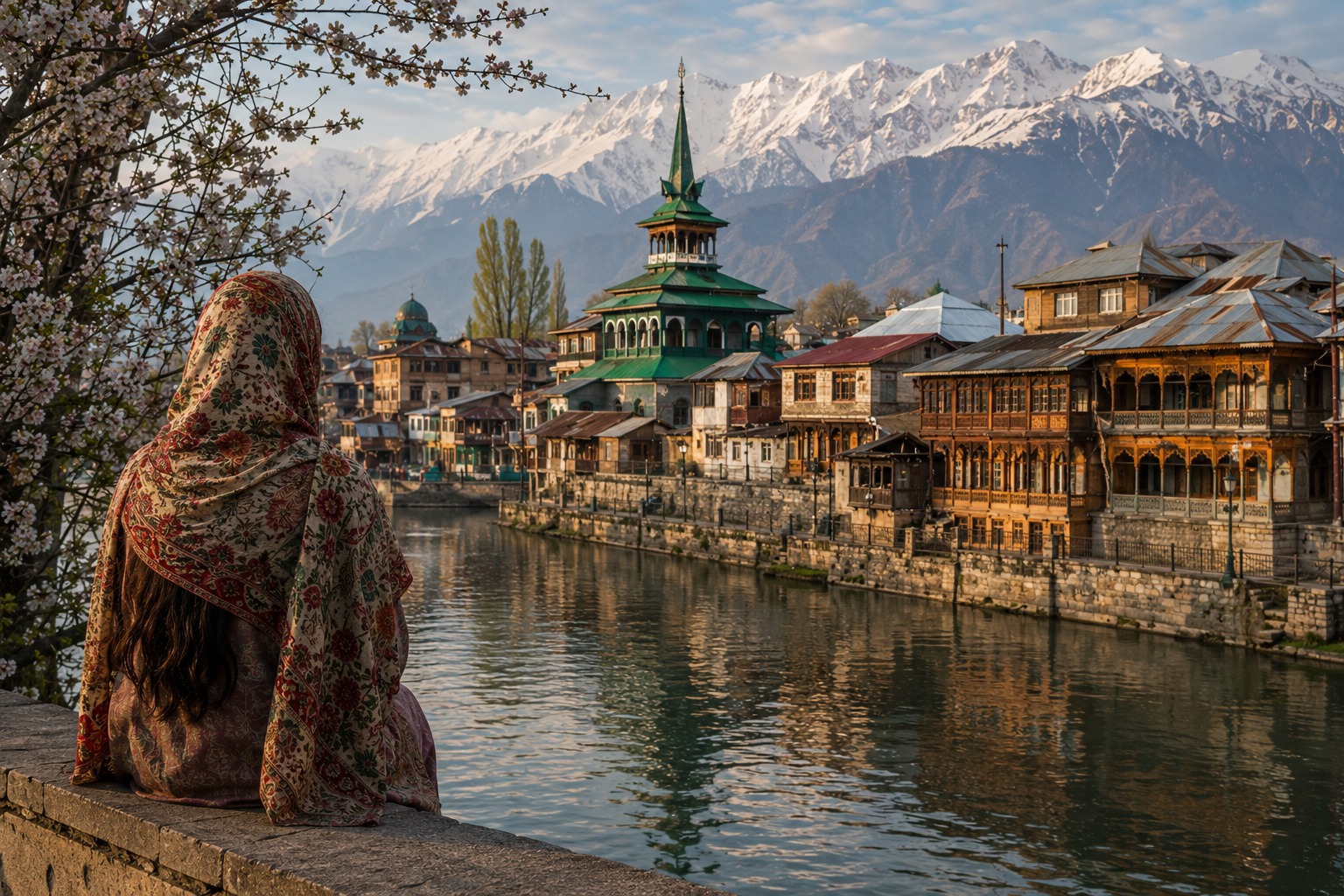
In the old cities of Srinagar one gets to touch the remnants of the art consciousness of Kashmir. It’s wooden windows, beautifully patterned, sloping tiled roofs and ancient holy places whisper stories of times when architecture was more than just a process of constructing structures, but one of conveying meanings. Structures like Jamia Masjid and Khanqah of Shah Hamadan among many others depict the architectural patrimony of Kashmir, amalgamating Persian, Central Asian and Kashmiri architecture. The Mughal Gardens like Shalimar Bagh and Nishat Bagh echo the illustrious past of Kashmir.
Nonetheless, while Kashmir experiences accelerated urbanization, numerous historical homes and structures are being demolished and constructed into concrete homes that do not represent any form of Kashmiri culture. The valley is at risk of losing its identity amid such development. Thus, the preservation of these heritage sites has become an urgent matter.
This threat exists not only in the realm of architecture but also in the field of Kashmir’s traditional arts and crafts that have represented the valley’s cultural identity in the international community. The unique craftsmanship behind Kashmiri pashmina shawls, papier–mâché, walnut wood carvings, and handmade carpets is not only a part of Kashmir’s economy but also a part of its rich culture that has been passed down from generation to generation.
The pressure from machine-produced imitations, the decline in profits from craft sales, and lack of interest among young people to carry on the crafting tradition have made it difficult for an increasing number of artisans to earn a living through these forms of craft. For many, the only way to secure their futures is to abandon their traditional occupation and seek a modern waged job. If these crafts die off, Kashmir will not just lose an industry but also centuries of cultural memories and pride.
The decline of the Kashmiri language is likewise a growing concern. Many children in today’s households regularly communicate with each other and their parents/siblings in English, Hindi, or Urdu rather than in Kashmiri. Kashmiri is preserved largely in conversations between the elderly. Language is not just a means of communication, but also is a reflection of who people are as a society. Languages contain in them the stories/folklore, proverbs, poems, humour, feelings and accumulated wisdom of an entire society. Language carries with it the emotional history of a people.
When kids stop speaking Kashmiri, there develops an invisible gap between different generations culturally. Folktale told during winters, sayings loaded with local wisdom, and the poetry in Kashmiri will start disappearing gradually. When culture starts losing its language, that becomes the initial indication of culture dying.
One needs to give equal importance to the folklore and cultural practices of Kashmir. There has always been the practice of storytelling in Kashmir along with folk music, sufiana music, dancing, and zikr. Traditionally, wedding ceremonies, seasonal celebrations, and festivals had cultural elements involved. But due to changing life styles and advancements in technology, those elements have started to fade away.
How does it feel to have the picturesque mountains of Kashmir in their lives without being able to appreciate the culture and heritage behind them?
The food of Kashmir itself is rich with culture and heritage. The traditional food of Kashmiri people, known as Wazwan, is not only a lavish banquet prepared for weddings but is also a sign of hospitality and unity. Preparing the dishes in the traditional manner by ‘Wazas,’ which include Rogan Josh, Yakhni, and Gustaba, requires expertise in handling the recipes passed down through generations.
There is always hope in the face of challenges. Various local groups, such as inhabitants of the area, ethnic communities, artisans, and historians are attempting to keep the culture of Kashmir alive through numerous efforts. Some of these endeavours include restoring heritage locations, promoting festivals, creating training programmes for traditional crafts/activities, and promoting language and cultural/religious Revival efforts within the community. All these endeavours will cause the youth of Kashmir to become aware of the necessity of preserving their culture. But to preserve the cultural heritage of Kashmir requires everyone to work together. Further evidence of community involvement can be demonstrated by the fact that any individual can lend a helping hand to preserve our diverse and distinct cultural traditions.
All sectors of society (government, schools, families and youth) should act to protect their cultural heritage. Schools must take the lead to preserve and teach traditional or local languages and customs while supporting artisans in their efforts to preserve their culture through financial means. The historic sites that serve as heritage sites for Kashmir should not be abandoned because of urban development projects that may damage those heritage sites. Lastly, in this world of globalization and modernization, the education of today’s youth must encompass the understanding that preservation of cultural heritage does not preclude or hold back a society’s development.
The cultural heritage of the Kashmir Valley is not only limited to the museums, the buildings of the region and the images in the history books on Kashmir. It is in the spoken words of the local people, the tunes of the folk music they create, the flavors of their food, the craftsmanship of their artisans and the legends that are passed on through many generations.
Preserving the culture of Kashmir is preserving the spirit of Kashmir valley. The spirit must not be suffered to die, for it will never be revived.
Comments are closed.