

Shabeer Ahmad Lone
“The enduring lesson across civilizations is clear: fear must become caution, greed must become measured ambition, and hope must become purposeful action. Without this transformation, these forces remain destructive.”
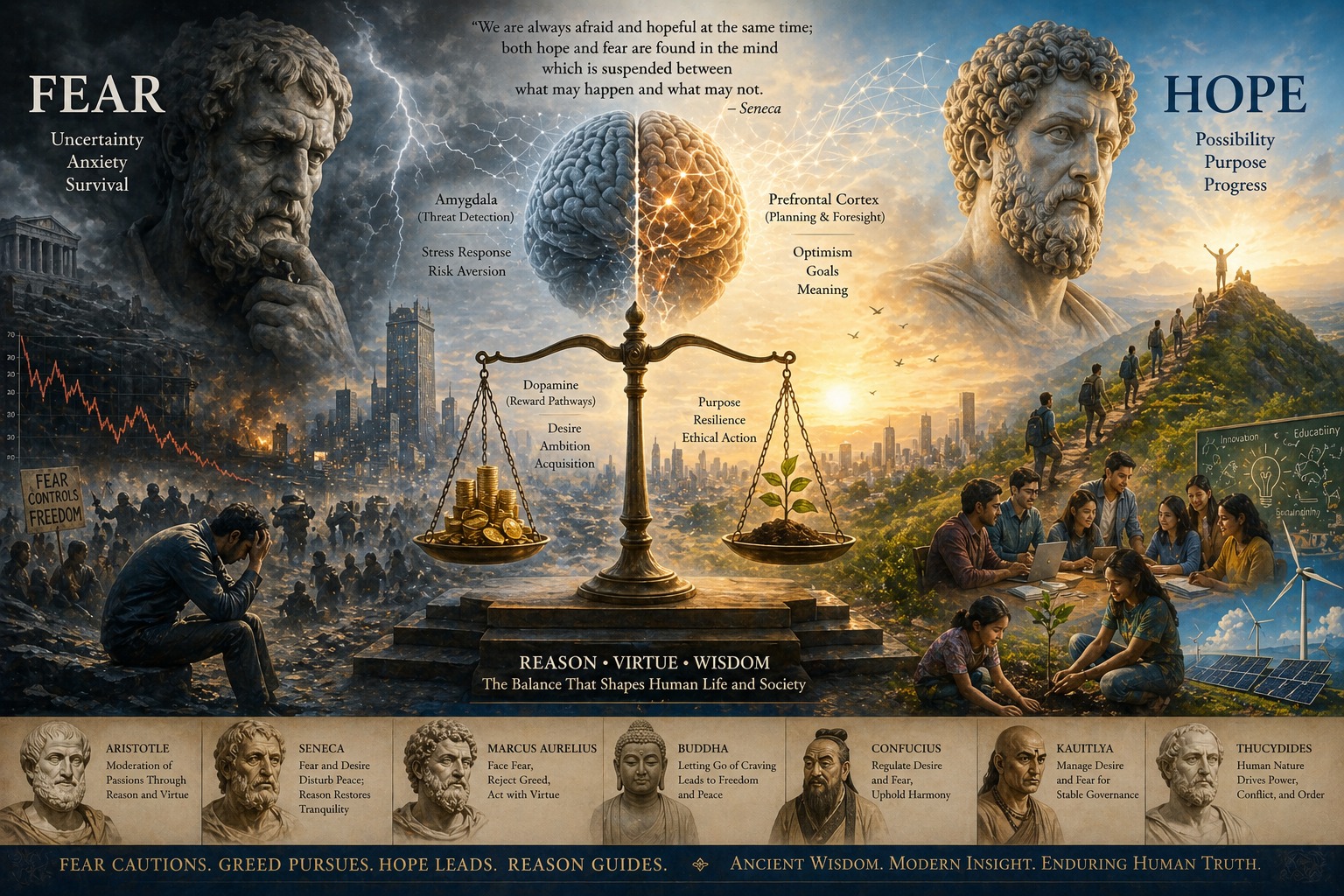
“We are always afraid and hopeful at the same time; both hope and fear are found in the mind which is suspended between what may happen and what may not. Reason alone can keep us steady.”-Seneca, Letters from a Stoic, Letter XIII (on Fear and Hope)
“It is not the man who has too little, but the man who craves more, who is poor.” (Letters to Lucilius, LXXIII)-Seneca
“To desire without limit is the greatest obstacle to serenity; to fear without reason is the greatest obstacle to action.” (Meditations, IV.3)-Marcus Aurelius
“From craving arises sorrow; from letting go arises freedom.” (Dhammapada, Ch.1, v.213)-Buddha
From the earliest extant texts of human thought to the latest interdisciplinary scholarship, fear, greed, and hope have been recognized not as fleeting feelings but as foundational forces shaping human life, thought, society, and institutions. In classical philosophy they are more than psychological curiosities; they are structural elements of ethical life and political order.
Aristotle’s ethics situates fear and desire within his broader account of practical reason and virtue, holding that ethical flourishing depends upon moderating the passions through rational judgment rather than being ruled by them, implicating both fear and greed in the formation of character and moral agency. Ancient Stoic thinkers such as Seneca and Marcus Aurelius treat passions-including fear and uncontrolled desire-as disturbances of reason that must be examined, disciplined, and transcended through philosophical practice to achieve tranquillitas animi and resilience in the face of uncertainty and adversity.
Seneca’s dialogues explore how anxiety and worry undermine ethical peace of mind, while the Meditations of Marcus Aurelius repeatedly affirm that the disciplined mind must confront fear without capitulation and orient action toward virtue rather than mere avoidance or craving for external outcomes.
In this classical frame, hope is not merely optimism but an active engagement of reason with possibility, driving prudent aspiration without dependency on uncontrollable externalities-a position that ancient letters and discourses on emotions implicitly map onto the very structure of ethical life and political stability.
Tusculanae Disputationes and its Stoic-inflected engagement with grief and mortality further illustrate how fear and hope are entwined in the human condition, where confronting the fear of loss becomes a practice that can deepen ethical resolve rather than induce paralysis. Philosophers like Spinoza later argued that fear and hope are co‑implicated in the very way we imagine and respond to the future, shaping human agency and social life in ways that are not reducible to mere emotion but are embedded in cognitive and imaginative structures of motivation.
The psychological dimension of fear, greed, and hope is deeply embedded in neurobiological processes, reflecting evolutionary imperatives. Fear engages the amygdala and triggers stress-related hormonal cascades, preparing the body for rapid response while influencing perception, memory, and decision-making. Greed activates dopaminergic reward pathways, reinforcing behaviors that lead to acquisition, status, and security. Hope, mediated through prefrontal cortical networks, enables forward-looking planning, self-regulation, and goal-directed action, mitigating the immobilizing effects of fear and the potentially destructive compulsions of greed.
Classical thinkers anticipated these insights long before neuroscience provided empirical support. Aristotle’s ethics explored the interplay between desire, fear, and rational moderation, framing virtue as the harmonization of affective drives.
Stoic philosophers emphasized disciplined self-mastery, viewing fear and desire as obstacles to rational judgment while valorizing the role of hope in sustaining virtuous action amid uncertainty. Eastern traditions converged on analogous insights: Buddhist teachings framed attachment and craving as sources of suffering, recommending mindfulness and ethical cultivation, while Confucian philosophy stressed regulating fear and desire to maintain social order.
Across civilizations, these forces operate as simultaneously psychological and ethical, structuring both personal character and communal life.
Ethically, fear, greed, and hope act as moral indicators, reflecting capacities and limitations within human character. Excessive fear can compromise courage, justice, and moral agency; unchecked greed may produce exploitation and structural inequities; hope motivates perseverance, ethical risk-taking, and constructive innovation.
Moral systems-from Hebrew and Islamic traditions to Confucian thought-linked ethical conduct to the moderation of fear and desire, with hope serving as a guiding orientation toward virtue and societal good. The moral dilemmas arising at the intersection of these forces are perennial: leaders must weigh caution against innovation, ambition against equity, and prudence against visionary action.
Hope becomes the compass by which humans navigate these tensions, fostering courage, resilience, and ethical discernment. Its cultivation is not merely personal but socially consequential, shaping norms, inspiring collective action, and reinforcing communal responsibility.
Politically, fear, greed, and hope operate as structural levers that shape governance, institutional stability, and social cohesion. Collective anxieties, ambitions, and aspirations drive alliances, conflicts, civic engagement, and institutional evolution. Thucydides’ analysis of human behavior in war, Kautilya’s systematic guidance in the Arthashastra, and Chinese Legalist and Confucian approaches to regulation all reflect an understanding of these forces as instruments and challenges of statecraft. Fear can enforce obedience and consolidate power; greed can stimulate economic growth and political ambition; hope can unify populations around ideals, motivate civic participation, and catalyze transformative projects.
Across time, the management and ethical harnessing of these forces have determined the resilience, justice, and adaptability of political systems, illustrating their inextricable link to human organization.
Socially, fear, greed, and hope shape collective behavior, cultural norms, and social institutions. Fear fosters cohesion, moral discipline, and ritualized compliance; greed drives competition, innovation, and the accumulation of resources; hope sustains imagination, solidarity, and collective aspiration. Civilizations from classical Greece to ancient China developed laws, religious codes, and civic practices to channel these forces toward social stability and shared prosperity.
Contemporary social science, including behavioral economics and political psychology, confirms the persistence of these dynamics, demonstrating that risk aversion, desire, and expectation continue to govern human interaction, cooperation, and economic behavior. Intersectional analyses further reveal that these forces are experienced and expressed differently across gender, class, and social position, highlighting the layered complexity of human motivation and social regulation.
Economically, greed forms the engine of trade, investment, and enterprise, fear calibrates risk-taking and resource preservation, and hope motivates long-term planning, innovation, and entrepreneurial daring. Cultural expression-myth, literature, theater, and visual art-reflects and mediates these forces, embedding them in narratives, symbols, and social imagination. Through these channels, fear, greed, and hope shape not only material life but ethical sensibilities, aesthetic values, and collective identity.
Historically, these forces adapt to context: technological change, social organization, and institutional frameworks modulate their expression and consequences, demonstrating both continuity and flexibility. Ancient empires, medieval polities, and contemporary democracies all reveal how these constants interact with circumstance to produce diverse trajectories of human endeavor.
In our contemporary world-where economic volatility, political polarization, environmental uncertainty, and social fragmentation test both individuals and communities-the classical insights into fear, greed, and hope remain urgently relevant and deeply illuminating. The psychological mechanisms and cultural manifestations of these forces are now examined through neuro-philosophy and behavioral sciences, which extend ancient observations into predictive models of risk‑sensitivity and reward (e.g., modern reinforcement theories that distinguish fear- and reward-based systems) and show how fear and greed recur in market behavior and social dynamics.
Yet the enduring wisdom of classical inquiry reminds us that fear and greed need not be eradicated but guided by reason and ethical cultivation, while hope-properly understood as reasoned aspiration toward possible goods-can animate both personal resilience and collective engagement.
In this sense, understanding fear, greed, and hope as intertwined dimensions of human cognition and culture allows us to navigate complexity with clarity, courage, and confidence rather than being driven by anxiety, unbridled desire, or passive optimism.
The transformative power of this integrated perspective lies in its timeless applicability and social relevance, offering a framework for personal mastery and civic flourishing that bridges ancient wisdom with contemporary scholarship, illuminating how we might ethically channel deep human motives toward justice, innovation, and shared wellbeing.
Comments are closed.