


Shoiab Mohmmad Bhat
“Books remain one of the most powerful tools the humanities have created; they bridge generations and cross borders without ever needing a passport. More than just bound pages, they are windows into new worlds where readers encounter new people, cultures, and ideas that shape both thought and future.”
World Book Day carries deep cultural significance because it connects literature with historical figures who have shaped global writing traditions and storytelling. Books remain one of the most powerful tools the humanities have created; they bridge generations and cross borders without ever needing a passport. More than just bound pages, books are windows into new worlds. Through them, readers encounter new people, explore diverse cultures, and engage with ideas that influence both thoughts and future.
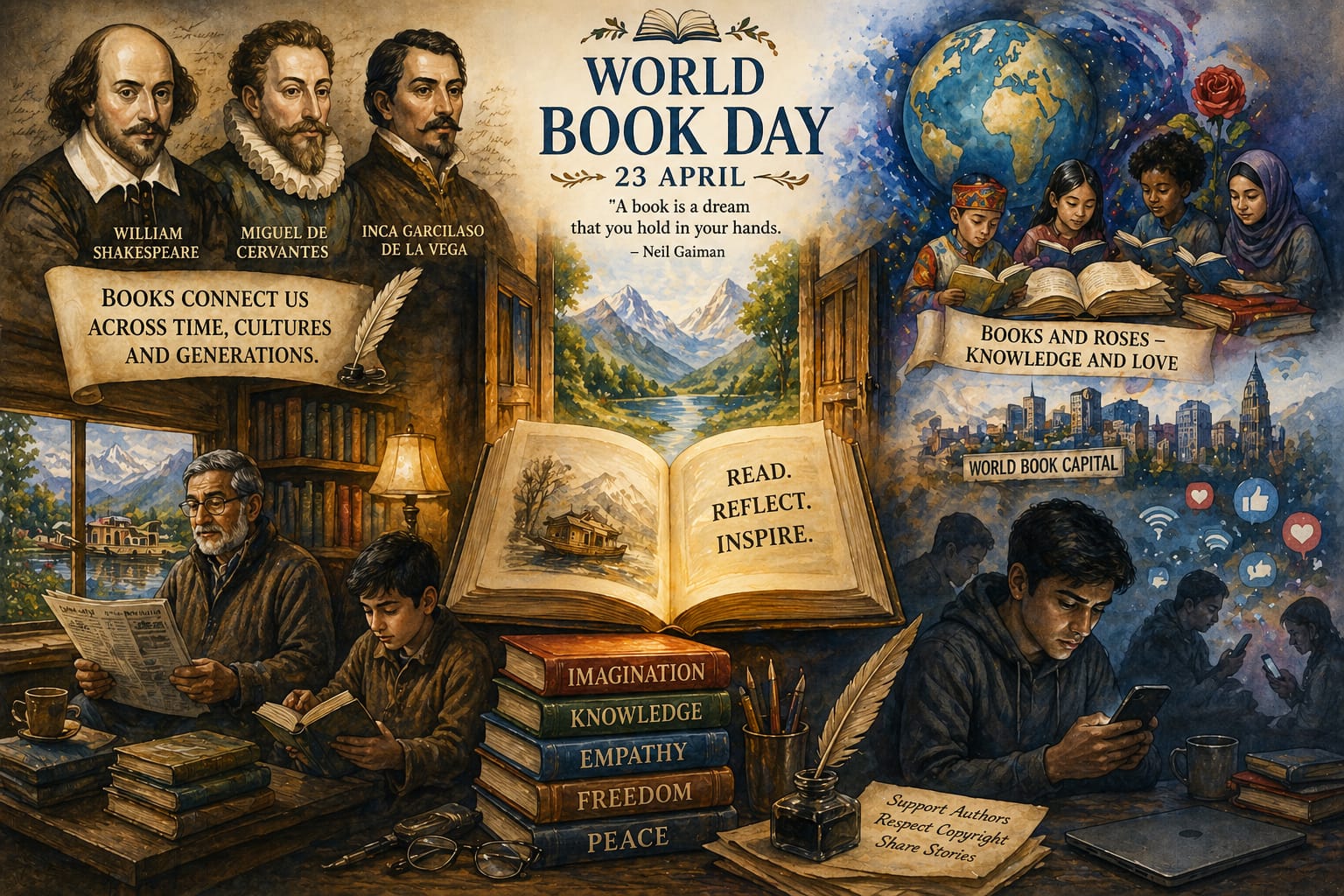
It is natural to ask ourselves why April 23 has been chosen for the celebration of World Book Day. The choice of this date is not accidental. It was on this day that the world bid farewell to three of its greatest literary figures – William Shakespeare, Miguel de Cervantes, and Inca Garcilaso de la Vega. Although they left this earth, they left behind their eternal message through literature. This is the essence of books: they allow conversations with the past while inspiring the future.
The celebration of this festival is further boosted by the cultural impact of the Catalan festival of ‘La Diada de Sant Jordi’, wherein there is an encouragement among the people to give roses and books as gifts to each other. These represent the concept of knowledge and love. One may take this cultural phenomenon as evidence of the nourishment of the mind that comes from literature. The concept of World Book Day was conceived in 1996.
To further promote reading, UNESCO introduced the World Book Capital programme, selecting one city each year to champion literacy and education. Cities such as Madrid, Rio de Janeiro, and Rabat have carried this responsibility, spreading the message that reading is a universal right, not a privilege. Books have the capacity to challenge poverty, reduce inequality, and contribute to sustainable peace.
When I talk about Kashmir’s present situation, I realize that most people, whether students or teachers, do not read books as they did in earlier years. There was a time when electronic devices like smartphones and laptops were not widely accessible, and reading was a natural and essential part of daily life. Mornings would begin calmly, often with a cup of tea and a newspaper in hand. People would spend time reading articles, editorials, and stories, while books and magazines were read not out of obligation, but out of genuine interest and habit. Reading was not limited to academics; it shaped thinking, language, and awareness, quietly influencing how individuals understood the world around them.
The reading culture was a phenomenon embedded in daily life. There were rooms set aside for books, which were systematically organized and safeguarded. The value of these books lies not only in their presence within homes but rather in the fact that they held information and ideas that people needed to think about. The reading of books promoted thoughtfulness in society.
Now, the situation has noticeably changed. The first interaction of the day for many people is no longer with a book or a newspaper, but with a mobile phone. Once we wake up, the first thing we do is go through notifications, messaging apps, and news on social networking sites. We have been slowly drifting away from the habit of reading because now, instead of spending quality time with books and stories, we consume a lot of short-lived content, which does not even leave much of an impact on us.
Our identities and personalities are increasingly shaped by the digital world. The effects that social media often replaces the reflective process that reading once encouraged. While technology has undoubtedly made information more accessible, it has also altered how that information is absorbed, often at the cost of depth and critical thinking.
As we think about what used to be in the past, books used to have decorations on them and be preserved in certain reading rooms or parts of our homes, as they held significance. This is no longer the case today. There are only a few books left for us, and there are fewer still who read them with the dedication that was once present in us. This goes completely against the philosophy behind World Book Day.
There is always an author behind each book. This creates the need for copyrighting because of the legal and moral basis of the literary world. It allows the writer or publisher to be acknowledged for their efforts and be compensated accordingly in order to keep contributing to the world.
Despite these initiatives, another question still needs to be raised: are books actually accessible to all? In many countries across the globe, including our very own, books are still not accessible enough. This shows the difference between celebrating and being realistic about it. Celebrating World Book Day must be more than just a token gesture; it should lead to something concrete.
Living in a divided world, one finds that books are one of the most powerful sources of unity. Books enable us to have empathy and understand that, regardless of how different we are from each other, our aspirations remain the same as humans.
Just one small act can make a big difference: grab a new book, help out a writer, and give your story to another person. Reading a book does not simply involve flipping pages; rather, it opens up an unlimited number of doors. Through this act, literature continues to build understanding and strengthen the foundations of peace in human minds.
Comments are closed.