

S Ahmad
“India has long been one of the world’s largest agricultural producers, yet it has struggled with post-harvest losses and weak processing systems. PLISFPI seeks to bridge this gap by linking farms directly to factories and global markets.”
India’s agricultural story has long been told in familiar images: golden wheat fields, sprawling rice paddies, fruit-laden orchards, and the quiet resilience of farmers working against the unpredictability of weather and markets. Yet for all its production strength, India has historically struggled with a paradox—being among the world’s largest producers of agricultural commodities while simultaneously losing enormous value in post-harvest inefficiencies, weak processing infrastructure, and fragmented supply chains.
Over the last decade, however, a quiet structural shift has begun to take shape. It is not always visible in political debates or headline controversies, but it is steadily redefining how India connects its farms to its factories and its factories to global markets. At the center of this transformation lies the Production Linked Incentive Scheme for the Food Processing Industry (PLISFPI), a policy intervention that seeks not just to boost output, but to fundamentally reimagine India’s place in the global food economy.
A Sector at the Intersection of Agriculture and Industry
To understand the significance of PLISFPI, it is important to first understand the sector it is attempting to transform.
India’s food processing industry sits at a critical intersection. On one hand, it is deeply tied to agriculture, employing millions and influencing farm incomes. On the other, it is part of the manufacturing ecosystem, contributing to industrial growth, exports, and urban employment. Over the past decade, this sector has grown from a largely unorganised, small-scale activity into a more structured and investment-attracting industry.
The numbers reflect this shift. The Gross Value Added (GVA) of the food processing sector has increased significantly—from ₹1.34 lakh crore in 2014–15 to ₹2.24 lakh crore in 2023–24. Even more telling is its growing contribution to exports: processed food exports as a share of agricultural exports have risen from 13.7% to 20.4% over the same period.
Yet, these achievements coexist with long-standing structural gaps. A large portion of India’s agricultural produce still remains unprocessed or minimally processed. Post-harvest losses continue to erode farmer incomes. Cold chain infrastructure remains uneven. And Indian food brands, despite global potential, have often struggled to establish a strong international identity.
It is in response to these gaps that PLISFPI was conceived.
The Policy Philosophy Behind PLISFPI
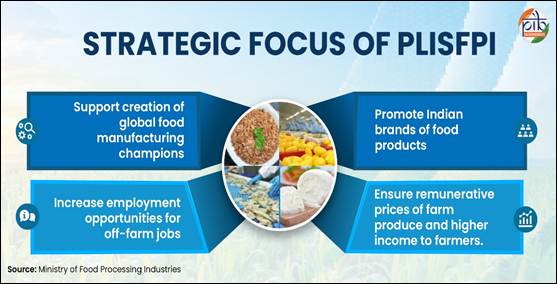
Launched in March 2021 as part of the broader Production Linked Incentive (PLI) framework, PLISFPI reflects a shift in India’s industrial policy thinking. Instead of relying solely on subsidies or input support, the scheme links incentives directly to performance—specifically, incremental production and sales.
This approach is rooted in a simple but powerful idea: if companies are rewarded for growing output and competitiveness, they will naturally invest in scale, efficiency, and innovation.
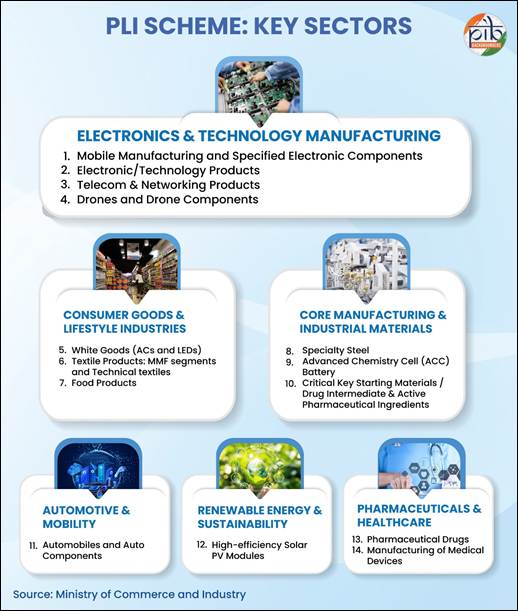
The broader PLI ecosystem itself—initially rolled out for sectors like electronics, pharmaceuticals, and medical devices—was designed to strengthen domestic manufacturing and reduce dependency on imports. Over time, it expanded to 14 strategic sectors, with a total outlay of nearly ₹1.97 lakh crore. Food processing, with an allocation of ₹10,900 crore, was identified as a key frontier where India’s agricultural strength could be converted into manufacturing and export competitiveness.
PLISFPI, implemented from 2021–22 to 2026–27, carries ambitious targets: generating processed food output worth over ₹33,000 crore and creating employment for approximately 2.5 lakh people. But beyond numbers, its underlying objective is structural—building a globally competitive food processing ecosystem rooted in Indian agriculture.
Three Pillars of Transformation
What makes PLISFPI particularly distinctive is its multi-layered design. It does not treat the food processing industry as a single homogenous sector, but instead addresses it through three interconnected components.
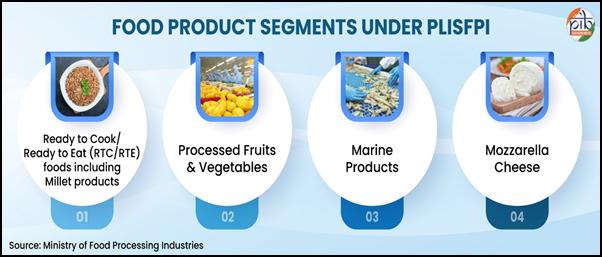
The first focuses on large-scale manufacturing in key food segments—ready-to-eat and ready-to-cook products, processed fruits and vegetables, marine products, and mozzarella cheese. This is the industrial backbone of the scheme, aimed at increasing output, efficiency, and global competitiveness.
The second component shifts attention to small and medium enterprises, particularly those working with innovative and organic food products. It includes niche categories such as free-range eggs and poultry products. This is a crucial inclusion, as MSMEs form the backbone of India’s food ecosystem but often lack the scale and financial support to compete in structured markets.
The third component moves beyond production entirely into branding and global marketing. Here, the government steps into a role it has rarely played before in the food sector: supporting Indian brands to establish visibility in international markets. Reimbursement of branding expenses abroad, shelf space support, and marketing incentives reflect an understanding that production alone is not enough—perception and branding are equally decisive in global trade.
Together, these three pillars represent a shift from a production-centric approach to a value-chain-centric approach.
Millets and the Expansion of Policy Vision
An interesting extension of the scheme came in the form of a dedicated component for millet-based products, carved out in 2022–23. With an allocation of ₹800 crore, this sub-scheme reflects India’s renewed global advocacy for millets as a “superfood.”
This move is not merely agricultural—it is strategic. Millets are climate-resilient, nutritionally rich, and historically rooted in Indian diets. By incentivising their inclusion in ready-to-eat and ready-to-cook formats, the scheme attempts to bridge traditional agriculture with modern consumption patterns.
It is also a recognition that global food markets are shifting towards healthier, sustainable, and minimally processed products. India’s millet push, therefore, is not only about domestic nutrition but also about positioning itself within emerging global food trends.
Implementation Architecture: The Role of Institutions
Policy design, however, is only as strong as its implementation. PLISFPI is administered through a structured institutional framework led by the Ministry of Food Processing Industries, with the Industrial Finance Corporation of India Limited (IFCI) acting as the Project Management Agency.
Applications are processed through an online portal, evaluated within defined timelines, and assigned unique IDs for tracking. A management information system monitors progress and allows for corrective interventions.
While such digitisation and monitoring systems reflect modern governance practices, they also point to a deeper shift: the increasing bureaucratic sophistication required to manage incentive-based industrial policy.
Early Outcomes: Scale, Investment, and Employment
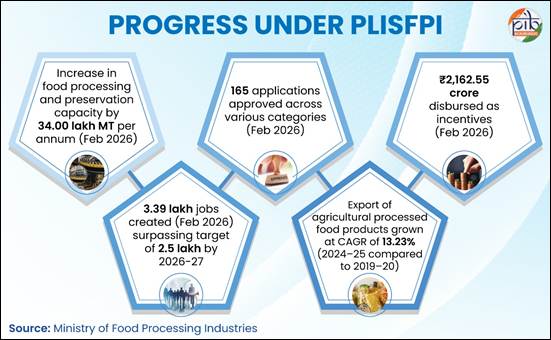
By early 2026, PLISFPI had already begun to show measurable impact.
The scheme has approved 165 applications across 274 project locations. Beneficiaries have received over ₹2,162 crore in incentives, while total private investment has crossed ₹9,200 crore. Processing capacity has expanded by 34 lakh metric tonnes annually.
Perhaps most significantly, employment generation has exceeded expectations. Against a target of 2.5 lakh jobs, the scheme has already created approximately 3.39 lakh direct and indirect employment opportunities. In a country where job creation remains one of the most pressing economic challenges, this overperformance is notable.
Export performance has also strengthened. Processed agricultural exports linked to the scheme have grown at a compound annual growth rate of over 13%, with cumulative export sales exceeding ₹89,000 crore over a multi-year period.
These numbers suggest that the scheme is not merely disbursing incentives but actively reshaping industrial behaviour.
MSMEs: The Quiet Beneficiaries
One of the less visible but critically important aspects of PLISFPI is its impact on MSMEs. Out of approved applications, a significant portion belongs to small and medium enterprises. Additionally, many contract manufacturing units integrated into larger supply chains are MSME-driven.
This integration matters because MSMEs often act as the connective tissue of India’s food economy. They operate at the intersection of rural production and urban consumption, yet historically face constraints in finance, technology, and market access.
By embedding MSMEs into incentive structures, PLISFPI indirectly strengthens rural livelihoods and decentralised industrial growth.
Beyond Economics: Structural Implications
While the immediate outcomes of PLISFPI are economic—investment, output, exports, and employment—the deeper implications are structural.
First, it is gradually reducing post-harvest inefficiencies by incentivising processing capacity closer to production zones. This has direct implications for farmer incomes.
Second, it is encouraging formalisation in a sector that has long been fragmented. As companies scale up to meet incentive criteria, supply chains become more organised and traceable.
Third, it is altering India’s position in global food markets—from a supplier of raw commodities to a producer of branded, value-added food products.
Finally, it is fostering a new policy culture where performance-linked incentives replace traditional subsidy frameworks.
Challenges and Questions Ahead
Despite its promising outcomes, PLISFPI is not without challenges.
One concern is regional imbalance. Large-scale investments tend to concentrate in already industrialised states, potentially widening disparities unless corrective measures are introduced.
Another issue is sustainability. Incentive-driven growth must eventually transition into self-sustaining competitiveness. If firms become dependent on subsidies without building long-term efficiency, the policy risks diminishing returns.
There is also the question of global competition. While India is scaling up processing capacity, it must still compete with established global food exporters with strong branding, logistics, and quality ecosystems.
Finally, infrastructure bottlenecks—particularly cold chains, storage, and rural connectivity—remain critical constraints that no incentive scheme alone can fully resolve.
Conclusion: A Sector in Transition
The Production Linked Incentive Scheme for the Food Processing Industry represents more than a policy intervention; it represents a shift in economic imagination.
It acknowledges that India’s agricultural strength cannot be fully realised without industrial transformation. It recognises that value addition is as important as production. And it attempts to position Indian food products not just for domestic consumption but for global recognition.
Its early results—rising investment, expanding capacity, growing exports, and job creation—suggest that the model has traction. But its long-term success will depend on whether it can move beyond incentive dependence to structural competitiveness.
Ultimately, PLISFPI is not just about food processing. It is about how India chooses to connect its farmers to its factories, its factories to its global ambitions, and its traditional agricultural strengths to a rapidly modernising world economy.
If it succeeds, it may well redefine not just what India grows—but what the world eats from India.
Comments are closed.