
Impact of Climate Change on Kashmir’s Apple Economy
Rising temperature fluctuations and untimely rainfall create uncertainty for farmers and challenge the sustainability of Kashmir’s apple sector


Shoiab Mohmmad Bhat
“Climate change is not just affecting crops; it is disrupting livelihoods. A decline in apple production directly impacts the economic stability of thousands of families.”
The apple economy of Kashmir forms the backbone of livelihood for a large section of its population. It is far more than an agricultural activity; it represents a way of life that sustains millions of families across the Valley. Sopore stands at the center of apple production, and is widely known as the Apple Town of Kashmir. Every year, vast quantities of apples are produced, packed, and transported to different parts of India and even exported to countries such as Bangladesh, Nepal and Bhutan. This industry supports farmers, traders, transporters, and labourers, making it one of the most vital economic pillars of the region.
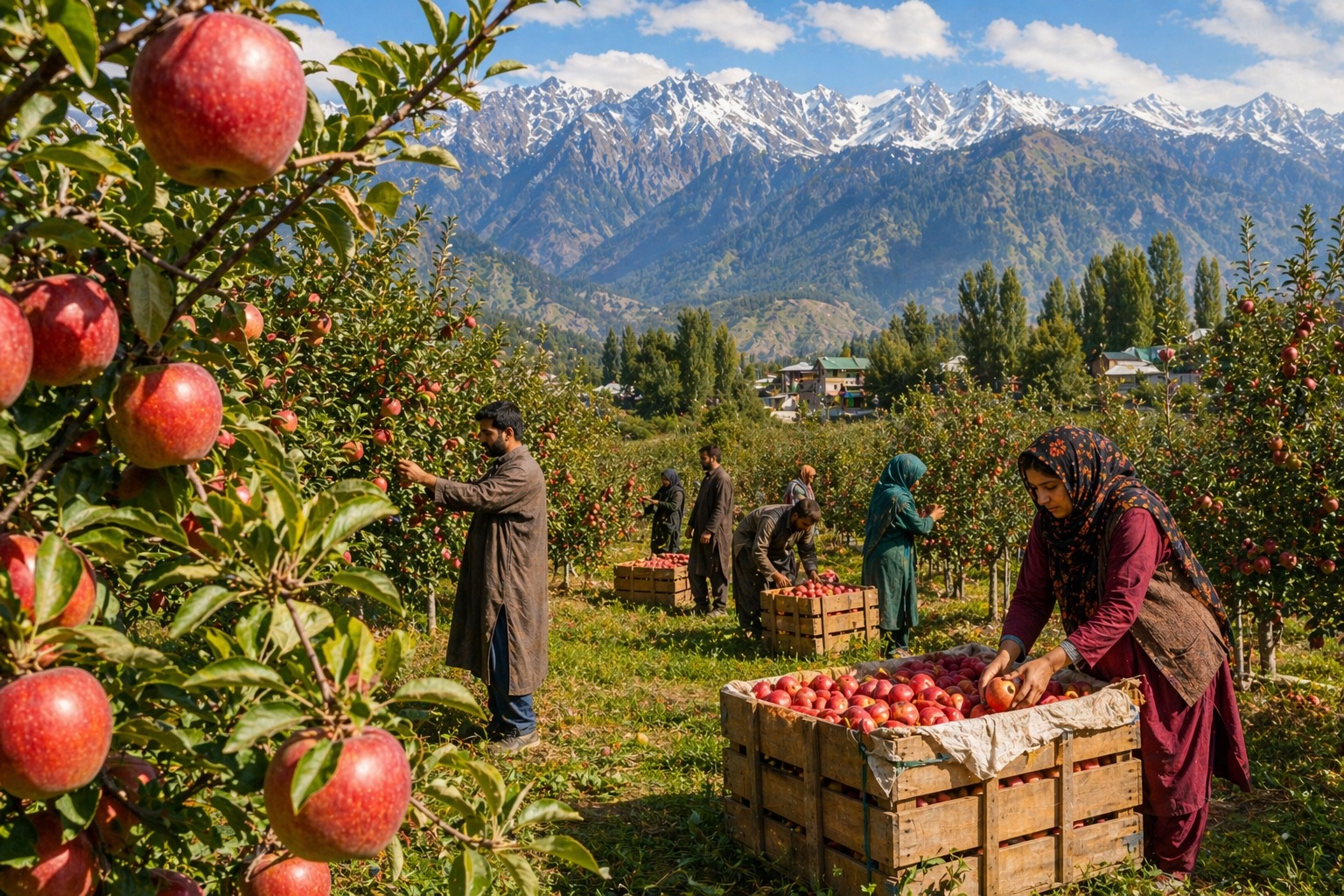
A significant portion of Kashmir’s population depends directly or indirectly on apple orchards. From orchard owners to daily workers, from youth to elderly individuals, the apple economy provides employment and sustenance. Women also play an essential role in this sector. They take an active part in the process right from the planting stage till after harvesting the apples. It is common to see women carrying manure made from cow dung that serves as a natural fertilizing agent, sharing the same activities as the men, helping pick apples, carry the boxes, grade them, and pack them.
For Kashmiris, the apple orchard is as important as a child. From the very beginning, when a seedling is planted, to the end when it is cared for by applying manure, fertilizers, irrigation, and protection from pests, everything has to be done properly. It involves a lot of patience, skill, and conducive weather conditions. In all of these, climate is the most important factor.
Apple cultivation requires a moderate climate. Extremely high or very low temperatures create challenges for healthy growth and fruit development. In recent years, the Valley has been experiencing significant climatic fluctuations, raising serious concerns among farmers and experts. Climate change has started to disturb the natural balance required for apple cultivation, directly influencing productivity and quality.
According to meteorological observations, Kashmir experienced an unusual warm spell from mid-February to mid-March this year, with temperatures ranging from 6°C to 11°C above the seasonal average. Unforeseen warming during this critical period disrupts the dormant period of apple trees. Chilling requirements still play an important role in ensuring apple trees successfully go into dormancy and bloom properly. Failure to do so results in irregular blooming and poor fruit set.
On the other hand, the latest data reveal that there have been fluctuating temperature levels that are comparatively low during the flowering stage. In Srinagar, the maximum temperatures registered were 16.3 degrees centigrade on Saturday and 17.3 degrees centigrade on Sunday. In places like Sopore and Shopian, where apples are produced, temperature levels were not even up to 15 degrees centigrade.
Low temperatures, especially during nighttime, lead to ovule damage. The ovule represents a critical part of the flower that develops into fruit after successful fertilisation. If the ovule is harmed because of the cold weather, the probability of developing fruits becomes very small. One apple producer from Sopore was worried, saying that if the weather is cold at night, then there will be a risk of ovule death.
Another major concern linked to lower temperatures involves the inactivity of pollinators such as bees. Bees play a crucial role in the pollination process, which remains essential for fruit formation. When temperatures fall below 15°C, bees remain inside their hives and avoid movement. This lack of pollinator activity disrupts the fertilisation process and reduces fruit set. As a result, even with proper flowering, the absence of active pollination leads to lower yields.
Farmers across the Valley continue to express concern over these erratic weather patterns. The combination of unusual warmth during one phase and unexpected cold during another creates an unstable environment for apple cultivation. Persistence of such conditions leads to a significant decline in overall production. This directly affects the income of farmers and all those associated with the apple industry.
In addition to temperature fluctuations, continuous and untimely rainfall has emerged as a serious challenge. Prolonged rainy conditions during critical stages such as flowering and fruit setting damage blossoms, wash away pollen, and encourage the spread of diseases. Excess moisture creates favourable conditions for fungal infections, further harming the crop. These factors collectively reduce both the quality and quantity of apples produced.
The impact of climate change on the apple economy extends beyond agricultural output. It carries wider social and economic consequences. A decline in production leads to financial stress for farmers, reduced employment opportunities for labourers, and disruption in the overall market chain. Since a large portion of Kashmir’s population relies on this sector, even a slight drop in production affects the region’s economy.
Furthermore, the unpredictability associated with shifts in weather patterns complicates the planning process for agricultural tasks. Historical knowledge and seasons, which have guided agricultural practice for centuries, have now become uncertain. This has implications for the risk associated with growing apples.
Overcoming these obstacles calls for knowledge, adaptability, and effective support systems. The farmers will require modern farming technology, weather predictions, and scientific advice. The promotion of climate-tolerant apple species, advanced irrigation methods, and pest control measures could minimize the impact of climate change.
In terms of policy issues, it is imperative that the government plays an important role in protecting the apple industry. The government has been working tirelessly, coming up with several programs that aim at helping farmers as well as the entire horticultural sector. Financial assistance and insurance for crops are among the most significant factors that ensure success. In recent years, the use of trains for the transportation of apples has been helpful for farmers in terms of reducing costs associated with transport and making sure that products are delivered on time.
The apple economy serves as the lifeline of Kashmir, deeply connected with the livelihood and identity of its people. The growing impact of climate change poses a serious challenge to this vital sector. Erratic weather patterns, temperature fluctuations, and untimely rainfall disturb the delicate balance required for successful apple cultivation. Timely measures and collective efforts can protect this industry and secure the future of millions who depend on it.
Comments are closed.