Baramulla, Apr 13 : The River Jhelum, considered the lifeline of north Kashmir, is facing severe pollution at Baramulla’s Jetty area, where heaps of uncollected waste have accumulated along its banks, raising serious health and environmental concerns among residents.
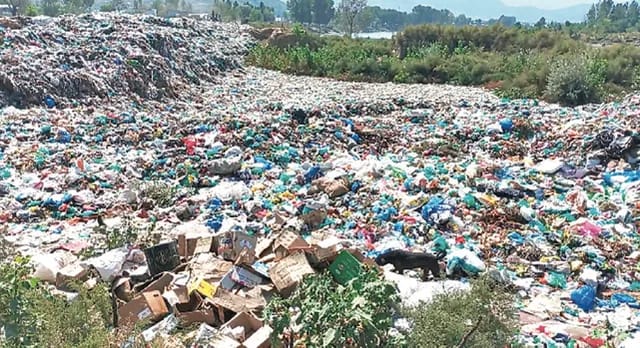
Plastic waste, biomedical refuse and decomposing organic matter lie scattered at the site, which has effectively turned into an open dumping yard. The situation persists even as authorities continue to promote cleanliness drives under the Swachh Bharat campaign.
With no functional solid waste management system in place, the Municipal Council (MC) Baramulla has designated the Jetty area as the town’s primary dumping site. Household waste collected through door-to-door services is being dumped directly along the river’s edge on a daily basis.
Locals say the stench from the site has made living conditions unbearable.
“I have difficulty breathing,” said Fatima Begum, 58, who lives barely 50 metres from the dumping site. “In the morning, such a foul smell rises that it feels like a dead body is lying there. And we have to drink that same water.”
The Jhelum remains the main source of water supply for much of the town. While the Public Health Engineering (PHE) department maintains that water is filtered before distribution, residents remain sceptical.
“Even after filtering, I don’t feel the water is right,” said Gulzar Ahmad, a college student. “When you can see with your own eyes that garbage is going into the river, how can you trust it?”
Another resident, Ghulam Nabi Dar, 62, expressed concern over the situation ahead of the summer season.
“Summer is coming. There will be water scarcity. And these people are dumping fresh garbage every day. I don’t know what we are drinking,” he said.
MC Baramulla Chief Executive Officer Farhana Showkat said that bioremediation of legacy waste at the site is underway.
“A new demand for bioremediation of the leftover waste too has been submitted for NARC approval,” she said.
However, she acknowledged constraints faced by the municipal body.
“Since no other dumping site has been provided to MC Baramulla except Jetty within the town limits, and since landfilling is not feasible near the water body, that’s why open dumping is being done there so that the same waste can be bioremediated later. Also, since MC Sopore has no dumping site, they too are dumping their waste at the site, which sometimes creates issues of haphazard dumping by their drivers,” she added.
Residents allege that the dumping has led to a rise in illnesses in the area.
“This is not just about the smell,” said Mohammad Iqbal Rather, a shopkeeper near the Jetty. “My two children are constantly sick. Doctors say it’s an infection. Where is the infection coming from? From this very filth.”
Voicing frustration, locals said repeated assurances by authorities have failed to yield results.
“We are just tired,” said Ameena, who uses only one name. “Leaders come, get their photos taken, make promises. Nothing happens. Ask them — how long will we fight this cancer?”
Environmental activist Dr Raja Muzaffar termed the situation alarming and called for immediate action.
“It’s very unfortunate — the situation there, really it’s becoming a cancer-like situation for people. How long will people remain silent? Lest it becomes too late somewhere. It’s time for people to wake up from their deep slumber. There is still time to fight against this filth — through the NGT, we can control it. We are tired of government assurances. It’s time for action on the ground,” he said.
He added that the issue extends beyond Baramulla. “The same situation is in Sopore, in Sumbal, from Srinagar — whatever filth people dump into the river, others drink it. It’s time for people to save the River Jhelum. A massive campaign should be launched from south Kashmir to north Kashmir,” he said.
As summer approaches and water demand rises, residents say urgent intervention is needed to prevent further deterioration of the river and safeguard public health.


Comments are closed.