

Shabeer Ahmad Lone
“Harmony is not a poetic metaphor; it is a practical necessity. A sustainable future depends on integrating ecological integrity, social justice, and moral responsibility into every level of decision-making.”
Humanity’s ethical imagination has long been constrained by a hierarchical conception of the world, one that elevates human interests above the intrinsic value of nature. This worldview, embedded in Western philosophy, industrial capitalism, and religions of dominion, enabled human expansion and technological advancement but also precipitated the ecological crises that define our era: climate disruption, mass extinction, resource depletion, and social inequities that disproportionately burden marginalized populations. Contemporary scholarship across philosophy, science, policy, mysticism, sacredtexts, and Indigenous knowledge now converges on a transformative insight: ethics cannot remain human-centered alone. A paradigm of harmony, not hierarchy, demands recognizing humanity as an integral participant in the web of life, whose well-being is inseparable from the flourishing of other species and ecological systems.
At the foundation of this reorientation lies the recognition that nature possesses intrinsic value independent of human instrumental interests. Aldo Leopold’s land ethic profoundly reframed moral responsibility by positioning humans as members of a biotic community, accountable for the integrity, stability, and beauty of ecological wholes. Leopold’s vision bridges philosophy and ecology, insisting that moral worth is inseparable from ecological understanding. Holmes Rolston III expands this by emphasizing that ecosystems, species, and evolutionary processes hold moral significance in their own right, a perspective reinforced by ecological science demonstrating the interconnectedness of life at local, regional, and planetary scales.
The deep ecology movement, pioneered by Arne Næss, further radicalizes our ethical imagination by advocating biospheric egalitarianism: all beings capable of flourishing have moral standing. Næss challenges anthropocentric assumptions and calls for lifestyles rooted in humility, ecological awareness, and long-term sustainability. Paul W. Taylor’s biocentric egalitarianism complements this vision by framing ethical duties toward all living beings, insisting that respect extends beyond non-harm to actively honoring the ability of others to pursue their own good. Richard Routley’s “last man” argument underscores that nature retains moral significance even absent humans, destabilizing anthropocentric hierarchies and compelling a moral framework grounded in ecological reality rather than human perception alone.
Yet, conceptual reframing is insufficient without interdisciplinary integration. Environmental science demonstrates that human actions reverberate across global biogeochemical cycles, hydrology, and biodiversity networks. Economics and policy studies reveal that traditional development metrics, such as GDP, fail to account for natural capital, ecosystem services, or social equity. Contemporary approaches like ecological economics, planetary boundaries frameworks, and climate adaptation policy exemplify ways to operationalize ethics in governance. Ethical theory, therefore, must converge with empirical evidence and institutional practice to guide responsible decision-making at local and global scales.
Central to this framework is environmental justice. Vulnerable communities often face the most severe consequences of ecological degradation while contributing least to its causes. Indigenous, Afrocentric, and non-Western philosophies offer instructive alternatives: for example, the Māori concept of kaitiakitanga enshrines collective stewardship over land and water, while African Ubuntu emphasizes relational responsibility among humans and the broader community of life. Integrating these perspectives ensures that ethics is inclusive, globally relevant, and attentive to inequalities inherent in environmental harm.
In the Anthropocene, ethical responsibilities extend to emerging technologies. Geoengineering, synthetic biology, AI-driven environmental management, and conservation tech offer transformative potential but carry risks of ecological disruption and inequity. Philosophical debates in wild animal ethics and intervention ecology highlight the delicate balance between respecting natural processes and alleviating suffering, illustrating the need for flexible, empirically informed moral frameworks capable of guiding innovation responsibly.
Practical examples illuminate the translation of ethical insight into action. Co-managed conservation projects integrating Indigenous knowledge with scientific research have improved biodiversity and community resilience. Urban initiatives embedding green infrastructure enhance human health while supporting ecological connectivity. Participatory conservation, rewilding programs, and ecosystem-based adaptation projects demonstrate that ethics grounded in harmony yields tangible social and ecological benefits.
Equally important are emotional, cultural, and narrative dimensions. Humans are meaning-making beings whose ethical commitments are reinforced through stories, rituals, immersive experience, and art. Cultivating ecological empathy and a sense of interconnectedness with other species fosters enduring behavioral change and strengthens moral imagination. Studies in environmental psychology indicate that attachment to place and awe of nature increase pro-environmental behavior, demonstrating that ethics is both rational and effective.
Philosophers expand environmental ethics by extending moral concern beyond humans: Singer emphasizes the suffering of all sentient beings, Jonas stresses intergenerational responsibility, Callicott links human flourishing to ecosystem health, and Kant frames indirect duties to nature through human virtue. Together, they reinforce a vision of “Harmony, Not Hierarchy”, where ethical responsibility and ecological integrity are inseparably intertwined.
Humans are part of the ecological community, with moral duties extending to all life and ecosystems ([Leopold, 1949]; [Rolston III, 1988]; [Chakraborty, In Defense of Intrinsic Value of Nature]). Nature has intrinsic value independent of human use, demanding respect, preservation, and sustainable coexistence ([Næss, 1973]; [Taylor, 1986]; [Routley, 1973]). A balanced ethic of “Harmony, Not Hierarchy” integrates human flourishing with the integrity and moral worth of the natural world (Stanford Encyclopedia of Philosophy, Environmental Ethics).
Across sacred, mystical, and literary traditions, humanity is inseparable from nature, with ethical responsibility extending to all beings. The Bhagavad Gita teaches selfless duty; Taoism honors alignment with natural flow; the Qur’an enjoins stewardship; Jewish texts, from the Torah to Kabbalistic teachings, emphasize tikkun olam-repairing the world through ethical care for creation; Christian mystics see creation as divine wisdom; Indigenous cosmologies regard land and animals as kin; and global literature celebrates the unity and moral worth of the natural world. Together, these voices affirm a universal ethic of interdependence, respect, and intrinsic value, showing that human flourishing is inseparable from the health and dignity of the more-than-human world.
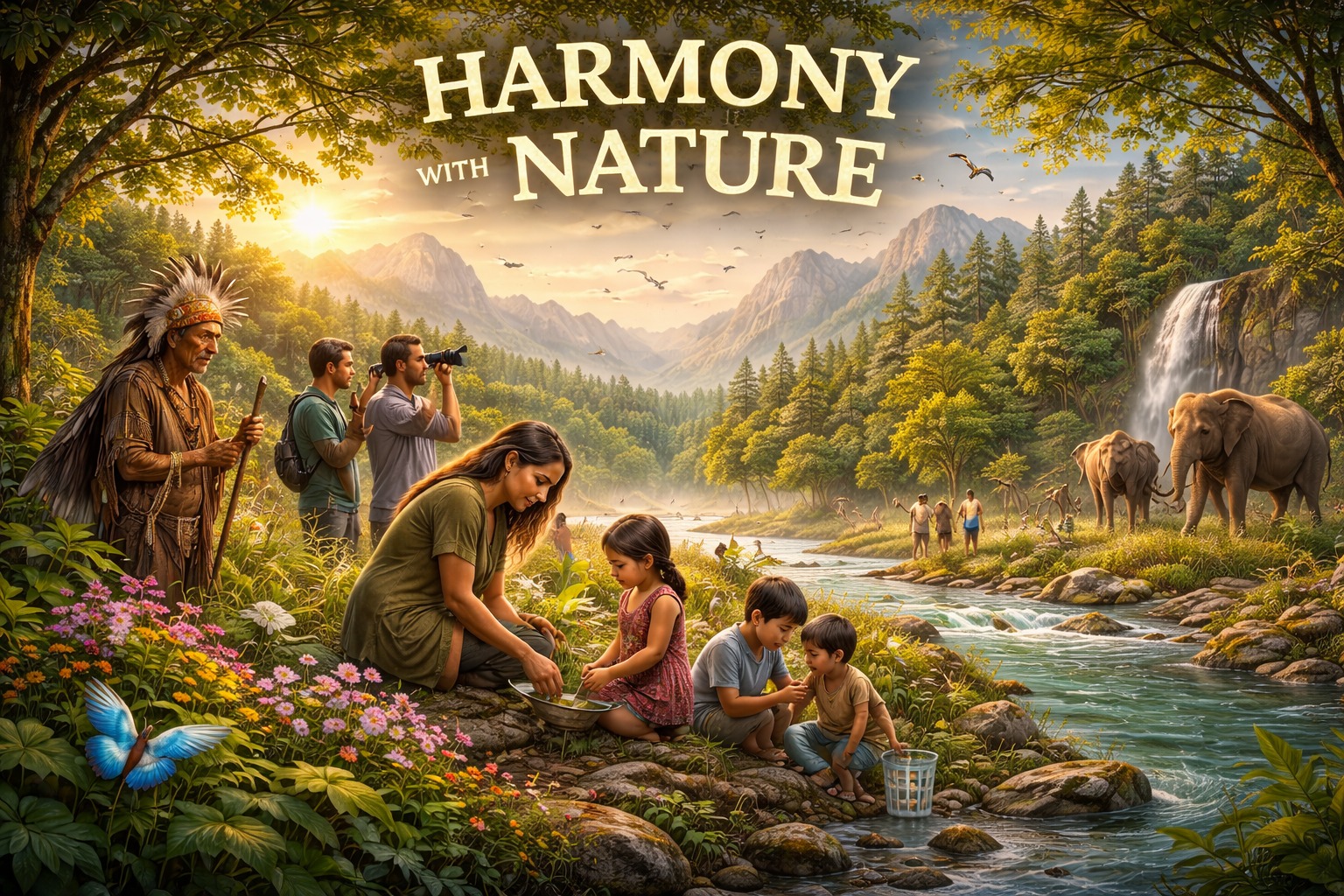
Harmony, Not Hierarchy presents a globally informed ethical vision in which humans are part of, not above, the living world. It affirms the intrinsic value of all life, the interdependence of human and ecological well-being, and the moral responsibility to act justly across species, generations, and cultures. Rooted in philosophy, sacred traditions, and literature, this ethic is both visionary and practical, guiding human action toward sustainable coexistence, resilience, and flourishing for all members of the moral and ecological community.
Comments are closed.