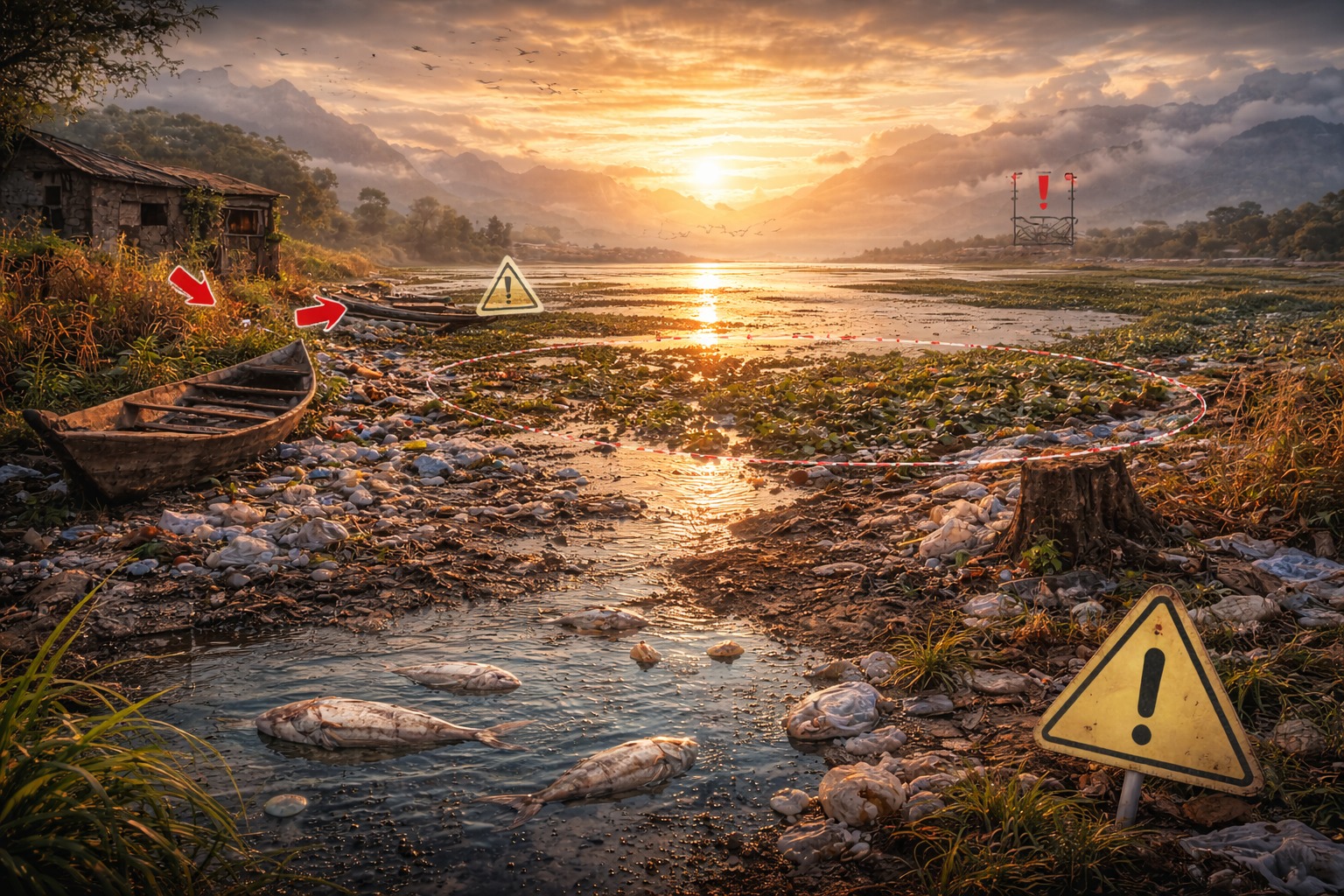
Srinagar, April 06: Wular Lake, one of Asia’s largest freshwater lakes, is on the verge of ecological collapse due to rampant encroachment and siltation, the Comptroller and Auditor General of India (CAG) has warned in a detailed audit of water bodies across Jammu and Kashmir.
The audit, which analysed land and water data from 1967 to 2020, found that 518 out of 697 surveyed lakes have either vanished or degraded beyond recovery. Of these, 315 lakes have disappeared entirely due to urban expansion, encroachment and conversion of wetlands for agriculture and housing.
The deterioration of Wular Lake in Bandipora district has emerged as a stark example of conservation failure.
“Wular Lake’s capacity to act as a natural flood buffer for the Kashmir Valley is being severely compromised. Rampant encroachment along its periphery and unchecked siltation have reduced its water-spread area significantly,” the CAG report stated.
The audit identified seven water bodies — including Rakh-e-Arth, Marhama and Galwal Talao — as having become “invisible” after drying up completely. It noted that even major lakes such as Dal Lake continue to face challenges like untreated sewage inflow and ineffective management.
Out of the 697 lakes surveyed, only six — Dal, Wular, Hokersar Wetland, Manasbal Lake, Surinsar Lake and Mansar Lake — received focused attention, leaving 691 without any dedicated restoration plan.
The report further revealed that 235 of the vanished lakes were under the Revenue and Agriculture Departments, while 80 were managed by the Forest Department. It recommended establishing a unified, specialised authority to prevent further wetland loss and called for urgent intervention to restore critical ecosystems, particularly Wular.
In a related development, a study by the University of Kashmir flagged five high-altitude glacial lakes — including Nundkol Lake and Gangabal Lake — as having “very high susceptibility” to Glacial Lake Outburst Floods (GLOFs), compounding the region’s water security risks.
During the recent autumn session of the Legislative Assembly, the Jammu and Kashmir government informed that a comprehensive bathymetric-hydrodynamic study of Wular Lake is being conducted by the National Institute of Hydrology to assess its water-carrying capacity and siltation rates.
In a written reply to MLA Sopore Irshad Rasool Kar, the Jal Shakti Department said that while no prior baseline survey exists, the ongoing study is expected to generate crucial data to guide conservation measures.
Environmental experts said the CAG findings underline the urgent need for political will, institutional reform and community participation, warning that without immediate and sustained intervention, Wular Lake could meet the same fate as the 315 lakes already lost.


Comments are closed.