

S. Ahmad
India’s external sector performance in 2025–26 reflects a combination of resilience, diversification, and strategic policy alignment. Cumulative exports of merchandise and services during April–January 2025–26 reached USD 720.76 billion, marking a 6.15 percent year-on-year increase. Within this, services exports alone stood at USD 354.13 billion, growing at 10.57 percent over the same period last year. High-growth sectors such as electronics, automobiles, pharmaceuticals, and defence manufacturing are expanding through targeted industrial policies and incentive schemes. Institutional reforms, including the Export Promotion Mission (EPM), are strengthening trade finance, logistics, regulatory compliance, and global market access. At the same time, the Union Budget 2026–27 has prioritised strategic manufacturing expansion to further enhance export competitiveness and reduce import dependency.
In the post-pandemic global economy, India has emerged as one of the fastest-growing major economies. The Economic Survey 2025-26 describes India’s growth trajectory as “the envy of the world,” supported by a stable banking system, strong credit intermediation, robust foreign exchange reserves, and a manageable current account balance. This macroeconomic strength has enabled India to navigate global volatility with greater confidence.
Meanwhile, the international trade environment has witnessed heightened uncertainty, as reflected in global policy indicators such as the United Nations Conference on Trade and Development Trade Policy Uncertainty Index and the Global Economic Policy Uncertainty Index in April 2025. In response to shifting supply chains and geopolitical realignments, India has accelerated efforts to diversify trade partnerships and strengthen resilient supply networks. Rather than pursuing inward-looking protectionism, India has adopted a calibrated strategy that combines targeted import substitution in critical sectors with a strong export orientation to maintain long-term competitiveness.
Manufacturing Renaissance: Building Domestic Capabilities
India’s drive toward self-reliance is anchored in the broader vision of Aatmanirbhar Bharat, translating into sector-specific incentives, investment facilitation, and regulatory reforms aimed at scaling domestic production. Over the past decade, transformative initiatives such as Make in India and the Production Linked Incentive Scheme have reshaped India’s industrial ecosystem. These reforms have not only expanded domestic capacity but also positioned India as an increasingly attractive global manufacturing hub.
The Union Budget 2026–27 reinforces this direction by focusing on strategic and labour-intensive sectors. Measures announced span manufacturing, services, Special Economic Zones, infrastructure, and ease-of-doing-business reforms. Flagship initiatives include Biopharma SHAKTI, the launch of India Semiconductor Mission 2.0, expansion of the Electronics Components Manufacturing Scheme, development of Rare Earth Corridors, and the establishment of Chemical Parks. Customs duty rationalisation on aviation parts, lithium-ion cell manufacturing inputs, and defence components is expected to reduce production costs in aerospace, electronics engineering, and energy storage segments, thereby enhancing export competitiveness.
Electronics: A Flagship Success Story
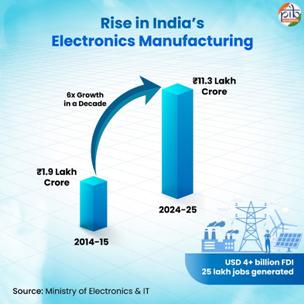
The most visible example of India’s import substitution strategy translating into export strength is electronics manufacturing. With an ambitious target of building a USD 500 billion domestic electronics ecosystem by 2030–31, India has significantly expanded production capacity over the past decade. Electronics production increased nearly six-fold, rising from ₹1.9 lakh crore in 2014–15 to ₹11.3 lakh crore in 2024–25. Since 2020–21, the sector has attracted over USD 4 billion in foreign direct investment, reflecting growing global investor confidence.
Mobile manufacturing exemplifies this transformation. Production in this segment surged from ₹18,000 crore in 2014–15 to ₹5.45 lakh crore in 2024–25, representing a 28-fold increase. India is now the world’s second-largest mobile phone manufacturer, with more than 300 manufacturing units compared to only two units a decade ago. The country has moved from heavy reliance on imports to near self-reliance in mobile device production, while simultaneously becoming a major exporter of smartphones.
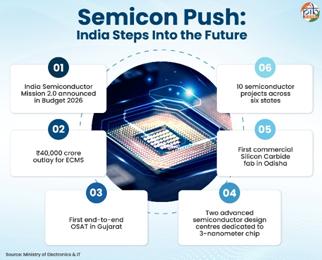
Recognising vulnerabilities exposed during global chip shortages, the government has deepened its focus on semiconductors. India Semiconductor Mission 1.0 provided substantial fiscal support for fabrication and chip design, while the newly launched Mission 2.0 emphasises industry-led research and full-stack intellectual property development. In August 2025, one of India’s first end-to-end OSAT facilities was inaugurated in Sanand, Gujarat, strengthening the semiconductor value chain. Multiple semiconductor projects across six states, including a Silicon Carbide fabrication facility in Odisha, are further consolidating India’s strategic position in global electronics manufacturing.
Automotive Industry: Expanding Domestic Strength and Exports
India’s automotive sector remains a cornerstone of industrial growth and employment. The country is the world’s largest market for two-wheelers and three-wheelers and ranks third globally in passenger and commercial vehicles. The industry supports over 30 million direct and indirect jobs and has recorded nearly 33 percent growth in production over the past decade.
Between FY21 and FY25, total production rose from 22.65 million units to 31.03 million units, while domestic sales climbed from 18.62 million to 25.61 million units. Export performance has also strengthened, with automobile exports increasing from 4.13 million units in FY21 to 5.36 million units in FY25, alongside double-digit growth in the first half of FY26.
Policy measures such as the PLI Scheme for Automobile and Auto Components, the PM E-DRIVE scheme promoting electric mobility, and support for advanced battery storage have catalysed investments and localisation. These initiatives are gradually positioning India as both a major domestic market and an export hub for next-generation mobility solutions.
Pharmaceuticals: Strengthening the “Pharmacy of the World”
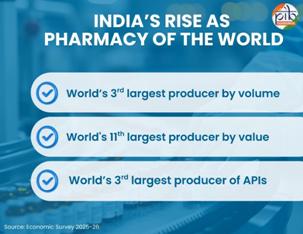
India’s pharmaceutical industry, widely known as the “Pharmacy of the World,” plays a crucial role in supplying affordable medicines globally. The sector ranks third worldwide by volume and eleventh by value, recording a turnover of ₹4.72 lakh crore in FY25. Given the strategic importance of Active Pharmaceutical Ingredients (APIs), India has prioritised domestic production to reduce vulnerability to external supply disruptions.
The PLI scheme for bulk drugs has mobilised significant investments and expanded domestic manufacturing capacity for critical inputs such as Penicillin G Potassium. Simultaneously, the PLI scheme for medical devices has facilitated the production of high-end devices within India. Global integration efforts, including collaboration with the World Health Organization and the establishment of the WHO Global Traditional Medicine Centre in Jamnagar, are enhancing India’s leadership in traditional and integrative medicine systems.
Defence Manufacturing: From Importer to Emerging Exporter
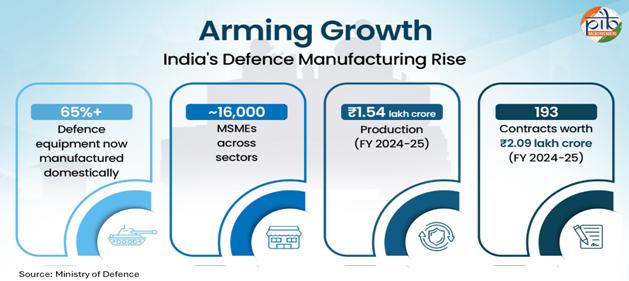
India’s defence sector has undergone a significant transformation, shifting from heavy import dependence to greater domestic production. Indigenous defence production increased from ₹46,429 crore in FY2014–15 to ₹1.54 lakh crore in FY2024–25. Currently, around 65 percent of defence equipment is manufactured domestically.
Policy reforms under the Defence Acquisition Procedure 2020 and the Defence Procurement Manual 2025 have accelerated procurement and improved transparency. Defence exports reached a record ₹23,622 crore in FY2024–25, with Indian defence products now exported to over 100 countries. The government’s target of ₹50,000 crore in defence exports by 2029 signals its ambition to position India as a global defence manufacturing hub.
Export Resilience and Diversification
India’s export performance during April–January 2025–26 underscores resilience amid global uncertainty. Growth has been broad-based, with strong performance in cereals, coffee, iron ore, marine products, engineering goods, petroleum products, and electronics. Electronics exports, in particular, have risen rapidly, becoming one of the country’s top export categories.
Diversification has also improved at the product and partner level. According to trade diversity indices compiled by United Nations Conference on Trade and Development, India ranks among the top Global South economies in product and partner diversification. Over the past three years, India concluded nine Free Trade Agreements covering 38 countries, expanding preferential access to markets representing nearly 70 percent of global GDP. This broadening of trade relationships reduces overdependence on specific markets and strengthens long-term export stability.
Institutional Strengthening: Export Promotion Mission
To enhance export competitiveness, particularly for MSMEs and first-time exporters, the government launched the Export Promotion Mission with an outlay of ₹25,060 crore for FY2025–26 to FY2030–31. The mission operates through the Niryat Protsahan and Niryat Disha sub-schemes, providing support for trade finance, compliance, logistics, and market intelligence.
New interventions include interest subvention for export factoring, structured credit facilities for e-commerce exporters, support for emerging markets, reimbursement of compliance costs under TRACE, assistance for overseas warehousing under FLOW, freight reimbursement in low-intensity districts through LIFT, and integrated trade intelligence systems under INSIGHT. Together, these measures aim to reduce transaction costs, improve liquidity, and strengthen India’s global market readiness.
Key initiatives to strengthen electronics manufacturing
Recognising that electronics manufacturing requires large capital investments, economies of scale, long gestation periods, access to advanced technologies, and a highly skilled workforce, the Government has undertaken a series of strategic interventions to strengthen domestic capabilities and enable domestic firms to integrate more effectively into Global Value Chains (GVCs). To support this objective, several targeted schemes have been launched to strengthen domestic manufacturing and attract investments.
Electronics Component Manufacturing Scheme (ECMS): Notified in 2025 with an outlay of ₹22,919 crore, the scheme aims to strengthen component manufacturing and integrate India’s electronics industry with global value chains through turnover-linked, capex, and hybrid incentives. With investment commitments already nearly double the initial target, the Union Budget 2026-27 increased the outlay to ₹40,000 crore to capitalise on this momentum.
India Semiconductor Mission: Approved in 2021 with an outlay of ₹76,000 crore, the India Semiconductor Mission (ISM) 1.0 provides up to 50% fiscal support for semiconductor fabrication, assembly, testing, and chip design. Building on this, the Union Budget FY 2026-27 provides ₹1,000 crore for ISM 2.0, focusing on industry-led research, technology development, and skilled workforce creation.
Other key initiatives include the Production Linked Incentive (PLI) Scheme for Large Scale Electronics Manufacturing, PLI Scheme 2.0 for IT Hardware, Electronics Manufacturing Clusters (EMC and EMC 2.0) Scheme, Scheme for Promotion of Manufacturing of Electronic Components and Semiconductors (SPECS), and the Modified Programme for Development of Semiconductors and Display Manufacturing Ecosystem.
Services Exports: A Core Strength
Services exports remain a central pillar of India’s external sector. In FY25, services exports reached a record USD 387.5 billion, registering 13.6 percent year-on-year growth and generating a trade surplus of USD 188.8 billion. This momentum has continued into FY26, with exports of USD 354.13 billion during April–January.
Growth is driven by the rapid expansion of Global Capability Centres, strong demand for software, consulting, business process management, and fintech services, and India’s deep talent pool. According to the Stanford AI Index Report 2025, India ranks second globally in AI skill penetration, reinforcing its competitiveness in emerging digital services.
India’s experience demonstrates that strategic import substitution can coexist with export dynamism when supported by institutional reform and targeted incentives. Across electronics, automobiles, pharmaceuticals, defence, and services, the emphasis is on building domestic capacity while integrating deeply with global markets. As industries scale and reduce import dependence, they simultaneously enhance export potential, strengthening the external sector.
Looking ahead to the vision of Viksit Bharat 2047, India’s path to self-reliance will remain intertwined with global engagement. By combining manufacturing expansion, export diversification, institutional strengthening, and technological advancement, India is consolidating its position as a resilient, competitive, and globally integrated economic power.
Comments are closed.