

Suhail Saeed Lone
“The youth of Kashmir deserve a future defined not by conflict and trauma, but by education, opportunity, creativity, and the freedom to dream.”
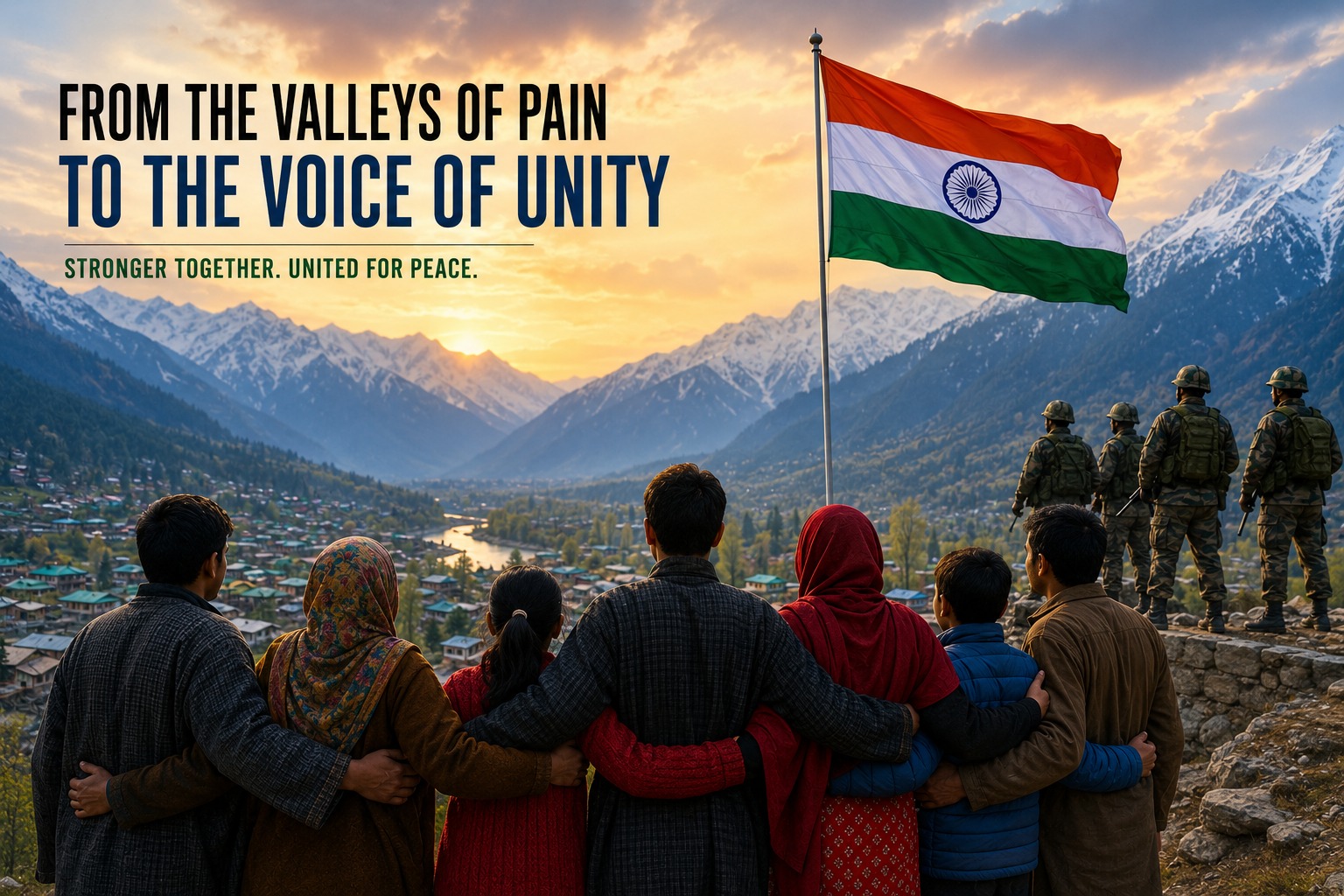
I was born and raised in Kashmir — a land known across the world for its breathtaking beauty, snow-covered mountains, flowing rivers, and centuries-old culture. But for many of us who grew up here, Kashmir has never only been about beauty. It has also been about fear, uncertainty, funerals, gunfire, loss, and generations learning to live under the shadow of violence.
For decades, the people of Jammu & Kashmir have carried wounds that are not always visible to the world. Behind every headline about terrorism, cross-border infiltration, or military operations, there are ordinary families trying to survive, trying to protect their children, and trying to hold on to hope.
That is why operations like Operation Sindoor are not just military events for us. They are reminders of the reality we have lived with for years.
During the night of 6th and 7th May, the Indian Army, Indian Air Force, and Indian Navy jointly carried out Operation Sindoor with the objective of targeting terrorist infrastructure operating from Pakistan. According to the mission reports, the operation successfully neutralized terrorist camps and disrupted networks involved in planning violence against India.
For many Indians sitting far away from border areas, such operations may appear as distant strategic events discussed in television debates or political speeches. But for those of us living in Kashmir, the issue of terrorism is deeply personal. We have seen the consequences of radicalization, cross-border militancy, and violence up close. We have seen innocent civilians die. We have seen children grow up amid fear. We have seen mothers waiting for sons who never returned home.
The truth must be stated clearly: India’s fight is not against innocent Pakistani civilians. India’s fight is against terrorism.
This distinction matters greatly. Whenever tensions rise between India and Pakistan, propaganda machines immediately become active. False narratives begin circulating. Misinformation spreads quickly through social media and political rhetoric. Attempts are made to portray anti-terror operations as attacks against ordinary people. But the reality is very different.
India has repeatedly stated that its operations are directed against terrorists and terror infrastructure — not against innocent civilians. No civilized society can remain silent after attacks on innocent people. No sovereign nation can allow terrorism to operate freely against its citizens.
The events of 22nd April once again reminded the country why vigilance remains necessary. Twenty-six innocent Indians lost their lives in a terrorist attack carried out by Pakistan-backed terrorists. Twenty-six families lost loved ones forever. Twenty-six homes were left grieving because violence once again became the language of extremism.
Those deaths were not statistics. They were human lives. And every time innocent blood is shed, the pain travels far beyond the site of the attack. It reaches every Indian home that believes peace should never come at the cost of surrendering to terror.
For decades now, terrorism has attempted to destabilize not only Kashmir but the entire idea of peaceful coexistence. Since 1988, Pakistan-sponsored infiltration and militancy have repeatedly tried to drag Jammu & Kashmir into cycles of violence. Thousands of civilians, security personnel, and innocent citizens have paid the price.
But despite decades of terror, something important has changed today: the world is no longer blind to the reality of cross-border terrorism.
There was a time when global powers treated terrorism in South Asia as a regional issue. Today, the international community increasingly recognizes the dangers posed by terror networks operating across borders. Evidence, intelligence reports, and repeated attacks have exposed how extremist groups have been used as instruments of instability.
Operations like Sindoor and Mahadev are not isolated military responses; they are part of a larger message that India will defend its sovereignty and protect its citizens against terrorism. At the same time, however, we must understand an equally important truth: military action alone can never guarantee permanent peace.
Weapons can eliminate terrorists, but only education, development, opportunity, and social empowerment can eliminate the conditions that allow extremism to grow. This is especially important for border regions.
“For those living in Kashmir, terrorism is not a distant headline or a television debate—it is a lived reality that has shaped generations through fear, loss, and uncertainty.”
Comments are closed.