

S. Ahmad
For centuries, the Ganga has been more than a river. It has been a civilizational artery, a source of food and faith, and a living ecosystem sustaining millions. Along its vast basin, fishing communities have depended on its seasonal rhythms, while its waters have supported one of the richest freshwater biodiversities in the world. Yet over the past few decades, that living wealth has thinned alarmingly. Habitat degradation, altered flow regimes due to infrastructure projects, pollution, and unregulated fishing pressure have steadily eroded native fish stocks.
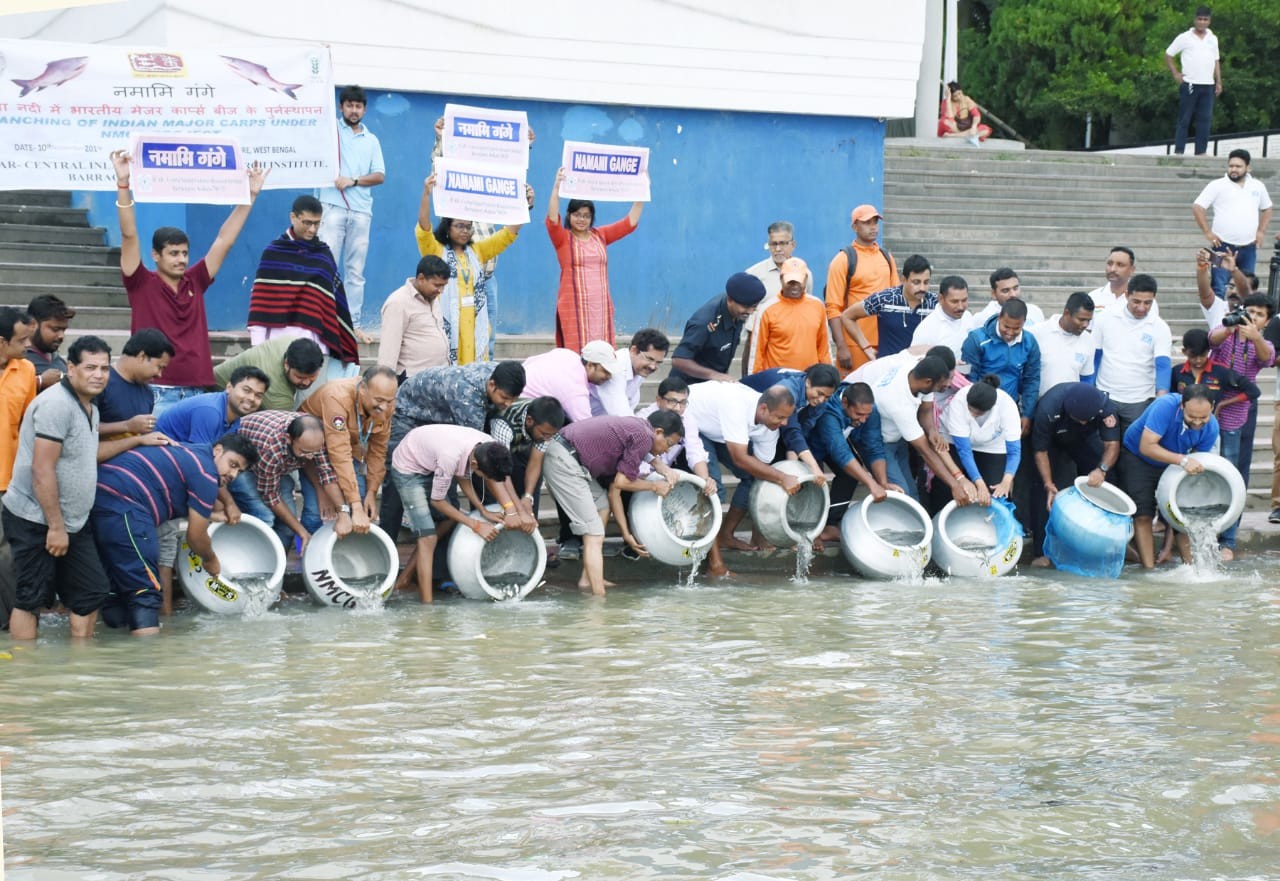
What often goes unnoticed, however, is that alongside the more visible campaigns for cleaning and rejuvenation, a quieter scientific intervention has been unfolding over the last decade. Under the Government of India’s Namami Gange Programme, the ICAR–Central Inland Fisheries Research Institute (ICAR-CIFRI) has undertaken a sustained programme of scientific river ranching—an effort aimed not merely at restocking fish, but at restoring ecological balance, safeguarding genetic integrity, and strengthening riverine livelihoods.
For much of the past century, the Ganga has carried more than water. It has sustained livelihoods, fed communities, and anchored a dense web of biodiversity along its course. In recent decades, however, the river’s native fish have thinned – casualties of habitat degradation, altered flow regimes, pollution and relentless, often unregulated fishing pressure.
Over the last 10 years, a quieter effort has been underway to reverse that decline. Under the Government of India’s Namami Gange Programme, the ICAR–Central Inland Fisheries Research Institute (ICAR-CIFRI) has carried out a large-scale programme of scientific river ranching – an intervention designed not merely to restock the river, but to restore its ecological balance.
River ranching, in its simplest description, involves releasing hatchery-reared fish into natural water bodies to replenish depleted populations. But the approach adopted under this programme has been far from cosmetic or symbolic. Between 2017 and 2025, ICAR-CIFRI organised 169 scientifically designed ranching programmes across ecologically sensitive stretches of the Ganga and its tributaries. During this period, 205.5 lakh seeds of indigenous fish species were released into carefully selected river segments.
The emphasis has consistently remained on native species conservation. These were not generic hatchery stocks produced for quick numerical gains. Instead, the fish were artificially bred from wild brooders collected directly from the Ganga, ensuring that native genetic lines were preserved. By prioritising genetic integrity, the programme sought to avoid the ecological risks often associated with indiscriminate stocking.
To improve survival rates after release, the institute stocked the river with fingerlings and advanced fingerlings measuring 10–15 centimeters in length, with an average body weight of 100–120 grams. These were not generic hatchery fish. The seed were artificially bred from wild brooders collected directly from the Ganga, a step intended to safeguard native genetic lines. Before release, the fish were reared under controlled hatchery and nursery conditions to enhance their adaptability in natural waters.
The distribution of these ranching efforts reveals a deliberate and data-driven strategy. The majority of interventions—around 68 percent—were concentrated in West Bengal, reflecting both the ecological significance of the lower Ganga basin and the intensity of fishing activity in that region. Bihar accounted for 17 percent of the interventions, followed by Uttar Pradesh at 9 percent, Jharkhand at 5 percent, and Uttarakhand at 1 percent.
This spatial focus underscores a key principle of ecological restoration: interventions must align with zones where biodiversity value and livelihood dependence intersect most sharply. In the lower reaches of the basin, where fishing pressure is intense and fish diversity historically rich, the stakes are particularly high. By concentrating efforts in these stretches, the programme addressed both conservation and socio-economic priorities. The concentration in West Bengal reflects both the ecological importance of its river stretches and the intensity of fishing activity in the lower reaches of the basin.
Ecological restoration is typically measured over long time horizons, often spanning generations. Yet early indicators from the Ganga basin suggest tangible progress. Fish landings of Indian Major Carps—considered key indicator species—have recorded notable increases at major riverine centres. At Prayagraj, landings rose by 24.7 percent, while Varanasi reported an increase of 41 percent. These improvements are widely attributed to sustained ranching interventions combined with broader conservation measures under the Namami Gange framework.
While ecological restoration is often measured over generations, early results suggest tangible gains. Fish landings of Indian Major Carps, a key indicator species group, have risen noticeably at major riverine centres.
-
Prayagraj recorded a 24.7% increase
-
Varanasi recorded a 41% increase
These improvements are largely attributed to sustained ranching interventions combined with associated conservation measures implemented under the Namami Gange Programme.
Beyond numerical increases, the initiative has helped rebuild native fish populations, strengthen the resilience of riverine ecosystems, and support the livelihoods of dependent fishing communities. It has also reinforced the role of science-based management in the stewardship of open-water fisheries.
-
ICAR-CIFRI has developed the technique of artificial breeding of hilsa with cryopreserved milt and brood females collected from Hooghly estuary in 2025.
-
A total of 3.82 lakhs of Hilsa adults were released in upstream of Farakka barrage in river Ganga. Of these, 6031 fishes were tagged.
-
54.91 lakhs of fertilized Hilsa eggs and 8.06 lakhs of hilsa spawn were released for improvement of natural Hilsa population.
-
With the efforts of the institute yielding dividends, India has become the world’s top producer of inland capture fishes with an annual production of 1.89 million tonnes, surpassing China.
-
In a landmark first, the institute estimated annual fish catches in major rivers, including 15,134 tonnes in the Mahanadi and 18,902 tonnes in the Krishna.
-
Sustainable management protocols were developed for four major estuaries – Hooghly-Matlah, Rushikulya, Mandovi-Zuari and Netravathi-Gurupur and three brackishwater lakes, strengthening science-based governance of these ecosystems.
Several ranching events were conducted in the presence of senior public representatives, signalling the national importance attached to restoring riverine biodiversity. These occasions served not merely as ceremonial releases but as platforms for public awareness, stakeholder engagement, and the promotion of sustainable fishing practices across the basin.
Established in March 1947 at Barrackpore in West Bengal, ICAR-CIFRI has evolved from a production-oriented research body into a leading institution for ecosystem-based fisheries management. Its mandate now integrates sustainability, conservation, climate resilience, catch estimation, habitat characterisation, and policy support for inland open waters.
Several of the ranching events were conducted in the presence of senior public representatives and policymakers, a signal of the national importance attached to restoring riverine biodiversity. These occasions doubled as platforms for:
-
Public awareness
-
Stakeholder engagement
-
Promotion of sustainable fisheries practices across the Ganga basin
Established in March 1947 at Barrackpore, West Bengal, ICAR-CIFRI has long been central to the evolution of inland fisheries research in India. What began as production-oriented research has matured into a broader ecosystem-based approach that integrates sustainability, conservation, livelihoods and nutritional security.
River ranching sits within a larger scientific mandate that includes river and estuarine fisheries restoration, habitat characterisation, catch estimation, ecosystem services valuation, climate resilience research and policy support for inland open waters.
ICAR-CIFRI has developed enclosure culture technologies with diversified high value fish species like Ompok bimaculatus, Labeo bata, Systomus sarana Labeo rohita, Labeo rohita (Jayanti), Labeo gonius, Osteobrama belengari, Cyprinus carpio haematopterus and Etroplus suratensis,etc. at different geographical locations for increasing profitability and adoptability of cage farming.
-
Three technologies ICAR-CIFRI-GI model cage, ICAR-CIFRI HDPE circular cage (16 m diameter, 5 m depth, 1005 m³ volume), and CIFRI-CAGEGROW feed have been developed and commercialised for promotion of cage culture.
o Cage culture produces an average of 3-4 MT of fishes per cage (96 m3) dimension with fast growing fish species like Pangasianodon hypophthalmus and Oreochromis niloticus.
-
CIFRI CAGEGROW, BSF Floating Fish Feed, RESHMEEN are three fish feeds developed by the institute in last couple of years which are nutritionally balanced with better digestibility.
-
CIFRI Fish Tanavhari and CIFRI ARGCURE are the two health care products released by the institute with the objectives of reducing disease loss and harnessing higher returns.
-
CIFRI GI cage, CIFRI Circular Cage, CIFRI FRP Coracle, CIFRI FRP Ornamental tank were the other technologies recently commercialised by the institute.
-
Two patents namely ‘Vertical gel electrophoresis’ and ‘Portable Split Beam Transducer Assembly on Water Craft for Measuring Exact Transducer Position Below the Water’ were obtained.
-
The institute is doing research on developing IoT (Internet of Things)-based technologies for:
Comments are closed.