SRINAGAR, JUNE 30: They did not have the luxury of a jeep. There was no ambulance on standby. Instead, Bashir Ahmad Teroo and his two colleagues strapped vaccine carriers to their backs and began walking — up steep, unforgiving mountain trails, through the thin air of the high Himalayas, with nothing but the crunch of their own boots on rock and the occasional screech of a falcon overhead.
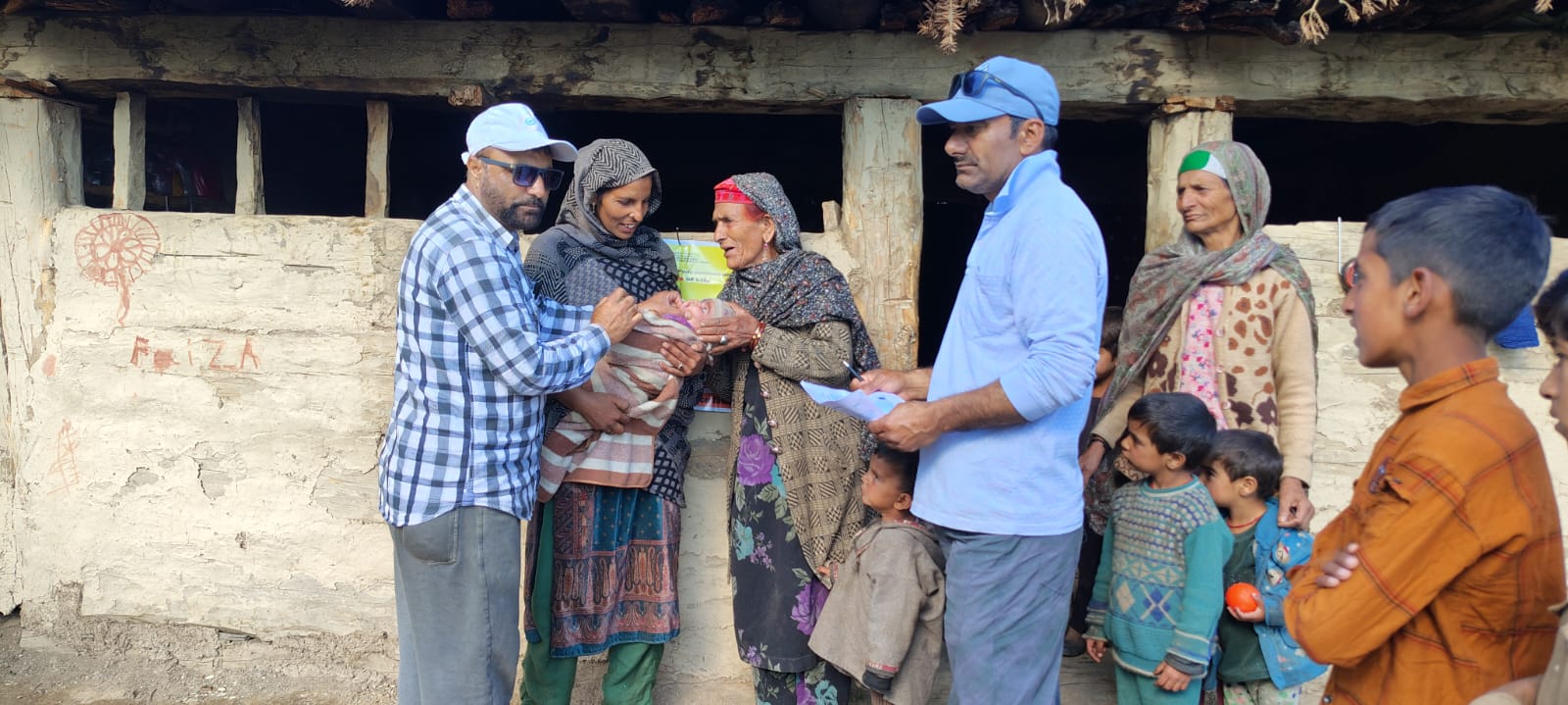
Their destination Patalwan, a remote alpine meadow perched on the eastern flank of the Gurez Valley in Bandipora district. The mission ensure that 30 children of nomadic Gujjar and Bakarwal families — who spend months in these isolated pastures with their livestock — were not missed in the National Pulse Polio Immunisation Campaign held last Sunday.
The round trip was nearly 38 kilometres on foot. The team started at dawn from Dawar, the main town in Gurez, and walked continuously — uphill, across rocky stretches, along narrow paths carved into mountainsides — for almost 10 hours to reach the seasonal settlement. They stayed the night and walked back the next day.
“It was one of the toughest journeys we have undertaken,” Teroo told Kashmir Convener. “The terrain was difficult and there were long uphill stretches. But we knew children there were waiting for us.”
This was not merely about the two drops of polio vaccine. The Block Medical Officer had instructed the team to set up a mini medical camp for the nomadic families — a rare lifeline for a community that lives beyond the reach of even the most basic primary health centres.
“We examined patients, distributed medicines, and addressed common health concerns,” said Teroo, who was accompanied by ASHA worker Rubina and Shams Din Nasir.
For Rubina, the arithmetic was simple. “These families spend months in high-altitude pastures and often have little access to medical facilities. If we don’t go to them, many children could miss essential immunisation. That is not an option for us,” she said.
The visit stunned the nomadic families, who have grown accustomed to being forgotten. Mohammad Kaleem, 45, staying in Patalwan with his family, said he had never seen health workers undertake such a journey.
“We never imagined a health team would walk such a long distance just to reach us. They came with medicines and ensured our children received polio drops. We are grateful for their dedication,” he told Kashmir Convener, adding “These are the real heroes of the health department. The government should acknowledge their commitment.”
Abdul Rahman, 38, a shepherd said the nearest health facility is a long distance away, and reaching it means losing an entire day’s work. Seeing health workers climb these mountains with vaccines and medicines for our children is something we will always remember. They came to us instead of waiting for us to come to them.”
As the team finally made its way back to Dawar — exhausted, their feet bruised, but their job done — Teroo reflected on the vast gulf between urban India’s ease of healthcare delivery and the harsh reality of the mountains.
“Giving a child polio drops in a town or city takes only a few minutes. But this is the real work of public health,” he said. “Here, every dose means walking for hours through mountains so that no child is left behind.”
In India’s remotest corners, public health is still measured not in statistics — but in footsteps.


Comments are closed.